
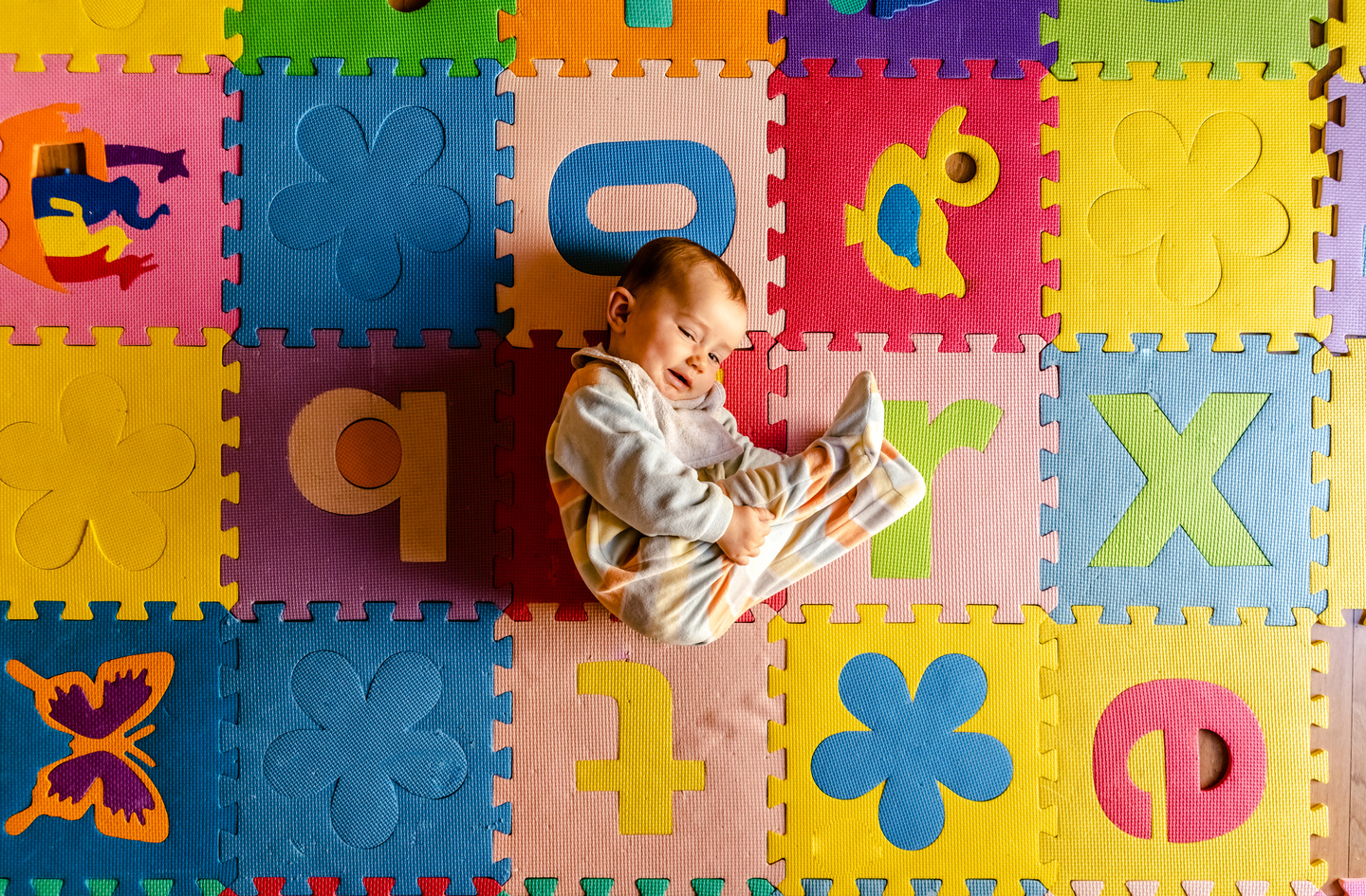
The material a baby play mat is made from shapes every practical decision a parent faces on hard playroom floors: how much it cushions a crawling baby’s knees, whether it stays put on hardwood, how quickly it cleans after a spill, and what chemical certifications to require. This article covers that single material decision within the broader context of Playroom Materials and Surfaces. The three dominant categories are EVA foam, quilted fabric, and natural rubber. Each makes different trade-offs, and a 2025 peer-reviewed study in Environmental Pollution found that cleaning method alone can increase volatile organic compound (VOC) release from certain mat materials nearly ninefold,2 which means material choice and maintenance cannot be separated.
Quick Answer
Which baby play mat material is right for a hard playroom floor?
EVA foam leads on cushioning and is the most widely used option, with baby-grade mats specified at 80-120 kg/m3 density for adequate impact absorption.7 Natural rubber delivers the best grip on hard surfaces, with a static coefficient of friction between 0.5 and 0.7.4 Quilted fabric is softest against bare skin but the hardest to maintain and the most prone to sliding without a rubberized backing. No single material wins every category; the right choice depends on the baby’s developmental stage, the floor type, and the household’s cleaning routine.
Key Takeaways
- EVA foam at 80-120 kg/m3 density cushions tummy time and crawling; foam below 80 kg/m3 compresses faster and loses its protective function sooner.
- Natural rubber has a static coefficient of friction of 0.5-0.7, meeting or exceeding the 0.6 COF threshold used for medium-risk anti-slip classification on hard floors.
- EU regulations limit formamide emission from foam toy materials to 20 micrograms per cubic meter after 28 days of testing; parents in the US should look for EN71/CE-certified mats tested to EU standards for the strictest chemical oversight.
- Disinfecting play mats with UV-bleaching can increase VOC release nearly ninefold; wiping with diluted soap and water is the safer routine cleaning approach.
- OEKO-TEX Standard 100 Class I certification is the most externally validated chemical safety signal for fabric play mats, covering over 1,000 harmful substances in products used by babies under age 3.
Comparing Baby Play Mat Materials: Foam, Fabric, and Rubber
The table below maps EVA foam, quilted fabric, and natural rubber across the decision factors that matter most on hard playroom floors. Specific values are used throughout; no vague Good/Fair/Poor ratings appear.
| Category | EVA Foam | Quilted Fabric | Natural Rubber |
|---|---|---|---|
| Best for | Tummy time, crawling, padded floor play | Soft sensory surface, portable coverage | Maximum grip, active toddler play, hard-floor zones |
| Typical thickness | 10-20 mm (3/8″-3/4″) | 5-15 mm (fill-dependent) | 5-12 mm |
| Cushioning | High (80-120 kg/m3 density) | Medium (fill and construction dependent) | Low to medium (dense, minimal compression) |
| Grip on hard floors | Low to medium (smooth EVA underside) | Low (slides without rubberized backing) | High (static COF 0.5-0.7) |
| Cleanability | High (wipe-clean closed-cell surface) | Medium (machine wash, full air-dry required) | High (wipe-clean, moisture-resistant) |
| Primary chemical concern | Formamide from azodicarbonamide foaming agent | Formaldehyde finishes and synthetic dyes if uncertified | Natural latex allergens; additives in synthetic rubber variants |
| Durability | Medium (compresses with extended use) | Medium (pilling and fill compression over time) | High (resists compression and tearing) |
| Key certification to request | EN71/CE, ASTM F963-23, CPSIA phthalate-compliant | OEKO-TEX Standard 100 Class I | OEKO-TEX Standard 100, CPSIA phthalate-compliant |
| Our verdict | Best cushioning and cleanability | Softest against skin; hardest to maintain | Best grip and longest service life |
Cushioning and Thickness on Hard Floors
EVA foam wins the cushioning category. Its cellular structure compresses on impact and rebounds, which matters for a baby’s knees, palms, and head during tummy time, rolling, and early crawling on a hard floor. Natural rubber is a dense, firm material: it does not compress meaningfully, which makes it stable but not protective against impact. Quilted fabric sits between the two. The fill layer adds softness against bare skin, which matters for comfort, but unless the fill is thick (15 mm or more) and dense, a fabric mat does not absorb impact the way a foam core does. A thin quilted mat on a hard floor provides only marginally more cushioning than a folded blanket.
What foam density means in practice
Foam density is measured in kilograms per cubic meter (kg/m3) and describes how much material is packed into a given volume. Higher density means more material per unit of space, which translates to better load distribution and longer-lasting resistance to permanent compression. Baby-grade EVA mats are specified at a recommended density of 80-120 kg/m3 for optimal cushioning performance.7 Below 80 kg/m3, the foam compresses noticeably within months of daily use and loses a meaningful share of its protective function. Above 120 kg/m3, the mat becomes firmer and heavier without significant gain for the infant use cases this article addresses.
Thickness compounds the effect of density: a 20 mm mat at 100 kg/m3 has a longer deceleration path on impact than a 10 mm mat at the same density. For tummy time and crawling, the practical starting point is 15-20 mm at 80-120 kg/m3. Mats sold by thickness alone without density information can be tested by pressing a thumb firmly into the surface: an indentation that does not rebound within a few seconds suggests the density is below the recommended range. For a comparison of thickness, seam construction, and core density across padded mat formats, see our overview of padded play mats.
Fabric and rubber thickness limits
Quilted fabric mats rely on their fill material for cushioning, not the outer fabric. Polyester batting, cotton wadding, and memory foam inserts are the common fill choices. A mat with dense fill (300 gsm or heavier polyester batting) provides more protection than one with low-density fill, regardless of what the outer fabric looks like or feels like to the hand. The outer fabric layer is relevant to skin comfort, not structural cushioning. Parents evaluating a quilted mat for tummy time on hardwood should press down on the fill to gauge how much compression the baby will actually rest on. If the floor surface is clearly felt through the mat under moderate hand pressure, the fill depth is insufficient for regular use on hard floors.
Natural rubber is dense and does not flex under body weight the way foam does: its role is stability and grip, not impact absorption. Parents who want both grip and cushioning from the same product should look at rubber-backed foam mats, where a bonded rubber base provides anti-slip performance and a foam core provides the cushioning. Confirm the specific product’s suitability for the floor type with the manufacturer before installation.
Grip and Anti-Slip Safety
Natural rubber wins the grip category. Its surface chemistry creates a high coefficient of friction (COF) against hard floor surfaces, and this grip is intrinsic to the material: it does not depend on suction cups, adhesive backing, or carpet gripper weave. Natural rubber achieves a static coefficient of friction between 0.5 and 0.7 on smooth surfaces.4 For context: a static COF above 0.6 meets the threshold used for medium-risk surface areas in standard anti-slip safety classifications, and above 0.5 covers low-risk areas by the same framework. On hardwood, tile, and laminate floors, this grip level keeps the mat in place under the shifting weight of a crawling or cruising baby.
Why EVA foam slides on hard floors
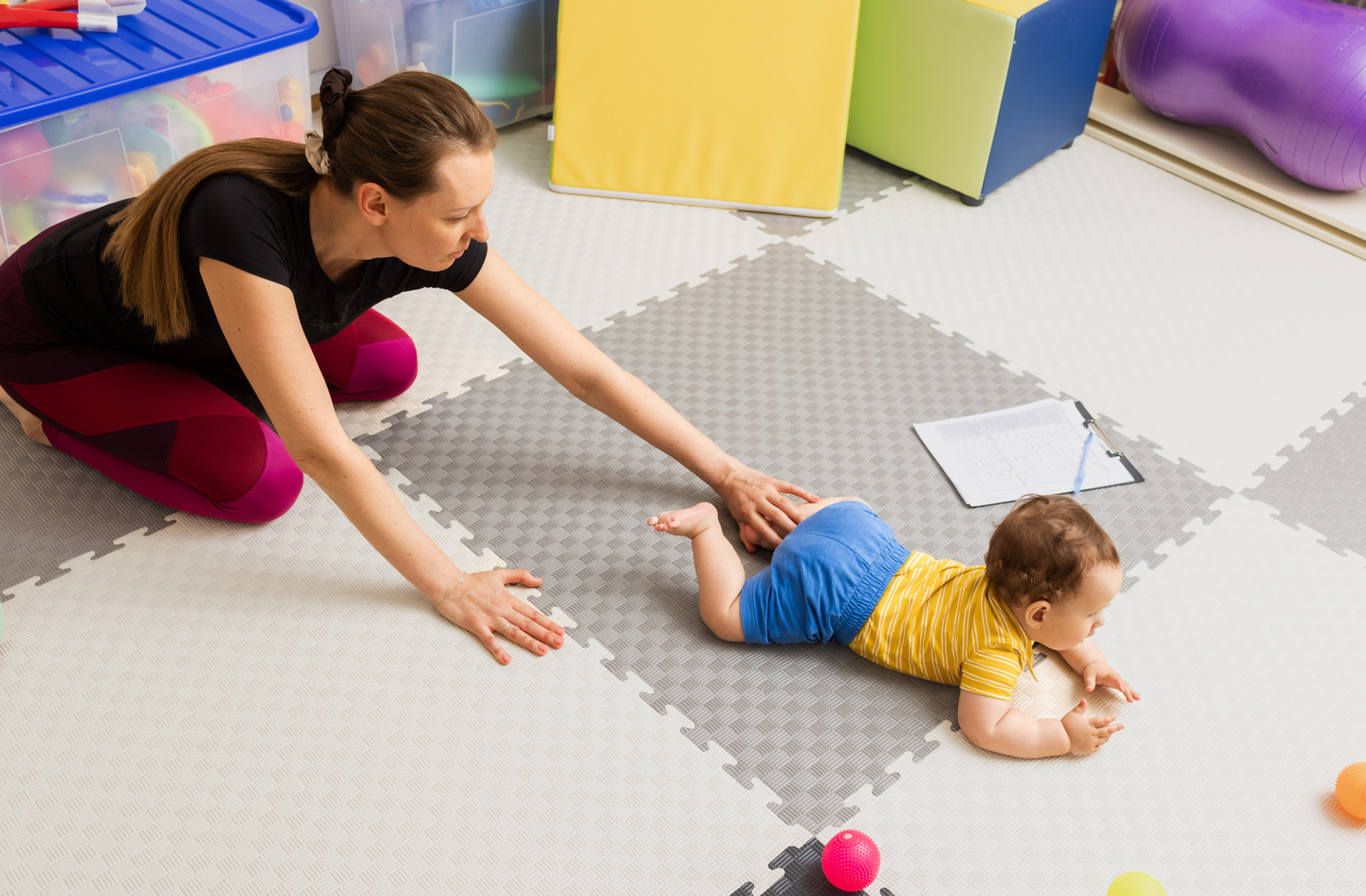
Most EVA foam mats have a smooth or lightly textured underside that does not grip hard flooring reliably. The mat shifts when a baby pushes off during crawling. EVA foam is optimized for cushioning, not surface friction. The two practical solutions are a rubber-backed foam mat (bonded rubber base, foam cushioning layer) or a separate non-slip rug pad placed beneath the mat on smooth floors. Foam mats on carpet grip reasonably from fiber-to-fiber contact; smooth hard floors are where sliding consistently becomes a problem.
Interlocking foam tile mats also shift more than single-piece mats, because the tile-to-tile connections are not load-bearing and can separate at the edges under active use. Tiles that have separated more than a few millimeters present a trip hazard for a baby learning to pull up and walk. For a detailed look at how foam tile seams behave across different room layouts, including how to manage edge clearance and connection stability, see our piece on EVA foam play mat trade-offs.
Fabric mat grip on hard floors
Quilted fabric mats are the weakest performers on smooth hard floors. Fabric has a low natural COF and moves easily under lateral force. Products with a rubberized underside (sewn-on rubber dots or a printed rubber coating) address this, but parents should verify the anti-slip feature is present before purchase. A mat listed without a specific underside description should be assumed to slide. On carpet, fabric mats are stable from fiber-to-fiber contact. On hard floors without rubber backing, position the mat against a wall or furniture edge, or place a non-slip rug pad underneath.
Cleaning and Maintenance
EVA foam and natural rubber are both wipe-clean materials. Their closed-cell (foam) or dense non-porous (rubber) surfaces do not absorb liquids, so spills, spit-up, and diaper leaks can be wiped off with a damp cloth and mild soap without the material retaining moisture or odor. Quilted fabric mats require machine washing and a full air-dry cycle, which takes substantially longer than a wipe-down and is harder to keep up with in a household where the mat is in daily use with an infant. Cleaning method also affects chemical safety independently of the material type: a 2025 peer-reviewed study published in Environmental Pollution found that disinfecting a polyethylene (PE) play mat with UV-bleaching treatment increased total VOC release from 1.82 mg/m2 (control, no treatment) to 15.82 mg/m2, a nearly ninefold increase.2
Foam mat cleaning in practice
EVA foam mats should be wiped down with mild soap and warm water. The closed-cell EVA surface does not absorb liquid, so this method removes surface contamination effectively. Foam mats should not be machine washed or submerged. Water can enter through seams, cut edges, or any surface damage, and once inside the foam, it takes a long time to dry, creating conditions for mold growth that are not visible from the outside. UV sterilization boxes, which are widely marketed for baby product sanitizing, should not be used on foam or PE mats: research shows this method can increase VOC release from play mats nearly ninefold compared to an untreated mat.2 Diluted household bleach solution produces fewer microplastics than UV treatments on disinfection, making it a safer option for periodic deep cleaning when disinfection is specifically needed.2
Fabric mat cleaning requirements
Quilted fabric mats vary by construction: some are fully machine washable with a removable padded insert; others are one-piece constructions where the fill cannot be separated. The care label should be checked before purchase. A one-piece mat requiring hand washing or dry cleaning is a significant maintenance burden with an infant. Machine-washable mats still need a full air-dry cycle: tumble drying compresses the fill layer and reduces cushioning permanently. A mat used for daily tummy time will need washing at least weekly.
Rubber mat cleaning
Natural rubber mats are wipe-clean and moisture-resistant. They do not absorb spills and clean quickly with mild soap and water. Rubber does not tolerate bleach well over extended time: repeated bleach exposure can degrade the rubber surface, causing cracking and surface breakdown that reduces both grip and longevity. For routine cleaning, soap and water is sufficient. Rubber’s denser surface holds up longer to cleaning cycles than foam, which can develop surface pitting or edge wear that traps dirt and makes wipe-cleaning less effective as the mat ages.
Safety and Chemical Certifications
Material chemistry is the category where sourcing decisions matter most and the regulatory gap between markets is largest. The primary chemical concern for EVA foam mats is formamide, a by-product of azodicarbonamide (ADA), the foaming agent used to create EVA foam’s cell structure. Formamide is classified as a class 1B reproductive toxicant under EU Regulation EC 1272/2008 and is on the European Chemicals Agency’s list of substances of very high concern.3 The EU sets a formamide emission limit of 20 micrograms per cubic meter after 28 days of standardized emission testing, applied to foam toy materials containing more than 200 mg/kg formamide.1 US federal regulation has no equivalent specific limit for play mats, so EU-certified mats represent a stricter chemical standard.
“This product class has the strictest requirements and limit values.”
OEKO-TEX AG, OEKO-TEX Standard 100 certification overview – describing Class I requirements for baby and infant products used by children under age 35
What certifications to look for on a foam mat
EN71/CE certification indicates a product has been tested to the EU Toy Safety Directive, which includes the formamide emission limit described above. This is the baseline chemical safety threshold for foam baby mats marketed in Europe, and it is the most meaningful voluntary certification for US-market purchases because it applies stricter limits than US-only standards alone. ASTM F963-23 became the mandatory US toy safety standard for products manufactured on or after April 20, 2024, replacing the prior ASTM F963-17 version.6 Products sold in the US as children’s toys or child care articles must comply with CPSIA phthalate limits: DEHP, DBP, and BBP are permanently banned at concentrations above 0.1% (1,000 ppm), with DINP and four other phthalates added in 2018 under the same threshold.8
For parents who want the strictest available chemical oversight, the combination of EN71/CE certification plus a third-party test report from an accredited independent laboratory (SGS, Intertek, or Bureau Veritas) confirms that certification claims were externally verified, not self-declared. Self-certification, where a manufacturer marks a product as compliant without an independent test report, provides weaker assurance. Dr. Meg Christensen, MD, founder of Interior Medicine and a physician with training in medicine, biochemistry, and epidemiology, notes in her 2025 review of non-toxic baby play mats that EVA foam typically uses formamide to make it soft and pliable, and that while the quantities in certified mats are likely low enough to be safe, some uncertainty remains in the research.9 This framing reflects the current regulatory and scientific position accurately: certified EVA foam mats are not categorically unsafe, but the certification documentation matters.
Fabric mat chemical safety
Quilted fabric mats carry a different risk profile. The outer fabric and fill may contain formaldehyde-based finishes, synthetic dyes, flame-retardant additives, or processing residues. OEKO-TEX Standard 100 Class I tests the finished product against over 1,000 harmful substances, including formaldehyde, heavy metals, and pesticide residues.5 A fabric mat with OEKO-TEX Class I certification represents the most externally validated chemical safety tier for a textile baby product. Parents should verify the certification by looking up the certificate number on the OEKO-TEX website: the logo without a verifiable number is not sufficient confirmation.
Rubber mat safety considerations
Natural rubber (latex) is derived from Hevea brasiliensis tree sap and carries a low synthetic additive risk profile. Its primary safety consideration is latex allergy: children with a documented sensitivity should not use natural rubber mats. For most babies without a known allergy, natural rubber is a low-additive-risk option for floor play. Synthetic rubber mats may contain petroleum-derived additives and should be evaluated for phthalate content. Note: fabric mats with a PVC-backed underside are sometimes marketed as “rubber-backed.” PVC is not natural rubber; CPSIA phthalate compliance applies to child care articles made of vinyl or PVC regardless of how the underside is labeled. Request a product-specific test report before purchase.
Durability and Lifespan
Natural rubber outperforms both EVA foam and quilted fabric on durability. It resists compression, tearing, and UV degradation better than EVA foam and does not develop the surface pitting that foam accumulates under daily use. Rubber mats in commercial settings routinely last five to ten years under continuous heavy use. In a home playroom, a natural rubber mat can be expected to outlast two or three comparable foam mats.
EVA foam compression and aging
EVA foam mats lose cushioning effectiveness over time as the cell structure compresses under repeated loading. The rate of compression depends on the initial density: low-density mats (under 80 kg/m3) begin showing compression marks and reduced rebound within months of daily use. Higher-density mats (100-120 kg/m3) maintain their thickness longer but still compress. The most practical indicator is the rebound test: if the indentation from use does not recover within a minute or two of the baby moving off the mat, the foam has compressed past its useful cushioning range and should be replaced.
Interlocking foam tiles also develop edge wear at the connection points, and tiles that have separated or whose interlocking edges have torn are a trip hazard for a baby learning to walk. Parents sizing a foam tile system for a full playroom zone should account for tile replacement over time, since individual tiles in high-traffic areas wear faster than tiles at the edges of the covered zone. For layout planning, seam management, and replacement sequencing for larger foam tile coverage, see our guide on 8×10 foam play mat coverage.
Fabric mat wear and longevity
Quilted fabric mats age through surface wear and fill compression. Surface wear includes pilling, edge fraying (single-stitched hems fray sooner than double-stitched), and color fading from washing. Fill compression is the more functionally significant change: the padding layer flattens with use and washing cycles, reducing cushioning. A mat whose fill has visibly compressed is no longer providing its original cushioning function. Double-stitched edges, heavyweight outer fabric, and high-density fill extend fabric mat service life.
Which Material Fits Your Playroom?
The right material depends on the floor type, the baby’s current developmental stage, and the household’s maintenance capacity. No material is the correct answer for every situation. The practical decision is about which trade-offs cost the least for the specific family and room. The three priority profiles below describe the most common decision patterns.
Newborns and early tummy time (birth to 6 months)
EVA foam, prioritizing thickness and density, is the most appropriate choice at this stage. A newborn and young infant spends most floor time stationary or with minimal movement: cushioning against a hard floor is the primary function, and grip is less critical because the baby is not yet generating the lateral push forces that cause mats to slide. The target specification is a minimum of 15 mm thickness at 80-120 kg/m3 density, with EN71/CE certification or equivalent third-party test documentation. If the mat will be used on a slippery hardwood or tile floor, a rubber-backed foam model or a non-slip rug pad placed beneath the foam mat addresses both cushioning and grip simultaneously without requiring a separate purchase decision.
Active crawlers and early walkers (6-18 months)
EVA foam with a rubberized backing, or a natural rubber mat where grip is the primary concern. A crawling baby generates significant lateral push forces on the mat surface that cause standard foam mats to slide on smooth floors. A mat that moves during crawling is a safety issue: the baby can slide or catch on the edge during forward movement. If an existing foam mat without a rubber backing is sliding, the most direct fix is a non-slip rug pad underneath. Natural rubber as the primary mat material is appropriate where the floor is hard and smooth and cushioning is secondary: at the crawling and cruising stage, the baby’s center of gravity is low and falls are shorter than at the standing and walking stage, so firm rubber support is adequate for many play sessions.
Parents prioritizing minimal chemical exposure
OEKO-TEX Standard 100 Class I certified fabric mat, or an EN71/CE-certified EVA foam mat with a third-party test report confirming formamide emission compliance. The OEKO-TEX Class I certification tests the complete finished product against over 1,000 substances and is audited by an independent certification body, not self-declared by the manufacturer. If grip performance is also needed on hard floors, a non-slip rug pad underneath the fabric mat addresses both requirements. For families where a latex allergy is a concern, natural rubber mats should be excluded from the selection. Regardless of material, requesting an independently verified test report before purchase is the single most effective way to confirm that a certification claim is backed by laboratory data.
Frequently Asked Questions
What is the safest material for a baby play mat?
No single material is unconditionally safest; each carries different risk profiles. For fabric mats, OEKO-TEX Standard 100 Class I certification tests against over 1,000 harmful substances and is the most externally validated safety signal available.5 For foam mats, EN71/CE certification with a third-party formamide emission test report is the chemical safety minimum. Natural rubber is generally low in synthetic additives, though latex allergy is a consideration for children with known sensitivities. For a specific child, consult a pediatrician; this article addresses material-level general guidance, not advice for a specific child or medical situation.
How thick should a baby play mat be?
For tummy time and early crawling on hard floors, a minimum of 15 mm (about 5/8 inch) at 80-120 kg/m3 density provides adequate cushioning.7 Mats under 10 mm thickness compress quickly and provide limited protection from hard floor impact. As the baby progresses to standing and early walking, 15-20 mm remains appropriate; density matters more than thickness alone once the child’s weight increases and the mat is used for active movement rather than stationary floor time.
Can you wash a foam baby play mat?
Foam play mats should not be machine washed or submerged. The closed-cell surface cleans well with a damp cloth and mild soap. Submerging foam allows moisture to enter through seams or cut edges, and the foam can take a long time to dry internally, creating conditions for mold growth that is not visible from the surface. UV sterilization of foam mats should also be avoided: research shows UV-bleaching treatment can increase VOC release from play mats nearly ninefold compared to an untreated mat.2
Is natural rubber safe for babies?
Natural rubber is generally considered safe and carries lower synthetic additive risk compared to PVC or some synthetic rubber alternatives. The primary consideration is latex allergy: children with a documented sensitivity should not use natural rubber mats. For most babies without a known allergy, natural rubber is a durable, high-grip option for floor play. Look for OEKO-TEX certification and request a product-specific test report to confirm no harmful additives were included in the manufacturing process.
What does EVA foam mean on a baby play mat?
EVA stands for ethylene-vinyl acetate, a polymer used to produce soft, flexible foam. It is the dominant material in interlocking foam floor tiles and single-piece padded play mats. EVA foam is produced by expanding the polymer with a foaming agent (commonly azodicarbonamide), and this process can leave formamide residues in the finished material. For a detailed look at EVA foam’s density range, odor characteristics, and the trade-offs between certified and uncertified foam products, see our article on EVA foam play mat trade-offs.
References
- European Commission – Commission Directive (EU) 2015/2115 of 23 November 2015 amending Appendix C to Annex II of Directive 2009/48/EC on the Safety of Toys, formamide emission limit of 20 micrograms per cubic meter after 28-day testing, enforced from May 2017.
- Environmental Pollution (Elsevier) – Ou, H. et al., “Disinfection inducing release of contaminants from baby play mats: Microplastics and volatile organic compounds,” Environmental Pollution, Volume 365, February 2025. DOI: 10.1016/j.envpol.2024.125497.
- Ecotoxicology and Environmental Safety (Elsevier) – Liu, et al., “Evaluation of volatile safety in children’s play mats based on non-targeted screening and risk prioritization,” Ecotoxicology and Environmental Safety, December 2024. Formamide EU regulatory classification and 8-day ventilation data.
- Tehnoguma – “Anti Slip Mats: Choose a Safe Coefficient of Friction (COF),” June 14, 2024. Natural rubber static COF range of 0.5-0.7 and anti-slip safety classification thresholds.
- OEKO-TEX AG – OEKO-TEX Standard 100 official certification overview, Class I description for baby products under age 3 and scope of over 1,000 tested substances, 2026.
- QIMA – “Changes in ASTM F963 Toy Safety Standard: What You Need to Know,” October 2023. Mandatory compliance date for ASTM F963-23 confirmed as April 20, 2024 for US toy distribution.
- Treelys – “Baby Foam Play Mats: Materials and Safety Guide,” April 2026. Recommended EVA foam density of 80-120 kg/m3 for baby mat cushioning performance.
- U.S. Consumer Product Safety Commission – “CPSC Prohibits Certain Phthalates in Children’s Toys and Child Care Products,” 2018 news release. Permanent ban on DEHP, DBP, and BBP above 0.1% (1,000 ppm) in children’s articles under 16 CFR Part 1307.
- Interior Medicine – Christensen, M., MD, “Best Non-Toxic Baby Play Mats 2026: Doctor’s Guide,” updated December 2025. Physician commentary on formamide uncertainty and residual risk in EVA foam products for infants.
Conclusion
Baby play mat material selection has direct consequences for cushioning, grip safety, cleaning frequency, and chemical exposure. EVA foam provides the best impact absorption for tummy time and crawling when specified at 80-120 kg/m3 density and backed by EN71/CE or ASTM F963-23 certification. Natural rubber delivers the strongest grip on hard floors and the longest service life of the three material categories. Quilted fabric is softest against bare skin but requires the most maintenance and the least grip without a rubberized underside. Regardless of material, cleaning method matters: routine wiping with mild soap and water is the recommended approach, and UV sterilization should be avoided for foam and PE-based mats.
For a wider view of how the play mat choice connects to flooring, wall protection, and surface decisions across a full playroom, see the overview in Playroom Materials and Surfaces.