
Activity mats for infants spend their working life pressed against your baby’s skin at floor level. The material determines how the mat cleans, whether the surface releases trace chemicals into a low-to-the-floor breathing space, and whether the mat offers enough firmness for tummy time. This article covers the three main constructions: fabric, foam, and padded, comparing each across the decisions parents face most. For a wider look at playroom surface choices, the Playroom Materials and Surfaces overview is a good starting point. A 2024 study testing 34 play mat samples across four foam types found measurable differences in volatile chemical output by material type.1

Quick Answer
Which infant activity mat material performs best overall?
Foam mats made from XPE or EPE foam carry lower volatile chemical risk than EVA foam in independent testing1 and reach the firmness and thickness hard floors require for daily tummy time. Fabric mats wash fully in a home machine but typically measure under 8mm thick, well short of the 15mm floor-level minimum. Padded mats sit between the two: washable and softer, but often still too thin for consistent use directly on hard floors without supplemental support underneath.
Key Takeaways
- EVA foam, the most common material in infant activity mats, shows higher volatile chemical risk than XPE or EPE foam in independent testing1; OEKO-TEX Standard 100 Class I certification6 is the most reliable indicator to check before purchasing.
- Fabric activity mats are fully machine washable but typically measure 2-8mm thick, well below the 15mm generally recommended for infant play directly on hard floors.
- No single material wins across all five evaluation criteria; foam leads on cushioning, fabric on washability, and padded mats occupy a useful middle position when weight and floor type are both priorities.
Comparing Activity Mats for Infants: Fabric, Foam, and Padded
The three main infant activity mat constructions serve different floors, routines, and cleaning habits. The table below covers five criteria parents most often weigh: chemical safety relative to the material category, typical thickness, tummy time suitability on hard floors, washability, and texture variety for sensory stimulation.
| Criteria | Fabric (quilted) | Foam (EVA / XPE / EPE) | Padded (polyester fill) |
|---|---|---|---|
| Core material | Cotton, muslin, or polyester quilted layers | EVA, XPE, or EPE closed-cell foam | Polyester batting under a fabric cover |
| Chemical safety (relative) | Low risk when OEKO-TEX Class I certified | Varies; EPE and XPE lower risk than EVA | Low risk when cover fabric is certified |
| Typical thickness | 2-8mm | 15-30mm | 8-18mm |
| Tummy time on hard floors | Insufficient (below 15mm minimum) | Suitable (meets 15mm threshold) | Marginal (depends on fill density) |
| Washability | Machine washable (full mat) | Wipe-clean only | Machine washable cover; insert is not |
| Texture variety | High (multiple surface textures, printed patterns) | Low (smooth or simple print) | Medium (fabric cover with quilt pattern) |
| Best for | Carpeted rooms, budget use, sensory play | Hard floors, daily tummy time, active crawling | Lighter floor play, carpeted areas |
| Verdict | Washability winner | Cushioning winner | Middle ground |
Material Safety: What Each Type Contains
Chemical safety for infant mats centers on three questions: what the mat is made from, what surface coatings or dyes the mat carries, and whether a third party has tested the finished product against a recognized limit. No material category is inherently free of risk, and labeling claims alone do not confirm what an independent laboratory would find.
Fabric mats: certification matters more than fiber type
Quilted fabric mats are built from cotton, muslin, polyester, or blended fibers with stitched layers. The primary chemical concerns are dyes, finish treatments, and flame-retardant coatings applied during manufacturing. A raw natural fiber is generally lower in added chemicals, but the finishing process determines actual exposure at skin contact. OEKO-TEX Standard 100 Class I is the most widely recognized textile certification for products with direct infant skin contact, and applies stricter limits on pH, residual formaldehyde, and heavy metals than Class II or Class III.6 When a fabric mat carries this certification, a third-party laboratory has confirmed the finished product meets those limits. Without third-party documentation, fiber claims like “organic cotton” are meaningful in terms of agricultural practice but do not guarantee post-processing chemical safety.
The practical implication: look for the physical OEKO-TEX or equivalent label on the mat itself, not in a general product description. The certification applies to the tested batch, not to the product line as a whole.
Foam mats: material type determines baseline risk
Foam mats present a more complex chemical picture than fabric mats because foam type, blowing agents, and surface coatings all contribute to the finished product’s chemical profile. A 2024 study published in Ecotoxicology and Environmental Safety tested 34 children’s play mat samples representing four foam types: EPE (expanded polyethylene), XPE (cross-linked polyethylene), PVC (polyvinyl chloride), and EVA (ethylene-vinyl acetate).1 The study ranked volatile chemical safety from lowest to highest risk in this order: EPE, then XPE, then PVC, then EVA.
The main chemical of concern across foam mats is formamide, a byproduct of the blowing agent azodicarbonamide used during the foam manufacturing process. The European Union set a formamide limit of 200 mg/kg for foam baby mats under Commission Regulation (EU) 2018/725.2 The United States has no equivalent federal formamide limit for play mats; testing in the US market is voluntary, and brands are not required to publish results. This regulatory gap means two mats sitting side by side in a US store could carry vastly different formamide levels with no visible difference on their packaging.
EVA foam, which dominates the market for infant activity mats because of its low cost and light weight, sits at the highest-risk end of the foam ranking. XPE foam shows lower formamide levels in testing and better physical durability. EPE foam shows the lowest volatile chemical risk in the 2024 study but appears less commonly in infant mat products. For any foam mat classified as a toy, ASTM F963-23, the US toy safety standard, became mandatory for products tested after April 20, 20243, setting limits on phthalates and heavy metals through third-party laboratory testing. For parents choosing foam, the most useful filter is a third-party test report confirming formamide levels below 200 mg/kg (the EU threshold, regardless of where the mat is sold), or an OEKO-TEX Standard 100 Class I certification on the foam product itself.
Padded mats: two components, two chemical profiles
Padded mats combine a fabric outer cover with an interior filling, typically polyester batting or a thin layer of low-density foam. Each component carries its own chemical considerations. The cover fabric follows the same certification logic as fabric mats: dyes and finish treatments are the main risks, and OEKO-TEX Standard 100 Class I applies to the surface the infant contacts. The polyester fill is generally inert and lower in added processing chemicals than foam, though fill density varies considerably between brands.
Because padded mats involve two separate materials and a seam construction, the path to full third-party certification is more complex. A brand certifying only the cover fabric has not certified the fill. Look for documentation covering the whole product, not just one component. Seam integrity also affects chemical exposure: a loose or worn seam on a padded mat allows the fill material to become accessible to an infant in a way a sealed foam mat does not.
Texture and Sensory Experience
Fabric wins on texture variety. Foam wins on surface consistency. Padded mats sit between the two. The right answer depends on how the mat fits into the infant’s floor time routine and at which developmental stage the mat does most of its work.
Fabric mats: built for sensory variety
Quilted fabric activity mats are often designed specifically around sensory stimulation for infants aged 0-6 months. A single mat frequently incorporates multiple surface textures: smooth sections, crinkle panels, raised loops, embroidered details, and varied pile heights. These textures are not incidental design choices. An infant lying on a surface with tactile variation gets input across different skin receptors simultaneously, which contributes to early sensory integration without the parent doing anything extra. For parents focused on supported developmental floor time rather than general play coverage, fabric mats carry this built-in advantage.
Printed patterns on fabric mats, particularly high-contrast black and white designs common in infant-specific products, address visual development at close range, which is the range a 0-3 month infant actually focuses at. A foam mat with a printed surface graphic serves a similar visual purpose, but the graphic is usually secondary to the mat’s cushioning function.
The trade-off: fabric mats wear their texture on the surface. A crinkle panel saturated with spit-up and washed repeatedly at cool temperatures loses structural integrity faster than a foam surface wiped clean after each use.
Foam mats: consistent, low-variation surface
The surface of a foam mat is typically uniform: smooth, slightly textured, or printed with a single design. Foam surface texture does not contribute meaningfully to tactile sensory variety for infants. The mat’s value lies in cushioning, coverage, and cleanability, not in the range of touch sensations the surface delivers. For older infants and crawling-age babies, the consistency of a foam surface is actually an advantage: a predictable floor makes early movement patterns easier to execute without surface variation interrupting a reach or push.
Foam mats designed specifically for infants sometimes include reversible surfaces with two different printed designs, providing minor visual variety without changing the material composition. For parents weighing texture primarily for early infant sensory needs (0-4 months), a foam mat alone likely does not deliver the input a fabric mat provides at this stage. Layering a thin sensory blanket or fabric mat over a foam base addresses both goals, though this adds a cleaning layer and changes the surface firmness the infant actually contacts. For a broader look at how foam compares across play stages, the article on baby play mat materials covers foam and fabric side by side.
Padded mats: moderate texture, fabric warmth
Padded mats deliver a quilted surface with stitched channels and fabric texture, warmer to the touch than foam and softer underhand than a smooth EVA surface. The texture variety is higher than foam but lower than a purpose-built sensory fabric mat. A quilted pattern adds mild tactile variation across the surface, and a padded mat with a printed fabric cover adds visual interest without the sensory range a dedicated infant activity mat with multiple texture zones provides.
Temperature feel matters more for padded mats than the other two types. On a cold winter floor, a padded mat surface feels warmer at first contact than a foam surface of the same thickness, which is a practical comfort factor for infants in cold-climate rooms or on unheated tile.
Cushioning and Firmness for Infant Use
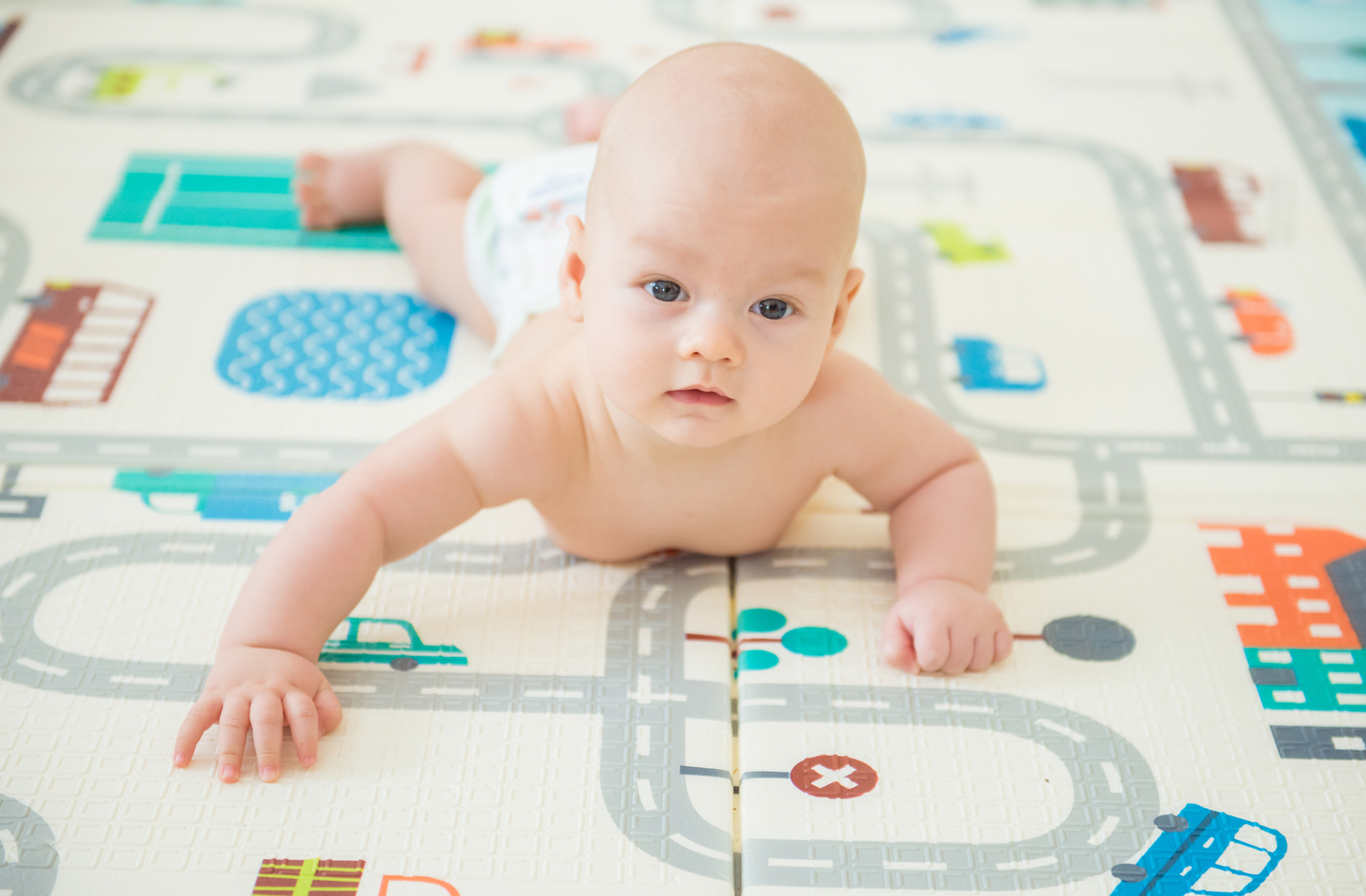
Foam mats win on cushioning for hard-floor infant use. The minimum thickness recommendation for floor-level infant play on a hard surface is 15mm, a figure consistent across multiple pediatric floor-play guidance sources. Foam mats regularly meet or exceed this threshold; fabric and padded mats typically do not.
The American Academy of Pediatrics recommends beginning tummy time within the first days after birth, progressing to at least 60 minutes of prone play daily by six months of age.4 Every session involves an infant pressing a developing chest, chin, and forearms directly against the floor surface. The firmness and thickness of the mat shape how sustainable those sessions are.
“Choose a firm, flat surface like a clean blanket or play mat on the floor.”
Pathways, tummy time guidelines developed with and approved by expert pediatric physical and occupational therapists4
The firmness note in this guidance is as important as the thickness note. Too soft a surface creates two problems for young infants. First, an infant who cannot yet reliably lift the head sinks slightly into a soft mat, making the push-up harder and raising the risk of obstructed breathing if the infant fatigues and the face presses down. Second, an overly soft surface reduces the proprioceptive feedback the infant’s muscles use during early strength-building. A mat built for cushioning and a mat built for safe tummy time are not necessarily the same product.
The chart below shows how typical thickness ranges across the three mat types compare to the 15mm floor-level minimum. Foam mats meet the threshold; padded mats are marginal; fabric mats fall short for direct hard-floor use.
For parents using a fabric or padded mat on carpet, the floor surface itself provides additional cushioning, which shifts the calculation. A fabric mat on a medium-pile carpet is meaningfully more cushioned than a fabric mat on bare hardwood. The floor underneath is part of the system.
Foam density as a cushioning quality indicator
Thickness is not the only foam cushioning variable. Density determines how much the foam compresses under load. High-density EVA or XPE foam in the range of 80-120 kg/m³ holds its shape under an infant’s weight and resists permanent compression better than low-density alternatives. A foam mat marketed as 20mm thick but made from low-density foam compresses significantly under a six-month-old’s weight during active tummy time, effectively reducing the working thickness. For foam mats, checking both thickness and density (or at minimum pressing on the foam firmly and watching how quickly the material rebounds) gives a more accurate cushioning picture than thickness measurement alone. For a deeper look at how density and thickness interact across foam types, the article on EVA foam play mats covers these trade-offs across common foam subtypes.
Washability and Daily Care
Fabric wins on washability. An infant mat collects saliva, spit-up, and skin oils daily. The material type determines whether effective cleaning is straightforward or structurally limited by the mat’s construction.
Fabric mats: machine washable, with a temperature caveat
Quilted fabric infant mats are designed to go through a home washing machine, and most withstand repeated gentle-cycle washing. The full mat enters the machine, not just a cover. This is the highest-convenience washability of the three types. The practical caveat is temperature. Research on laundry hygiene published in Applied and Environmental Microbiology found an increased bacterial count on textiles washed at 30°C, and established that temperatures above 40-60°C are needed for reliable pathogen inactivation.5 Fabric infant mats are typically labeled for cool or lukewarm water to protect printed surfaces and structural integrity. This creates a real tension: the temperature needed for effective hygiene and the temperature the mat tolerates are often different.
A practical resolution is to use a mild baby-safe detergent with documented antimicrobial activity at lower temperatures and to dry the mat fully in a dryer on low heat when the label permits, since heat during drying provides additional pathogen reduction. Air-drying a fabric mat in a warm, ventilated space also reduces residual moisture. Weekly washing for general use, and same-day washing after a contamination event, are reasonable baselines regardless of mat type.
Foam mats: wipe-clean surface, no machine washing
EVA and XPE foam mats are not machine washable. Submerging closed-cell foam saturates any surface seams, degrades adhesive layers if the foam is laminated, and risks delamination of surface coatings. The correct approach is spot cleaning with a damp cloth and mild soap, followed by thorough air-drying before the infant uses the mat again. For a surface used during daily tummy time, this means wiping down after each session and doing a more thorough clean weekly.
The advantage of foam is speed: a wipe-down takes under a minute. The limitation is that wiping does not substitute for the thermal or chemical sanitization a machine wash provides. A foam mat with repeated surface contamination and wipe-cleaning retains residue in surface pores over time. For parents with infants who drool or spit up heavily, a foam mat used without a removable fabric cover becomes a more significant hygiene challenge over weeks of daily use.
Some foam mats include a thin waterproof coating on the surface. This coating makes wipe cleaning more effective by reducing liquid absorption into the foam, but the coating itself should be verified as non-toxic and durable. A peeling or cracking coating on a foam mat in contact with an infant’s face or hands introduces its own chemical concern, one that third-party certification at the time of purchase does not necessarily cover after months of use.
Padded mats: cover washes, insert does not
Padded mats with removable covers offer a useful split: the cover goes in the machine, the insert does not. This is a practical cleaning structure for parents who want machine-washing convenience without giving up the cushioning a polyester fill provides. The limitation is seam alignment after washing. A removable cover washed and replaced repeatedly sometimes shifts on the insert, bunching at edges or creating uneven surface tension. Over months of daily use, this affects both comfort and safety if the infant’s head or face contacts an irregular surface.
Padded mats without removable covers follow the foam approach: wipe-clean on the surface, no machine washing of the whole unit. For non-removable padded mats, inspect the stitching regularly. Fabric-to-fill seams under daily pressure from an infant’s weight and repeated wipe-cleaning are the most common failure point in padded mat construction. For more detail on padded mat construction, core density, and seam durability, the article on padded mat materials covers these factors across current options.
No surface used directly under an infant should go more than a week without cleaning, regardless of material type. Bacteria and allergens accumulate faster than visible soiling suggests, so the method the mat actually withstands, done consistently, is the one worth optimizing.
Grip and Stability on Playroom Floors
A mat used during infant tummy time needs to hold position on the floor. An infant pushing up on arms applies directional force to the mat surface, and a mat without adequate grip slides forward on smooth floors. This disrupts the session at every age and frustrates the movement pattern a four-month-old is actively building.
Foam mats: best grip on hard floors
Closed-cell foam surfaces create natural friction against hardwood, tile, and laminate. Most foam infant mats also include a non-slip bottom layer, either a textured foam underside or a separate non-slip coating. On smooth hard floors, foam mats are the most stable of the three types. The mat’s weight and surface friction work together: heavier, thicker foam mats shift less than thinner, lighter ones under the same applied force. For infants on bare hardwood or tile, foam is the most reliable option for a mat staying in position during active sessions.
Fabric mats: floor-type dependent
Quilted fabric mats grip carpet well. The stitched fabric underside catches on carpet pile and stays in place during tummy time sessions. On hardwood or tile, fabric mats slide more readily than foam unless the mat includes a specific non-slip backing such as a rubber or silicone dot grid on the underside. When purchasing a fabric mat intended for use on hard floors, confirming the non-slip backing is present is worth verifying before the first use. A fabric mat without this feature, used on bare hardwood, needs to be placed against a wall or furniture edge to prevent sliding during active sessions.
Padded mats: variable by construction
Padded mat grip depends entirely on whether the cover fabric extends under the mat or whether a separate non-slip layer is included. A padded mat with a smooth fabric underside slides on hard floors at roughly the same rate as a fabric mat without non-slip backing. A padded mat with a rubberized or textured underside grips comparably to foam on hard floors. Check the underside construction before assuming grip performance on smooth surfaces. On carpet, padded mats typically stay in place without issue, as the stitched cover fabric catches on pile in the same way a quilted fabric mat does.
For parents with mixed flooring between rooms (carpet in one space, hardwood in another), a foam mat handles both settings consistently. Fabric and padded mats perform well on carpet and require more attention on hard floors.
Who Should Choose What
The right infant activity mat material depends on floor type, cleaning frequency, and the age and developmental stage of the infant. No single type is best across all households or all stages of early infancy.
Choose foam (XPE or EPE preferred over EVA)
Choose foam when the playroom or nursery has hardwood, tile, or laminate flooring. Choose foam when the infant is in the daily tummy time progression recommended from birth through six months. Choose foam when the cleaning routine relies on quick wipe-downs between sessions rather than weekly machine washing. When selecting foam, prioritize XPE or EPE over standard EVA based on the 2024 volatile chemical safety ranking1, and confirm a third-party test report or OEKO-TEX certification on the specific product rather than relying on brand claims alone.
Choose fabric
Choose fabric when the primary floor surface is carpet. Choose fabric when the infant is in the early sensory-stimulation stage (0-4 months) and texture variety matters as much as cushioning. Choose fabric when the cleaning preference is machine washing rather than wipe-cleaning. Fabric mats used on carpet are a sound combination: the carpet provides the floor cushioning the mat does not, and the mat provides sensory variety and a clean surface boundary. Look for OEKO-TEX Standard 100 Class I on the label, and check whether the mat includes a non-slip backing if use on any hard floor is possible.
Choose padded
Choose padded when the priority is a washable surface with more cushion than a flat fabric mat but lighter weight than foam. Padded mats work well in spaces where the mat moves between rooms, and in carpeted or soft-floored settings where the 15mm hard-floor threshold is less critical. A padded mat with a machine-washable cover and a dense polyester fill is the closest this category gets to a general-purpose infant mat across light play and nap-adjacent floor time, though the insert non-washability remains a limitation when contamination events are frequent.
Frequently Asked Questions
What is the safest material for an infant activity mat?
EPE and XPE foam carry the lowest volatile chemical risk among foam types based on a 2024 study of 34 play mat samples.1 For fabric and padded mats, OEKO-TEX Standard 100 Class I certification6 is the most reliable third-party signal for infant skin contact safety. No material is inherently free of risk without independent testing documentation covering the specific finished product.
How thick should an activity mat be for a newborn?
For direct use on hard floors, 15mm is the generally recommended minimum. Foam mats typically measure 15-30mm and meet this threshold. Fabric mats measure 2-8mm and fall short for hard-floor use. A fabric mat placed on carpet gains supplemental cushioning from the pile beneath, making the combination more suitable than the mat alone on bare hardwood.
Are EVA foam mats safe for infants?
EVA foam ranks highest in volatile chemical risk among the four foam types tested in the 2024 volatile safety study.1 The EU limits formamide in foam baby mats to 200 mg/kg,2 but no equivalent US federal limit exists for play mats. EVA mats with third-party formamide testing documentation or OEKO-TEX Standard 100 certification present lower risk than uncertified products.
Can I machine wash a foam infant activity mat?
Standard closed-cell foam mats (EVA, XPE) are not machine washable. Submersion risks delamination, seam failure, and degraded surface coatings. The correct approach is wipe-cleaning with a damp cloth and mild soap, followed by thorough air-drying. Fabric-covered foam mats with a removable cover allow the cover to be machine washed; the foam core remains wipe-clean only.
What temperature effectively cleans bacteria from a fabric infant mat?
Research on laundry hygiene indicates pathogen inactivation requires temperatures above 40-60°C.5 Most fabric infant mats are labeled for cool or lukewarm washing to protect prints and structure. Using a baby-safe detergent with antimicrobial properties and drying on low heat when the label permits partially offsets the lower wash temperature.
Limitations and Edge Cases
- Thickness figures in this article represent typical midpoints for common product categories; actual brand thickness varies significantly, and some specialty padded mats exceed 20mm while some budget foam mats fall below 15mm.
- The 2024 volatile chemical study covered 34 samples across four foam types; the ranking applies to the tested population and does not guarantee every EVA mat is unsafe or every EPE mat is risk-free. Third-party test documentation on the specific product remains the reliable filter regardless of foam type.
- For specific child developmental needs, surface firmness requirements, or chemical sensitivity concerns in a specific infant, consult a pediatric occupational therapist. The floor-level guidance in this article is engineering-informed education, not individualized developmental or medical advice.
References
- ScienceDirect – “Evaluation of volatile safety in children’s play mats based on non-targeted screening and risk prioritization,” Ecotoxicology and Environmental Safety, 2024.
- EUR-Lex – Commission Regulation (EU) 2018/725, amending Annex XVII to REACH: formamide limit of 200 mg/kg for foam articles intended for use by children under 36 months, European Commission, 2018.
- CPSC – ASTM F963 Requirements Chart, U.S. Consumer Product Safety Commission; mandatory third-party testing under ASTM F963-23, effective April 20, 2024.
- Pathways.org – Tummy Time: Essential Guide for Parents, developed with and approved by expert pediatric physical and occupational therapists and speech-language pathologists; AAP-aligned progression guidelines.
- Applied and Environmental Microbiology – “Laundry Hygiene and Odor Control: State of the Science,” American Society for Microbiology, 2021.
- OEKO-TEX – OEKO-TEX Standard 100 certification criteria; Class I applies to products with direct skin contact for infants and babies up to 36 months.
- Eurofins – “ASTM F963-23 Compliance: Navigating US Toy Safety Standards,” Eurofins Scientific, 2024.
Conclusion
Material type is the first decision point for any infant activity mat, and the three main constructions each make real trade-offs. Foam, particularly XPE or EPE over EVA, offers the cushioning and firmness hard floors require for tummy time from birth onward. Fabric offers machine-washable convenience and sensory texture at a cost in thickness and floor grip. Padded mats occupy a useful middle position for carpeted rooms with moderate cushioning needs. Third-party certification is the practical filter across all three types, since labeling claims alone do not reflect what independent testing finds.
For a broader view of how infant mat choices fit into the full range of playroom surface decisions, see the Playroom Materials and Surfaces overview.