
A homework station for kids works when it is planned around the homework, not around the desk in the catalog. Our homeschool learning zones guide covers learning areas across the whole home. This article covers one part of it: a single station where a child reads, writes and works on a screen after school. The workload is substantial: in 2019, high school students who did homework outside school spent an average of 7.5 hours a week on it1.
Quick Answer
How do you plan a homework station for kids?
List the homework tasks first, then pick a spot the child will use and an adult can supervise. Fit the surface and chair to the child, light the page without glare, and store daily supplies within reach. For public buildings, accessibility standards place children’s work surfaces 26 to 30 inches above the floor2, a useful reference range at home.
Key Takeaways
- Many younger children get frequent help. In 2019, parents of 29.5% of K-8 students who did homework helped three or four days a week, and 14.0% helped five or more days1.
- Furniture fit matters: in a pilot study of 108 Spanish primary school children aged 6 to 12, 97.2% used a school desk that did not match their body size3.
- Size the surface to the child, since public-building standards set children’s work surfaces at 26 to 30 inches2, a reference range rather than a home rule.
- Place the screen directly in front of the child, at least 20 inches away, per OSHA guidance for adult workers4. Turn it at right angles to the window7.
- Plan the reset: a station that clears in a few minutes is ready again the next afternoon.
Before You Start: What a Homework Station for Kids Needs
A homework station for kids needs a task list, a short list of possible spots and a few measurements before anything is bought. Observation before shopping prevents the furniture from dictating the plan. A homework station is a fixed or portable work area set up for one child’s after-school assignments. It needs a surface, a seat, light and the supplies those assignments use. Gather these first:
- A one-week homework log noting each assignment, whether it used paper, a book or a screen, and where the child actually did it.
- The child’s seated measurements: the height from floor to the back of the knee and from floor to the elbow, taken in socks.
- A tape measure for each candidate spot, including the walking path past it and the nearest outlet.
- A note of who helps, on which days, and where that adult is usually working at homework time.
- Time: one week of observation and one weekend for installation.
Treat the room as a system: the desk is one component, and the station’s location, storage, lighting and reset decide whether the child uses it. Playroom Architect founder Oded Feigin, a mechanical engineer (M.Sc., UCLA) who plans residential renovations, wrote this guide. It is engineering-informed planning, not ergonomic or medical advice for a specific child.
Step 1: List the Homework Tasks Before Choosing Furniture
Step 1 turns a week of homework into a short list of tasks, because each task asks something different of the surface. The workload also increases with age. In 2019, K-8 students who did homework outside school spent an average of 4.6 hours a week on it, against 7.5 hours for high school students1. A station planned for a first grader’s reading log will not hold a ninth grader’s laptop, textbook and notes.
| Task | Surface need | Light need | Storage need |
|---|---|---|---|
| Worksheets and handwriting | Flat area for one open sheet plus the forearm | Even light on the page, no shadow from the writing hand | Pencils, eraser and sharpener in arm’s reach |
| Reading assignments | Room for an open book, or a nearby chair | Light on the page without glare on glossy paper | A cover-out spot for the current book |
| Laptop or tablet work | Depth for the screen plus space for a notebook | Low glare on the screen, window to the side | Charger, headphones and an outlet |
| Projects and posters | A large surface used now and then, such as a table | Bright general light | A flat bin for work in progress |
- Group the week’s log into the four task types in the table.
- Mark the most frequent task, which determines the surface size.
- Mark the rarest task, which can borrow a larger surface elsewhere in the home.
- Write down every supply each task used, so storage follows real use.
Take a hypothetical second grader whose log shows reading on four afternoons and a worksheet on Friday, all at the kitchen table. Reading is the main task, so a supportive chair and good light matter more than a large desk.
The step is complete when one task is marked as primary and every other task has an assigned location, even if that location is the kitchen table.
Size the station for the most frequent task, not the largest one, because a desk sized for the rare poster project takes floor space every school day.
Step 2: Choose Where the Homework Station Goes
Step 2 picks a spot by matching how much help the child needs to where the adult is at homework time. Many younger children get frequent help. In 2019, parents of 29.5% of K-8 students who did homework helped three or four days a week, and 14.0% helped five or more days1. Among high school students, 24.0% got no help at all1.
A child who receives help most days needs a station within sight of the adult, which usually means a shared room. An older child who works alone can take a quieter spot, such as a bedroom, as long as screens and sleep are planned for.
| Location | Works well for | Main trade-off | Planning note |
|---|---|---|---|
| Kitchen or dining table | Younger children helped most days | Supplies must clear for meals | A caddy or cart that leaves the table each evening |
| Living room corner | Children who need an adult nearby but not beside them | Noise and screens in the same room | Face the desk away from the television |
| Bedroom | Older children who work alone | Less supervision of screens | Agree where devices charge overnight |
| Shared learning space | Siblings or homeschool families | Two users with different sizes | One surface height per child, or adjustable parts |
For the kitchen table, the station is a kit rather than a desk. Our portable learning system guide covers carts and caddies that set up and clear in minutes. Where the only spot is a corner of a small room, our small-space learning zone guide covers perimeter placement and keeping the walking path clear.
Check each spot for three things. It needs a clear path past the chair and an outlet within reach of a lamp cord. The window should sit to the side of the desk, not behind or in front of it.
Place the station where help already happens, because a well-equipped desk in a far bedroom often loses to the kitchen table when the child needs a parent.
Step 3: Decide Between a Desk and a Table
Step 3 chooses the surface type, and the choice follows the main task and the location from Steps 1 and 2. A desk gives one child a fixed, sized place with storage built in. A table gives several users a larger, shared surface but usually provides no storage, so each option suits a different household.
When does a desk work better?
A desk works better when one child does most of the homework at a fixed spot, and the main task is writing or screen work. Drawers or a side shelf keep daily supplies in place between sessions, and a corner desk can help with screen work. OSHA guidance written for adult workers notes that a corner may provide more space and depth for large monitors or several items4.
When does a table work better?
A table works better when siblings share the space, when an adult sits beside the child, or when projects need a broad surface. The cost is storage: supplies need a cart, a caddy or a nearby shelf. A table also tends to be adult height, so a raised chair and a footrest matter more.
A third option is a height-adjustable desk, which costs more but lets one surface follow a growing child or serve siblings of different sizes.
Choose a desk for a child who works independently in one location and a table for a family that works together. Then budget for the storage a table lacks.
Step 4: Fit the Desk Height and Chair to the Child
Step 4 sizes the surface and the seat to the child’s body, because standard furniture often does not match a child’s size. A pilot study measured 108 Spanish primary school children aged 6 to 12. Of them, 91.7% used a school chair and 97.2% a school desk that did not match their body size3. The mismatched furniture was larger than the children needed3.
Accessibility standards provide a reference range: for public buildings, the U.S. Access Board sets the tops of children’s work surfaces at 26 inches minimum and 30 inches maximum2. The same section permits a knee clearance of 24 inches minimum under those surfaces2. Knee clearance is the open height under a work surface where a seated person’s knees and thighs fit without touching the underside.
Those numbers are not home rules, and they do not size a desk for a specific child. They show that a child’s surface sits well below a typical adult desk, while the individual child’s fit determines the final height.
“This study confirmed that the currently used guidelines need to be revised and that children had difficulty in selecting the appropriate height of school furniture by themselves.”
Yushin Lee and Myung Hwan Yun, Department of Industrial Engineering, Seoul National University, in Work, 20195
In that study of Korean primary school children, only a quarter picked a matching school desk and seat height on their own5. So the adult runs the fit check, and the child gives feedback.
- Set the seat first: OSHA guidance, written for adult workers, calls the chair height appropriate when the entire sole of the foot rests on the floor6. The back of the knee should sit slightly higher than the seat, a test parents can adapt for a child6.
- Add a footrest if the feet dangle: the same guidance allows the feet to rest flat on the floor or a footrest6. A sturdy box or step can serve.
- Then check the surface: with the child seated and shoulders relaxed, the forearms should rest near the desk top while writing, without the shoulders lifting.
- Check the legs: thighs should clear the underside of the desk, with room to shift position.
The step is done when the child can write for ten minutes without perching on the seat edge, kneeling on the chair or hunching toward the page. Recheck the fit after each growth spurt, or at the start of each school year.
Fit the chair before the desk, because a chair and footrest are cheap to change, and they let one desk serve a child for several years.
Step 5: Light the Work Surface and Place the Screen
Step 5 lights the page and positions any screen so the child does not squint, lean in or fight glare. Glare is bright light that reflects off a screen or glossy page, or shines straight into the eyes, and makes the work harder to see. OSHA workstation guidance, written for adult workers, recommends lamps with glare shields or shades that direct light away from the line of sight7.
The same OSHA page provides a range for general illumination, stating that office lighting for paper tasks should generally range from 20 to 50 foot-candles7. A foot-candle is a unit of illuminance, the amount of light falling on a surface, equal to one lumen per square foot.
- Turn the desk so the window is to the side: OSHA advises placing the workstation so bright light from windows is at right angles to the screen7.
- Add a shaded task lamp: position it opposite the writing hand, so a right-handed child gets light from the left and no hand shadow on the page.
- Set the screen distance: OSHA guidance places a monitor directly in front of the user, at least 20 inches away4.
- Build in breaks: the American Academy of Ophthalmology suggests pre-marking books with a paperclip every few chapters, to remind a child to look up8.
“Avoid using screens outside or in brightly lit areas, where the glare on the screen can create strain.”
American Academy of Ophthalmology, five-step screen strategy from pediatric ophthalmologist Luxme Hariharan, MD8
The same AAO guidance says to keep the computer or desk an arm’s length away and at a slight downward angle from the child’s face8.
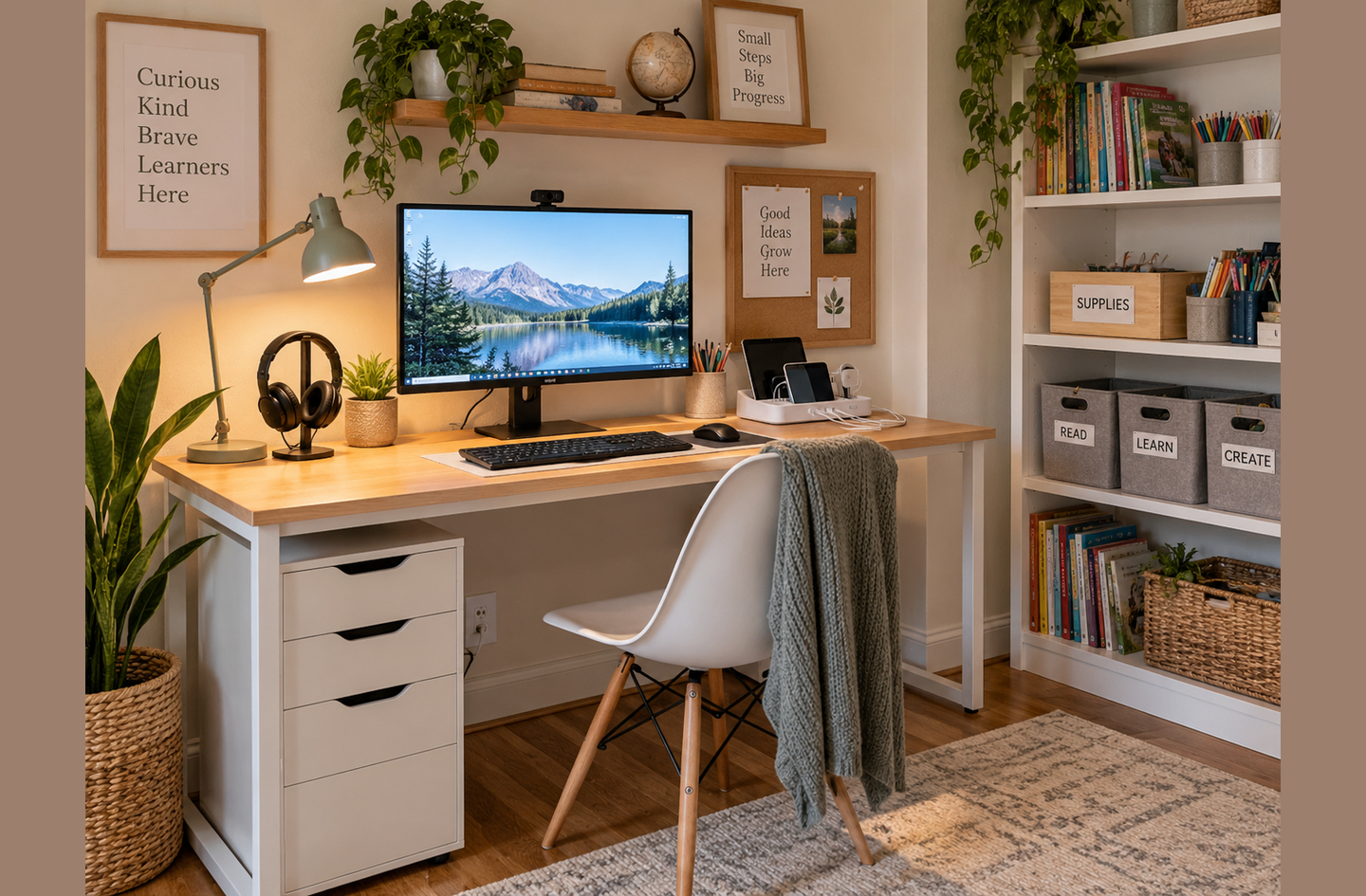
The step is complete when the page is evenly illuminated and no window or lamp reflects in the screen. The child should read the screen while sitting back, not leaning forward.
Fix glare with placement before buying a brighter lamp, because turning the desk a quarter turn costs nothing and can remove the reflection at its source.
Steps 4 and 5 add up to one station envelope, drawn in the side view that follows. The surface top sits at 26 to 30 inches in public-building standards for children2, with a permitted knee clearance of at least 24 inches2. The screen sits 20 inches or more away4, and room light for paper tasks runs 20 to 50 foot-candles in OSHA office guidance7.
Step 6: Store Homework Supplies Within the Child’s Reach
Step 6 puts each daily supply where the child can reach it from the chair or one step away, and moves everything else out of the station. A child who must stand, climb or ask for a pencil can lose the thread of the assignment. Accessibility guidance for public buildings gives reach ranges for building elements designed mainly for children. The ranges run 18 to 40 inches above the floor for ages 5 through 8, and 16 to 44 inches for ages 9 through 122.
Those bands come from Advisory 308.1 of the ADA Standards, which is guidance for elements designed mainly for children2. Homes are not bound by it, but the bands give a starting range, so daily supplies go inside the band and spares above it.
What belongs at the station?
Keep only the daily kit at the station: pencils, an eraser, a sharpener, a ruler, a highlighter, lined paper, the current book and the device charger. A small caddy or a top drawer holds the kit, and one labeled position per item makes the end-of-session check fast, because an empty slot reveals what is missing.
What belongs somewhere else?
Refills, finished work, project materials and the supplies for other children belong outside the station. A nearby shelf, a closet bin or a parent-managed cabinet holds them. Our homeschool storage system guide covers back-stock, overflow rules and shelving for a larger collection.
- Sit the child in the chair and mark the comfortable reach on the desk and the wall.
- Place the daily kit inside that zone, on the side of the writing hand.
- Move every item the log shows was not used in a week out of the station.
The step is done when the child can complete a normal assignment without leaving the chair, and the desk top holds only that day’s work.
Store less at the station than seems sensible, because every additional item on the desk must be moved before work starts and replaced afterward.
Step 7: Build a Daily Reset Into the Homework Station
Step 7 adds a short routine that returns the station to its ready state after each session, so the next afternoon starts without clearing. A reset is the set of actions that returns a space to its starting layout, in a fixed order, at a fixed time. Most parents already close the loop on homework: in 2019, 99.1% of K-8 students who did homework had parents who checked that it was done1. The reset can attach to that existing check.
- Pack the bag: finished work goes into the school bag or the return file before anything else moves.
- Return the kit: each supply goes back to its labeled home in the caddy or drawer.
- Clear the surface: books, scrap paper and snack plates leave the desk.
- Close the screen: the device goes to its agreed charging spot, which may be outside a bedroom.
- Check the empty slots: a missing item goes on the shopping list now, not at the start of the next assignment.
Put the five moves on a card at the station, in words and pictures for a pre-reader. The parent’s homework check becomes the cue, so the reset starts once the work is checked. For a younger child, the parent does the reset alongside the child at first, then hands over one move at a time.
Design for the reset, not just the reveal: the station that stays useful is one a child can restore to its starting state in minutes, without help.
Common Mistakes When Setting Up a Kids Homework Station
The most common homework station mistakes come from buying first and planning second. Oversized furniture is the documented example: in the Spanish pilot study, most of the mismatched chairs and desks were larger than the children needed3.
Buying an adult desk with no plan for the chair
An adult desk is too high for most children, so the child perches or kneels to reach the page. The fix is a raised seat, a footrest and a recheck of fit each school year, or a desk whose height can change.
Placing the desk to face a window
A window behind a screen creates contrast, and a window behind the child reflects in it. The fix is to turn the desk so the window sits to one side, then add a shaded lamp.
Putting the station far from the helper
A younger child who needs help most days will leave a remote desk and carry the work to the adult. The fix is to place the station where help already happens, then move it as the child works more on their own.
Fix placement and fit before buying more organizers, because most homework station problems are layout problems that no bin will solve.
What a Working Homework Station for Kids Looks Like
A working homework station for kids is ready when the child arrives, fits the child’s body and resets in minutes. The planning checks are simple to observe over one school week:
- The child starts homework without clearing the desk or hunting for a pencil.
- Feet rest flat on the floor or a footrest, and the forearms rest near the desk top while writing.
- No window or lamp reflects in the screen, and the page has no hand shadow.
- The helper can see the work from where they usually are at homework time.
- The reset happens after the homework check, and the desk top is clear by bedtime.
The stretch goal is to let the station grow with the child. The principle of layout first, products second still applies at every stage.
Frequently Asked Questions
What desk height works for a kids homework station?
For public buildings, accessibility standards place children’s work surfaces 26 to 30 inches above the floor2. Use that as a reference range, then check the child: feet flat on the floor or a footrest, and forearms resting near the desk top while writing.
Where should a homework station go in the house?
A homework station should go where assistance happens: in 2019, parents of 14.0% of K-8 students who did homework helped five or more days a week1. A child who gets help most days can work near an adult, such as at the kitchen table or in a living room corner. Older children who work alone can use a bedroom.
Is a desk or a table better for homework?
A desk suits one child at a fixed spot, and a table suits siblings or a parent working alongside. Either option must fit the child: in a pilot study of 108 Spanish primary school children, 97.2% used a school desk that did not match their body size3.
How far should a screen be from a child doing homework?
OSHA guidance, written for adult workers, places a monitor directly in front of the user and at least 20 inches away4. The American Academy of Ophthalmology suggests keeping a child’s computer at arm’s length and at a slight downward angle from the face8.
How much homework time should the station be planned for?
Plan for more time as the child gets older. In 2019, K-8 students who did homework outside school averaged 4.6 hours a week, and high school students averaged 7.5 hours1. A teenager’s station needs more surface, better light and room for a laptop.
Limitations and Edge Cases
- The Access Board figures apply to public buildings2, and the OSHA figures are written for adult workers4. Neither sets a standard for a home homework desk or for a specific child.
- The furniture studies measured school furniture in Spanish and Korean primary schools35, not homes. The NCES homework figures exclude homeschooled students1, so a home-school station may carry more hours of daily work than these averages suggest.
- A child with ongoing back pain, eye strain, headaches or trouble focusing needs a pediatrician, a pediatric ophthalmologist or a pediatric occupational therapist, not a new desk.
- A wall-mounted desk, a fold-down surface or a tall shelf above the station should be checked by a licensed installer for the specific wall. Tall units should also be anchored.
References
Methodology: every figure comes from an independent published source, checked live on October 11, 2026. The task table, station envelope and reset routine are planning syntheses built on those sources by the article’s author.
- National Center for Education Statistics – Digest of Education Statistics, Table 227.40, homework time and parent involvement, 2007, 2012, 2016 and 2019, prepared April 2021.
- U.S. Access Board – ADA Accessibility Standards, section 902.4 on children’s work surfaces and Advisory 308.1 on children’s reach ranges.
- PubMed – Prieto-Lage I, Ayan C, Alonso-Fernandez D, et al. Degree of mismatch between anthropometric characteristics and school furniture in a sample of Spanish students aged 6-12 years old: a pilot study. Archivos Argentinos de Pediatria, December 2021.
- Occupational Safety and Health Administration – Computer Workstations eTool: Desks.
- PubMed – Lee Y, Yun MH. Evaluation of the guidelines and children’s ability to select the anthropometrically recommendable height of school furniture: a case study of Korean primary school children. Work, 2019.
- Occupational Safety and Health Administration – Computer Workstations eTool: Chairs.
- Occupational Safety and Health Administration – Computer Workstations eTool: Workstation Environment.
- American Academy of Ophthalmology – Screen Use for Kids, Eye Health Tips and Prevention.
Conclusion
A homework station for kids works when it follows the homework: the main task sets the surface, the helper sets the location, and the child’s body sets the height. Low-glare light, a small daily kit and a five-move reset keep it ready each afternoon. The room as a system, not the desk alone, decides whether the child uses it.
For how one station fits the wider plan for learning areas at home, see the overview in the homeschool learning zones guide.