
Storage ideas for a small playroom work when they move toys off the floor and onto one planned wall, inside the heights a child can reach. Our small-space playroom layouts guide is the broader overview of planning a small room that works. This article goes deep on one angle: vertical storage that clears the floor. For children ages 3 and 4, the Access Board’s advisory reach range, written for public buildings, runs from 20 to 36 inches3. A wall planned around that band, with every tall unit restrained, gives the floor back to play.

Quick Answer
What makes storage ideas for a small playroom work?
Vertical storage works in a small playroom when daily toys sit inside the youngest child’s reach, backups sit above it, and the floor stays open for play. For public buildings, the Access Board’s advisory children’s reach runs from 20 to 36 inches at ages 3 and 4. It runs from 16 to 44 inches for ages 9 through 123. Restrain every tall unit to the wall.
Key Takeaways
- Reach comes first. In the Access Board’s advisory table for public buildings, the high maximum is 36 in at ages 3 and 4. It rises to 40 in at ages 5 through 8 and 44 in at ages 9 through 123. Daily toys belong inside the youngest user’s band.
- Tip-over injuries remain common. From 1990 to 2019, United States emergency departments treated an estimated average of 18,673 children a year for furniture or TV tip-over injuries1.
- The federal clothing storage rule requires testing of units 27 inches and above in height, but its scope does not cover shelving units, such as bookcases2. Restraining a playroom bookcase is a planning decision for the household.
- Fewer toys within reach can lengthen play. In a 2018 study, 36 toddlers had longer durations of toy play in a Four Toy session than in a Sixteen Toy session4.
- Design for the reset, not just the reveal: a wall that gives each category one visible home turns the reset into a matching task.
Getting Started: What Vertical Storage That Clears the Floor Means
Vertical storage that clears the floor moves a small playroom’s toys from floor bins onto one planned wall, so the open floor becomes the play surface. In a small room the floor is the scarcest resource, and every bin left on it shrinks the space children have to build, spread out and move.
What is vertical storage in a small playroom?
Vertical storage is storage that stacks upward on a wall, through shelves, rails, pegboards and tall cube units, instead of spreading across the floor. A wall has height that the floor does not, and a small playroom with one planned storage wall can keep its center open for building, pretend play and movement.
The wall also becomes the room’s map. When every toy category has one visible home, a child can see where a toy goes, and a parent can see at a glance whether the room is reset. That is the room as a system: the storage wall carries the organizing work, so the floor does not have to.
Height cuts both ways, though. Storage above a child’s reach is storage the child cannot use alone, and a tall unit that is not restrained can tip. A floor-clearing wall therefore has two jobs: put the right things at the right height, and keep the whole wall stable.
Who does a floor-clearing storage wall suit?
A storage wall suits families with a small dedicated playroom, a corner of a shared room or a spare bedroom where floor space is tight. It also suits rooms that serve two ages, because one wall can hold toddler toys low and an older child’s materials higher up.
Good fit:
- Small rooms where floor bins crowd the walking route between the door and the play area.
- Children old enough to fetch and return toys on their own, which is when shelf height starts to matter.
- Families who want the room to reset in a few minutes each evening.
Weaker fit:
- Rental walls where fixings are restricted. Ask the landlord or a licensed installer about fixings first, and still restrain any unit tall enough to tip.
- Babies who are not yet crawling, whose play happens on a mat beside a parent and needs very little storage.
When the playroom doubles as a home office, the small office playroom storage article covers vertical storage for a shared work and play room.
If floor bins are what makes a small playroom feel full, a planned storage wall is the first fix to try, provided the wall can take fixings.
How Storage Ideas for a Small Playroom Work on One Wall
Storage ideas for a small playroom work on one wall when the wall is split into height bands by who uses each band. The Access Board’s advisory table for public buildings sets children’s reach at 20 to 36 inches for ages 3 and 4. It gives 18 to 40 inches for ages 5 through 8, and 16 to 44 inches for ages 9 through 123.
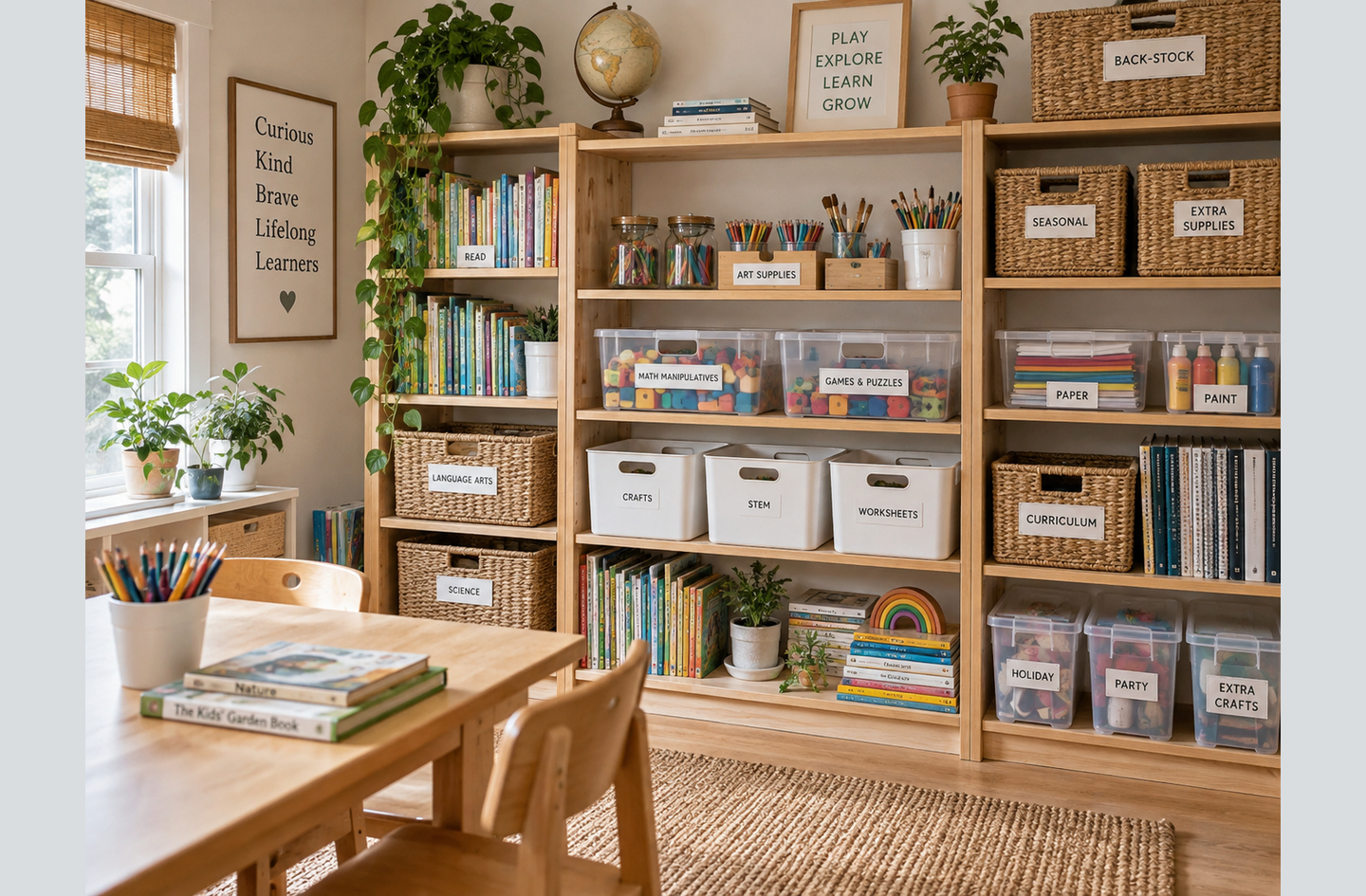
The three bands of a playroom storage wall
A reach band is the span of heights, measured from the floor, between the low and high limits of a child’s forward or side reach. The Access Board table is accessibility guidance for coat hooks, lockers and similar elements in public buildings. Here it serves as a reference point for a home wall, not a rule for it. The table covers ages 3 through 12 only, and it shows where children can use things, not where they cannot get to them.
- The daily band: the shelves inside the youngest user’s range from that table. Daily toys, books and the reset baskets live here, because the youngest child is the one who cannot reach up.
- The backup band: the shelves above the oldest child’s high limit, for resting rotation sets in plain lidded bins that give a child little reason to climb. Height alone does not keep things from a child, so paint, glue and other adult-only supplies go in latched or closed storage.
- The floor band: the bottom shelf, which can sit below the table’s low limits. A child sitting on the floor reaches it easily. It is also the right home for heavy block sets and full book bins, because weight carried low keeps the center of gravity down.
The federal clothing storage rule adds a second height to the picture. Under the STURDY Act, the rule must test clothing storage units 27 inches and above in height2. CPSC staff assessed that the adopted standard includes tests that simulate the weight of children up to 60 pounds2. Set beside the advisory reach table3, that 27-inch line falls inside every children’s band, but it marks a dresser rule’s scope, not a tip-over threshold for shelving.
What is the difference between open and closed vertical storage?
Open storage shows its contents and resets fastest, while closed storage hides visual clutter and keeps adult-only supplies out of sight. A working wall can use both, with open fronts in the daily band and closed fronts in the backup band.
| Feature | Open shelves and cubes | Closed cabinets and lidded bins |
|---|---|---|
| What the child sees | Every item, so choosing is quick | A label or photo, so choosing takes a step |
| Reset speed | Fastest: items drop straight into place | Slower: a door or lid has to open first |
| Visual load on the wall | Higher, especially with bright toys facing out | Lower: the wall reads as calm surfaces |
| Best band | The daily band | The backup band |
| Best for | Books, blocks, current toys | Rotation sets, art supplies, adult-only items |
A cleared floor also opens the view across the room, and the open floor and clear sightlines article plans a small playroom around that view.
Plan the wall by bands before choosing a single unit: the band tells you what each shelf is for, and the unit only has to fit the band.
Common Problems: Why Small Playroom Storage Stops Working
Small playroom storage stops working for three repeat reasons: too many toys are out at once, tall units are not restrained, and the wall itself becomes visually busy. Published research bears on each one, from a toddler play study, a national injury analysis and a classroom experiment, though none of them studied home storage walls.
Why does the floor fill up again after a reset?
The floor refills when the daily band holds more toys than a child can use at once. In a 2018 University of Toledo study, 36 toddlers each took part in a Four Toy session and a Sixteen Toy session4. With fewer toys, they had longer durations of toy play and played with toys in a greater variety of ways4.
For a storage wall, that finding argues for a small daily band and a larger backup band. Toy rotation is the practice of keeping a few toys out and swapping in sets from storage on a regular schedule. On a vertical wall, rotation has a natural home: the backup band holds the resting sets, and the daily band holds only what is in play this week.
The study ran supervised sessions with one child at a time, not family homes, so it does not set a toy count for a playroom. It supports a direction, fewer toys within reach, rather than a number. For questions about a specific child’s play or attention, a pediatric occupational therapist is the right professional.
Why do tall shelves raise tip-over questions?
Tall shelves raise tip-over questions because a child can climb, pull or lean on them, and an unrestrained unit can fall forward. From 1990 to 2019, United States emergency departments treated an estimated average of 18,673 children a year for furniture or TV tip-over injuries1. Children younger than 6 accounted for 69.9% of furniture and TV tip-over injuries overall1.
A tip-over is a piece of furniture or a TV falling over, for example when a child climbs it or pulls on an open drawer. A clothing storage unit (CSU) is a freestanding dresser, chest or armoire. ASTM F2057-23 scopes CSUs at 27 inches or greater in height, 30 pounds or greater in mass and 3.2 cubic feet or greater of enclosed storage volume2. CSUs were involved in 17.2% of the tip-overs in that national analysis1.
The federal rule for dressers shows why playroom shelving needs its own plan. The scope of that standard does not cover shelving units, such as bookcases2. An open cube shelf or bookcase in a playroom sits outside that scope whatever its height. Restraining it is a household planning decision, using the hardware and fixing method the maker specifies. The study authors describe the promotion and use of tip restraint devices as important, while calling for stronger stability requirements1.
How heavy-low loading and wall restraints work together
The physics favors heavy-low loading. A unit tips when the weight of the unit, its contents and a child pulling on it shifts the center of gravity past the front edge of the base. Heavy bins on the bottom shelf keep that center low, while a child hanging on an upper shelf pushes it forward. A restraint holds the top of the unit to the wall, which is why it matters most on tall units.
For plaster, brick, masonry or metal-stud walls, or a built-in wall of storage, ask a licensed contractor or installer to confirm the fixings before loading the shelves. Playroom Architect offers engineering-informed education, not an evaluation of a specific room or wall.
Why can a busy storage wall pull attention?
A busy storage wall may pull attention, judging by classroom research on visual displays. The Association for Psychological Science reported a 2014 study in which 24 kindergarten students were placed in laboratory classrooms5. They had six introductory science lessons, taught in a heavily decorated classroom and in a sparse classroom5. Accuracy was higher in the sparse classroom, at 55% correct, than in the decorated classroom, at 42% correct5.
Off-task behavior was also higher in the decorated classroom, at 38.6% time spent off-task, than in the sparse classroom, at 28.4% time spent off-task5. The lead researcher did not argue for bare walls:
“Therefore, I would suggest that instead of removing all decorations, teachers should consider whether some of their visual displays may be distracting to young children.”
Anna V. Fisher, Carnegie Mellon University5
A home playroom is not a classroom, and storage is not decoration. Still, a wall of bright bins with every toy facing out works as a visual display. Plain bins in the daily band, with a few favorite items facing out, keep the wall readable without stripping it bare.
When a small playroom keeps failing, check restraint, toy count and visual load in that order. The first decides the tip-over exposure, the second the reset, and the third how calm the wall reads.
How to Organize a Small Playroom Storage Wall That Resets Fast
To organize a small playroom storage wall, give each toy category one home inside the right band, keep the walking route clear and restrain every tall unit. The reset then becomes a matching task, where each item goes back to the one place that holds its kind.
Best practices for a floor-clearing wall
- Walk the room first: before buying a single bin, note where toys pile up and where children actually play. Observation before shopping shows which categories need homes closest to the play floor.
- Size the daily band to the youngest user: older siblings can reach down to a low shelf, but the youngest child cannot reach up to a high one. The Access Board table starts at age 3, so for a toddler, watch what the child actually reaches.
- Load heavy items low: large block sets and full book bins go on the bottom shelf, which keeps the center of gravity down.
- Restrain every tall unit: fix it to the wall with the maker’s restraint hardware, into studs or anchors suited to that wall.
- Keep the route clear: for public buildings, the ADA Standards set a clear width of 36 inches minimum for walking surfaces3, a wheelchair-route rule. It is still a useful yardstick for the path from the door to the play floor.
- Watch shelves that stick out: the ADA Standards cover this for public buildings. There, objects with leading edges more than 27 inches and not more than 80 inches high protrude 4 inches maximum into a circulation path3. The rule exists so cane users can detect objects. Our own inference is that a deep shelf beside the door can put an edge at a child’s head or shoulder.
- Label for the non-reader: a photo or drawing on each bin lets a child who cannot read yet return items alone.
- Give rotation its own shelf: plain lidded bins on the top shelves hold the resting toy sets. The daily band stays small, and the top holds nothing a child is eager to climb for.
For the full build sequence from layout to daily use, the DIY playroom ideas for small spaces plan sets out each setup step for a fast shared-space reset.
Storage wall crosswalk: published figures mapped to a small playroom wall
The crosswalk below maps each published figure in this article onto one part of a home storage wall, with the setting each source was written for.
| Part of the wall | Published figure | Setting the source covers | What it means on a home wall |
|---|---|---|---|
| Daily band, ages 3 and 4 | Reach range 20 to 36 inches | Advisory guidance, public buildings | Daily toys and reset baskets for a preschooler sit in this span |
| Daily band, ages 5 through 8 | Reach range 18 to 40 inches | Advisory guidance, public buildings | The band widens slightly at both ends as a child grows |
| Daily band, ages 9 through 12 | Reach range 16 to 44 inches | Advisory guidance, public buildings | Hobby supplies can rise higher once the youngest user is older |
| Backup band | Above the 44-inch high limit for ages 9 through 12 | Derived from the same table | Resting rotation sets sit above every child band; adult-only supplies also need latched storage |
| Walking route | Clear width of 36 inches minimum | ADA Standards, public buildings | Keep the path from the door to the play floor free of bins |
| Wall shelf beside the route | Leading edges more than 27 and not more than 80 inches high protrude 4 inches maximum | ADA Standards, public buildings | Keep deep shelves off the walking route |
| Tall freestanding dresser | Testing of units 27 inches and above; staff assessed the tests simulate children up to 60 pounds | Federal clothing storage rule, 2023 | Dressers sold under the rule face stability tests; shelving units are outside its scope |
| Bookcase or cube unit | Not covered: shelving units, such as bookcases | Federal clothing storage rule, 2023 | Restrain every tall shelf unit to the wall |
| Why restraint matters | An average of 18,673 children a year treated for furniture or TV tip-over injuries, 1990 to 2019 | National injury surveillance sample, children under 18 | The figure comes from national injury data, not from anecdotes |
How does a storage wall compare with floor bins and under-furniture storage?
A storage wall frees the most floor, floor bins give a toddler the easiest access, and bench or under-furniture storage hides bulk without adding height. A small room can use all three, as long as the wall carries the daily categories.
| Criterion | Storage wall | Floor bins | Bench or under-furniture storage |
|---|---|---|---|
| Floor space used | Least: storage moves up the wall | Most: every bin takes floor | Low: shares a footprint with seating |
| Child access | Good inside the daily band | Easiest for toddlers | Good for bulky, rarely sorted items |
| Reset speed | Fast when each category has one home | Fast to dump, slow to sort | Slow: lids and drawers add a step |
| Tip-over exposure | Present on tall units until restrained | Low, unless bins are stacked high | Low: the unit stays near the floor |
| Who it suits | Small rooms that need open floor | Toddler-only rooms with spare floor | Rooms that also need seating |
The storage wall that works is the one a child can reset alone. If a category has no single home in the daily band, add a home before adding a bin.
Frequently Asked Questions
How do you organize a small playroom?
Organize a small playroom by giving each toy category one home on a single storage wall, with daily toys inside the youngest child’s reach and backups above it. The Access Board’s advisory range for ages 3 and 4, written for public buildings, runs from 20 to 36 inches3. Restrain tall units and keep the walking route open.
How high should shelves be in a playroom?
Daily shelves belong inside the youngest user’s reach, and higher shelves hold backups. For public buildings, the Access Board’s advisory ranges are 20 to 36 inches at ages 3 and 4 and 18 to 40 inches at ages 5 through 8. The range is 16 to 44 inches for ages 9 through 123.
Do playroom bookcases need to be anchored to the wall?
Yes. The federal clothing storage rule covers dressers 27 inches and above in height, but its scope does not cover shelving units, such as bookcases2. Restraint is up to the household. Use the maker’s restraint hardware, and ask a licensed installer about plaster, brick or metal-stud walls.
How many toys should be out in a small playroom?
None of the sources cited here sets a toy count for a home, but fewer toys within reach can lengthen play. In a 2018 study of 36 toddlers, the Four Toy session produced longer durations of toy play than the Sixteen Toy session4. Keep a small daily set out and rotate the rest from a higher shelf.
Are wall shelves better than toy bins for a small playroom?
Wall shelves free more floor than floor bins, but bins set on low shelves combine the strengths of both. The shelf lifts the bin off the floor, and the bin keeps small pieces together. Use open fronts for daily toys and lidded bins for backups, and restrain any tall shelving unit to the wall.
Limitations and Edge Cases
- The children’s reach ranges come from accessibility guidance for public buildings. They are reference points for a home wall, not a rule for it, and children of the same age differ in height and reach.
- The toy-count and classroom findings come from supervised laboratory sessions with toddlers and kindergarten students, so they show a direction rather than a number for a family playroom.
- The tip-over figures are national emergency department estimates for 1990 to 2019 and include TVs as well as furniture1. Zoning the whole room, beyond its storage wall, belongs to the Small-Space Playroom Layouts hub.
References
Methodology: the figures in this article were gathered in October 2026 from federal accessibility standards, a federal product safety rule, two peer-reviewed studies and a research news release. Each figure was checked against its source page. Playroom Architect founder Oded Feigin holds editorial responsibility.
- PubMed – Lu C, Badeti J, Mehan TJ, Zhu M, Smith GA. Furniture and television tip-over injuries to children treated in United States emergency departments. Injury Epidemiology, 2021. DOI 10.1186/s40621-021-00346-6.
- Federal Register – Safety Standard for Clothing Storage Units, Consumer Product Safety Commission direct final rule, document 2023-08997, May 4, 2023.
- U.S. Access Board – ADA Accessibility Standards (2010 ADA Standards for Accessible Design with advisories), sections 307.2, 403.5.1 and Advisory 308.1.
- PubMed – Dauch C, Imwalle M, Ocasio B, Metz AE. The influence of the number of toys in the environment on toddlers’ play. Infant Behavior and Development, 2018. University of Toledo Occupational Therapy Doctoral Program. DOI 10.1016/j.infbeh.2017.11.005.
- Association for Psychological Science (APS) – Heavily Decorated Classrooms Disrupt Attention and Learning In Young Children, news release on Fisher, Godwin and Seltman, Psychological Science, May 27, 2014.
Conclusion
Storage ideas for a small playroom work when the wall does the storing and the floor does the playing. Plan the bands by reach, keep the daily set small, load heavy items low and restrain every tall unit. Shelving can tip, and the federal dresser rule does not cover bookcases. That is the room as a system: design for the reset, not just the reveal.
See the broader overview in small-space playroom layouts for how one storage wall fits into planning a small room that works.