
Learning corner ideas for kids work best when the corner is planned as a small system, not as a desk pushed into a spare gap. Our homeschool learning zones guide covers learning areas across the whole home. This article covers one smaller job: turning a single corner into a focus zone with a sized surface, nearby supplies, a clear edge and a short reset. School children need that spot too: in 2019, K-8 students who did homework outside school spent an average of 4.6 hours a week on it1.

Quick Answer
How do you set up a learning corner for kids?
Watch where the child already works, then pick a corner an adult can see. Mark its edge with a rug or low shelf and keep the path open. For public buildings, the ADA Standards permit accessible children’s work surfaces at 26 to 30 inches high2, a range written for wheelchair access rather than a home desk height. Keep only the day’s supplies within reach and end each session with a short reset.
Key Takeaways
- Calm walls can matter: in a lab study of 24 kindergartners, children scored 55% correct in a sparse classroom and 42% in a decorated one3.
- Fewer materials can lengthen play: in a study of 36 toddlers, sessions with four toys led to longer play with each toy than sessions with sixteen4.
- For public buildings, the ADA Standards permit accessible children’s work surfaces at 26 to 30 inches and require 36 inch walking paths2; at home, both are references only.
- Anchor any shelf in the corner. From 1990 to 2019, U.S. emergency departments treated an estimated average of 18,673 children a year for furniture or TV tip-over injuries7.
- Plan the reset, not just the setup: a corner that clears in a few minutes is ready for the next session.
Before You Start: What a Learning Corner for Kids Needs
A learning corner for kids needs a chosen spot, a clear edge, a fitted surface and a small set of supplies. A learning corner is a defined part of a shared room, set up for one child’s reading, writing or screen work, with its own surface, light and supplies. It is smaller than a homeschool room and more permanent than a kitchen table. Gather these before buying anything:
- A one-week activity log noting each task, whether it used paper, a book or a screen, and where it happened.
- Two or three candidate corners, each sketched with its window, outlets and the path past it.
- The child’s seated measurements: floor to the back of the knee and floor to the elbow.
- Painter’s tape to mark the footprint on the floor before any furniture moves.
- Time: one week of watching and one weekend of setup.
Observation before shopping keeps the furniture from writing the plan. Treat the room as a system: the desk is one part, and the edge, light, storage and reset decide whether the corner gets used. Playroom Architect founder Oded Feigin, a mechanical engineer (M.Sc., UCLA) who plans residential renovations, wrote this guide. It is engineering-informed planning, not developmental or medical advice for a specific child.
Step 1: Choose the Corner by Watching How the Child Works
Step 1 picks the corner by matching the child’s need for help to where an adult usually is at work time. Many K-8 students get frequent help: in 2019, parents of 29.5% of K-8 students who did homework helped three or four days a week1. Another 14.0% helped five or more days1.
A child who gets help most days needs a corner within sight of the adult. An older child who works alone can use a bedroom corner, with a plan for screens at night. For a full day of homeschool lessons, a corner is only a start, and our compact learning zone guide covers a whole small room.
Sound matters too: a review of noise research found that short-term noise harmed speech perception and listening comprehension in experiments, with stronger effects in children than in adults5. The same review found disruption of reading and of memory for visually presented lists5. A corner beside the television or the dishwasher can work against reading and listening tasks.
- Rank the candidate corners by how easily the helper can see the child.
- Cross off any corner beside a television, a busy doorway or the kitchen at cooking time.
- Prefer a corner with the window to one side of the desk.
The step is complete when one corner is chosen and each rejected corner has a written reason.
Put the corner where help and quiet overlap, because a well-equipped corner in a far room loses to the sofa when the child needs an adult.
Step 2: Mark the Edge of the Learning Corner
Step 2 gives the corner a visible edge, so the child knows where focused work happens and everyone else knows where to walk. A visual boundary is a physical cue that shows where one activity zone ends and the next begins.
The edge must not take over the path, and for public buildings the U.S. Access Board sets the clear width of walking surfaces at 36 inches minimum2. It also limits objects with leading edges between 27 and 80 inches above the floor to 4 inches of protrusion into a circulation path2. Homes are not bound by either figure, but both argue against a deep shelf at head height beside the path.
Which boundary works in a small room?
A rug is the simplest boundary, because it marks the zone without adding height. A low shelf turned with its back to the room adds storage and a firmer edge, but it must be anchored. A block of wall color works where the floor is too tight for anything else.
How big should the corner be?
The corner should hold the surface, the chair pulled back and room to stand up. Tape that footprint on the floor for two days before buying anything. If people step on the tape to get past, the corner is too big or in the wrong place.
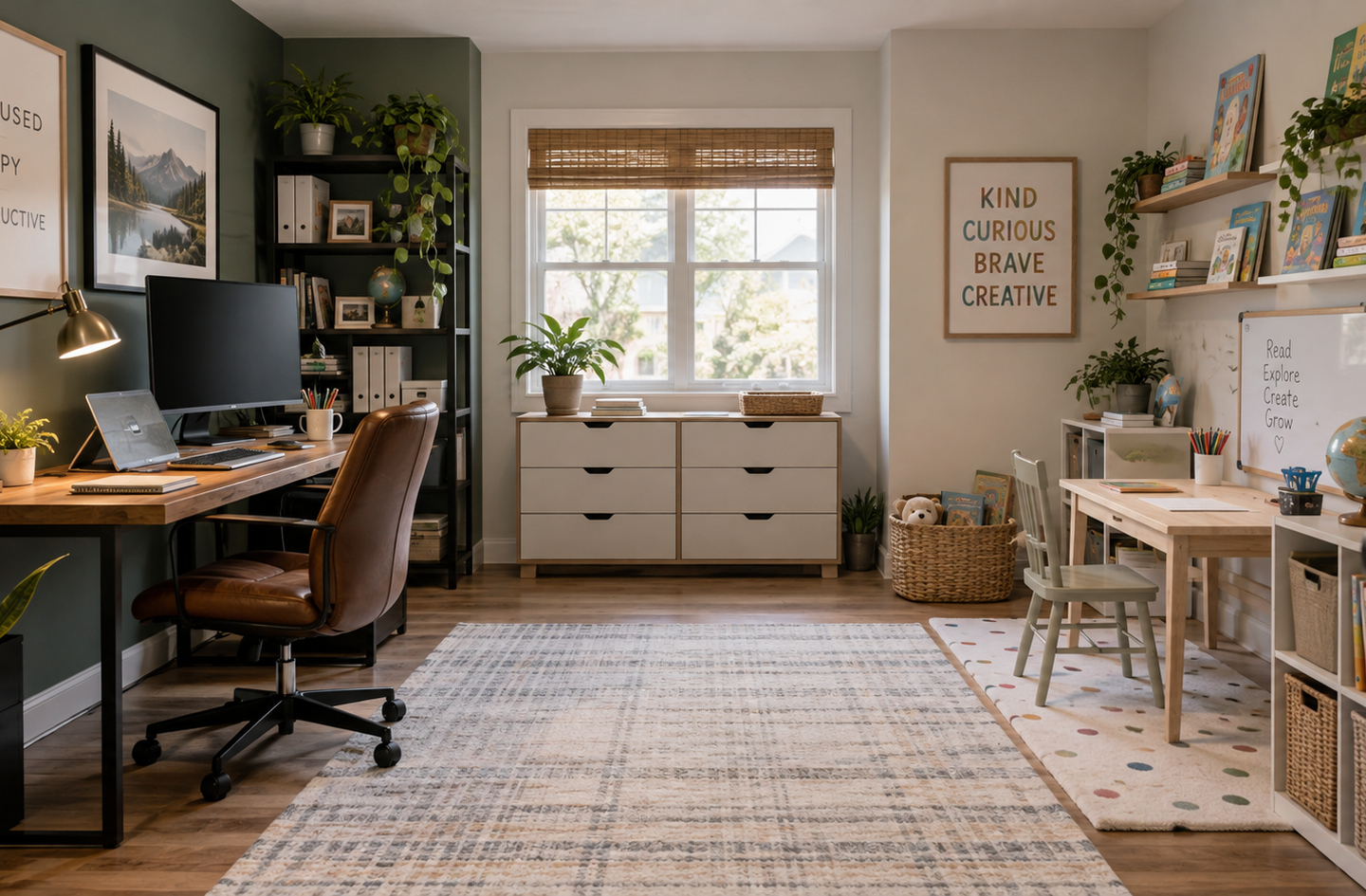
The step is complete when the footprint is taped, the path stays clear and anyone in the family can say where the corner starts.
Choose the lowest boundary that still reads as an edge, because a rug or low shelf marks the zone without blocking the adult’s line of sight.
Step 3: Size the Work Surface and Seat to the Child
Step 3 fits the surface and chair to the child, so the child works without perching or hunching. For public buildings, the ADA Standards permit accessible work surfaces for children with tops at 26 inches minimum and 30 inches maximum2. The same section allows knee clearance of 24 inches minimum under them2.
Knee clearance is the open height under a work surface where a seated person’s knees and thighs fit without touching the underside. That range is written for accessible surfaces a child using a wheelchair can pull up to, so it does not size a desk for a child on an ordinary chair. The child’s own fit decides the final height.
- Set the seat first: the child’s feet should rest flat on the floor, or on a sturdy footrest when the seat is raised.
- Check the surface: with shoulders relaxed, the forearms should rest near the desk top while writing.
- Check the legs: the thighs should clear the underside of the desk with room to shift position.
A wall-mounted or fold-down desk saves floor space, but a licensed installer should check the wall, the fixings and the load. Our homework station planning guide covers the desk-or-table decision and chair fit in more detail.
The step is done when the child can write for ten minutes without sliding forward or lifting the shoulders, and the fit gets a recheck each school year. If a child slumps, tires quickly or reports pain while writing, a pediatric occupational therapist can assess seating for that child.
Fit the chair before the desk, because a chair and footrest are cheap to change and let one surface serve a growing child for several years.
Step 4: Put the Day’s Supplies Within Reach, and Fewer of Them
Step 4 places daily supplies within reach of the chair and keeps the total small. Accessibility guidance for public buildings lists reach ranges for building elements designed mainly for children. They run 20 to 36 inches at ages 3 and 4, 18 to 40 at ages 5 to 8, and 16 to 44 at ages 9 to 122.
A reach range is the band of heights above the floor that a person can reach, forward or to the side. These bands come from Advisory 308.1 of the ADA Standards, which is guidance rather than a requirement2. They still give a starting band: daily supplies inside it, spares above it.
Fewer materials can also lengthen play with each item. In a study of 36 toddlers, four toys led to longer play with each toy, and more varied play, than sixteen did4.
“This suggests that when provided with fewer toys in the environment, toddlers engage in longer periods of play with a single toy, allowing better focus to explore and play more creatively.”
Carly Dauch, Alexia E. Metz and colleagues, Occupational Therapy Doctoral Program, The University of Toledo, in Infant Behavior and Development, 20184
That study watched toddlers at free play, not school-age children at work. It is a reason to test a smaller set of materials, not proof that one number suits every child.
What belongs in the learning corner?
Keep only the daily kit: pencils, an eraser, a sharpener, markers, paper, the current book and any charger. One labeled spot per item turns the end-of-session check into a glance, because an empty spot shows what is missing.
What belongs somewhere else?
Refills, finished work, projects and other children’s materials belong in a closet bin or an adult-managed cabinet. Our homeschool storage system guide covers back-stock, overflow rules and larger book collections.
The step is done when the child can finish a session without leaving the chair, and every item in the corner appeared in the week’s log.
Stock the corner for one day of work, not one term, because every extra item is one more thing to move before work starts and to return afterward.
Steps 2 to 4 add up to one footprint, drawn here from above. Each zone carries a figure cited in its step: surface height, reach and path width from the Access Board2, and the display result from the lab study3.
Step 5: Keep the Wall the Child Faces Calm
Step 5 limits what hangs on the wall in the child’s line of sight while working. In a Carnegie Mellon University lab study of 24 kindergartners, children scored 55% correct after lessons in a sparse classroom and 42% in a decorated one3. Time spent off task was 38.6% in the decorated room and 28.4% in the sparse room3.
“Therefore, I would suggest that instead of removing all decorations, teachers should consider whether some of their visual displays may be distracting to young children.”
Anna V. Fisher, lead author and associate professor of psychology, Carnegie Mellon University3
The advice is to edit displays, not strip them. The study ran six science lessons in lab classrooms3, so it is a signal about young children’s attention, not a rule for every wall.
How do you sort the walls around a corner?
Sort them by where the child looks: the facing wall carries one board with the current week’s work and nothing else. The side wall holds storage, ideally closed bins, so the contents do not compete with the page. Artwork, maps and posters go behind the child.
What goes on the one board?
Keep the board to the work in hand: a session checklist, a calendar if the child uses one, and one or two pieces of current work. Move finished work into a folder each week.
The step is complete when the seated child sees the board, the page and a plain wall.
Edit the wall the child faces and leave the rest of the room alone, because the corner needs calm in one direction, not a bare house.
Step 6: Light the Page and Manage Screens and Sound
Step 6 lights the work without glare and keeps screens and noise from pulling the child away. Glare is bright light that reflects off a screen or glossy page, or shines straight into the eyes, and makes the work harder to see. The American Academy of Ophthalmology advises avoiding screens outside or in brightly lit areas, where glare on the screen can create strain6.
- Turn the desk so the window is to one side: a window behind the screen or behind the child can create glare.
- Add a shaded task lamp: place it opposite the writing hand, so the hand does not shadow the page.
- Set the screen position: the AAO suggests keeping the computer or desk at arm’s length and at a slight downward angle from the child’s face6.
- Build in look-up breaks: the same guidance suggests pre-marking books with a paperclip every few chapters, as a reminder to look up6.
Sound needs the same care, because a corner shares the room’s noise. Reverberation is sound that persists in a room after its source stops, because it keeps reflecting off hard surfaces. The noise review reports that studies linked indoor noise and reverberation in classrooms with poorer performance in verbal tasks5.
At home, a rug, a curtain and a filled bookshelf all soften hard surfaces. Keeping the television off during work time deals with the louder source.
The step is complete when the page is evenly lit, nothing reflects in the screen, and the child can hear a quiet instruction from the adult’s usual spot.
Fix glare with placement before buying a brighter lamp, because turning the desk a quarter turn costs nothing and can remove the reflection at its source.
Step 7: Anchor the Furniture and Plan the Daily Reset
Step 7 secures anything that could tip, then adds a short routine that returns the corner to its ready state. An estimated 560,203 children under 18 were treated in U.S. emergency departments for furniture or TV tip-over injuries from 1990 to 20197. That is an average of 18,673 children a year, and children under 6 accounted for 69.9% of the injuries7.
Anchor every shelf, bookcase and drawer unit in the corner to the wall, even a low one, and keep heavy items on the lowest shelves. Plaster, brick, uneven walls and any wall-mounted desk call for a licensed installer.
A reset is the short, fixed sequence of actions that returns a space to its starting layout at the end of each session. Five moves cover most corners:
- File the work: finished pages go into the school bag first.
- Return the kit: each supply goes back to its labeled spot.
- Clear the surface: books, scraps and plates leave the desk.
- Park the screen: the device goes to its agreed charging spot, which may be outside the bedroom.
- Check the empty spots: anything missing goes on the shopping list now.
Put the five moves on a card at the corner, with pictures for a pre-reader. With a younger child, the adult does the reset alongside at first, then hands over one move at a time. Where the corner must clear completely each evening, our portable learning system guide covers caddies and carts that pack away.
Design for the reset, not just the reveal: the corner that keeps working is the one a child can restore in a few minutes without help.
Learning Corner Ideas by Room and Age
Learning corner ideas change with the room and the age of the child. The same five parts apply everywhere: a chosen spot, a visible edge, a fitted surface, a small kit and a reset. What changes is which part needs the most attention.
| Corner location | Works well for | Boundary idea | Watch for |
|---|---|---|---|
| Living room corner | Children who need an adult nearby | A rug plus a low shelf with its back to the room | The television sightline and its sound |
| Bedroom corner | Older children who work alone | A desk facing a side wall, on a small rug | Screens near the bed at night |
| Landing or under-stair space | One child who prefers a quiet spot | A block of wall color | Dim light and the stair path |
| Window corner | Reading and paper work | A rug under the desk and chair | Screen glare, so keep the window to one side |
| Closet nook with the doors removed | One child who likes an enclosed spot | The closet frame itself | Light, airflow and a reachable outlet |
| Fold-down wall desk | Rooms with no floor to spare | The open desk marks the zone | An installer check of the wall and fixings |
| Shared sibling room | Two children of different ages | One corner each, with separate bins | Two surface heights in one room |
Preschool learning corner, about ages 3 to 5
A preschool corner works best at a low table, with trays that hold one activity each and picture labels on every bin. Every item’s labeled spot should sit within the child’s reach without a step stool, and the corner belongs in the room where the adult already is.
Early school learning corner, about ages 6 to 8
An early school corner adds a small desk, a chair with a footrest and one board for the week. As homework starts, the kit grows to include a ruler, a sharpener and a folder for papers.
Learning corner for older kids, about ages 9 to 12
An older child’s corner needs a deeper surface for a laptop beside a notebook, closed storage and a clear rule about where devices charge. The child can run the whole reset.
Plan for the child’s next two years, because a surface and storage that adjust with a footrest or a moved shelf avoid a second purchase.
Common Mistakes When Setting Up a Kids Learning Corner
Most learning corner mistakes come from buying first and placing second, and each is cheaper to prevent with tape on the floor than to fix later.
Buying the desk before choosing the corner
A desk bought for its looks lands wherever it fits, which is rarely where the child works or the adult can help. The fix is to run the log, choose the corner, then buy the surface.
Leaving a shelf unanchored because it is low
A low shelf is easy to climb, and a child leaning on an open drawer shifts its balance. The fix is to anchor every storage unit in the corner, whatever its height.
Fix placement and edges before buying more organizers, because most learning corner problems are layout problems that no bin will solve.
What a Working Learning Corner at Home Looks Like
A working learning corner at home is ready when the child arrives, fits the child’s body and resets in minutes. The checks are simple to observe over one school week:
- The child starts work without clearing the desk or hunting for a pencil.
- Feet rest flat on the floor or a footrest, and the forearms rest near the desk top while writing.
- The wall straight ahead shows one board and little else.
- The five-move reset happens after each session, and the desk top is clear by bedtime.
The stretch goal is to let the child run the corner. Playroom Architect uses a phrase associated with the Reggio Emilia approach to early education, the Third Teacher. It means the room itself supports independence, focus and routine alongside the adults. A corner the child can set up, use and reset alone has reached that point.
Frequently Asked Questions
What is a learning corner for kids?
A learning corner is a defined part of a shared room set up for one child’s reading, writing or screen work, with its own surface, light and supplies. It suits school children too: in 2019, K-8 students who did homework outside school averaged 4.6 hours a week on it1.
How much space does a learning corner need?
A learning corner needs room for the surface, the chair pulled back and a clear route past it. For public buildings, the U.S. Access Board sets walking paths at 36 inches of clear width minimum2. Use it to check that the corner leaves the route open.
What desk height works for a kids learning corner?
For public buildings, the ADA Standards permit accessible children’s work surfaces at 26 to 30 inches2, a range written for wheelchair access. At home, fit the child instead: feet flat on the floor or a footrest, and forearms resting near the desk top.
Should a learning corner have decorations on the wall?
Keep the wall the child faces light. In a lab study of 24 kindergartners, children scored 55% correct after lessons in a sparse classroom against 42% in a decorated one3. Keep one board for current work in front and artwork elsewhere.
Where should a learning corner go in the house?
A learning corner should go where help already happens, away from the television. In 2019, parents of 29.5% of K-8 students who did homework helped three or four days a week1. A child who gets help most days needs a corner within an adult’s sight, and an older child who works alone can use a bedroom.
Limitations and Edge Cases
- The Access Board figures apply to accessible features in public buildings, and Advisory 308.1 is guidance rather than a requirement2. Neither sets a standard for a home corner or for a specific child.
- The display study used lab classrooms and kindergartners3, and the toy study watched toddlers4. The noise review notes that reported effects are usually small5.
- The NCES homework figures exclude homeschooled students1, so a homeschool corner may carry more daily work than these averages suggest.
- A child with ongoing trouble focusing, eye strain or pain needs a pediatrician, a pediatric ophthalmologist or a pediatric occupational therapist, not a new corner.
References
Methodology: every figure comes from an independent published source, and each link was checked live on October 11, 2026. The plan view, wall sort and reset routine are planning syntheses built on those sources by the article’s author.
- National Center for Education Statistics – Digest of Education Statistics, Table 227.40, homework time and parent involvement, 2007, 2012, 2016 and 2019, prepared April 2021.
- U.S. Access Board – ADA Accessibility Standards, sections 307.2, 403.5.1 and 902.4 and Advisory 308.1 on children’s reach ranges.
- Association for Psychological Science – Heavily Decorated Classrooms Disrupt Attention and Learning in Young Children, on Fisher, Godwin and Seltman in Psychological Science, May 27, 2014.
- PubMed – Dauch C, Imwalle M, Ocasio B, Metz AE. The influence of the number of toys in the environment on toddlers’ play. Infant Behavior and Development, February 2018.
- PubMed – Klatte M, Bergstrom K, Lachmann T. Does noise affect learning? A short review on noise effects on cognitive performance in children. Frontiers in Psychology, August 2013.
- American Academy of Ophthalmology – Screen Use for Kids, Eye Health Tips and Prevention.
- PubMed – Lu C, Badeti J, Mehan TJ, Zhu M, Smith GA. Furniture and television tip-over injuries to children treated in United States emergency departments. Injury Epidemiology, August 2021.
Conclusion
A learning corner for kids works when it follows the child’s real routine. Help and quiet choose the spot, a rug or low shelf marks the edge, and the child’s body sets the height. A calm facing wall, a one-day kit and a five-move reset keep it ready. The room as a system, not the desk alone, decides whether the corner gets used.
For how one corner fits the wider plan for learning areas at home, see the overview in the homeschool learning zones guide.