
A reading nook is a small, defined zone where a child can sit, reach books and read in good light, away from the pull of active play. It works when four things line up: placement, seating, book access and light. That setup matters because the reading habit fades with age. In 2023, only 14% of U.S. 13-year-olds said they read for fun almost every day1. This guide is for parents planning a nook in a bedroom, playroom, living room or found space. It covers the whole topic in short and points to deeper guides on each part.
Quick Answer
What is a reading nook for children?
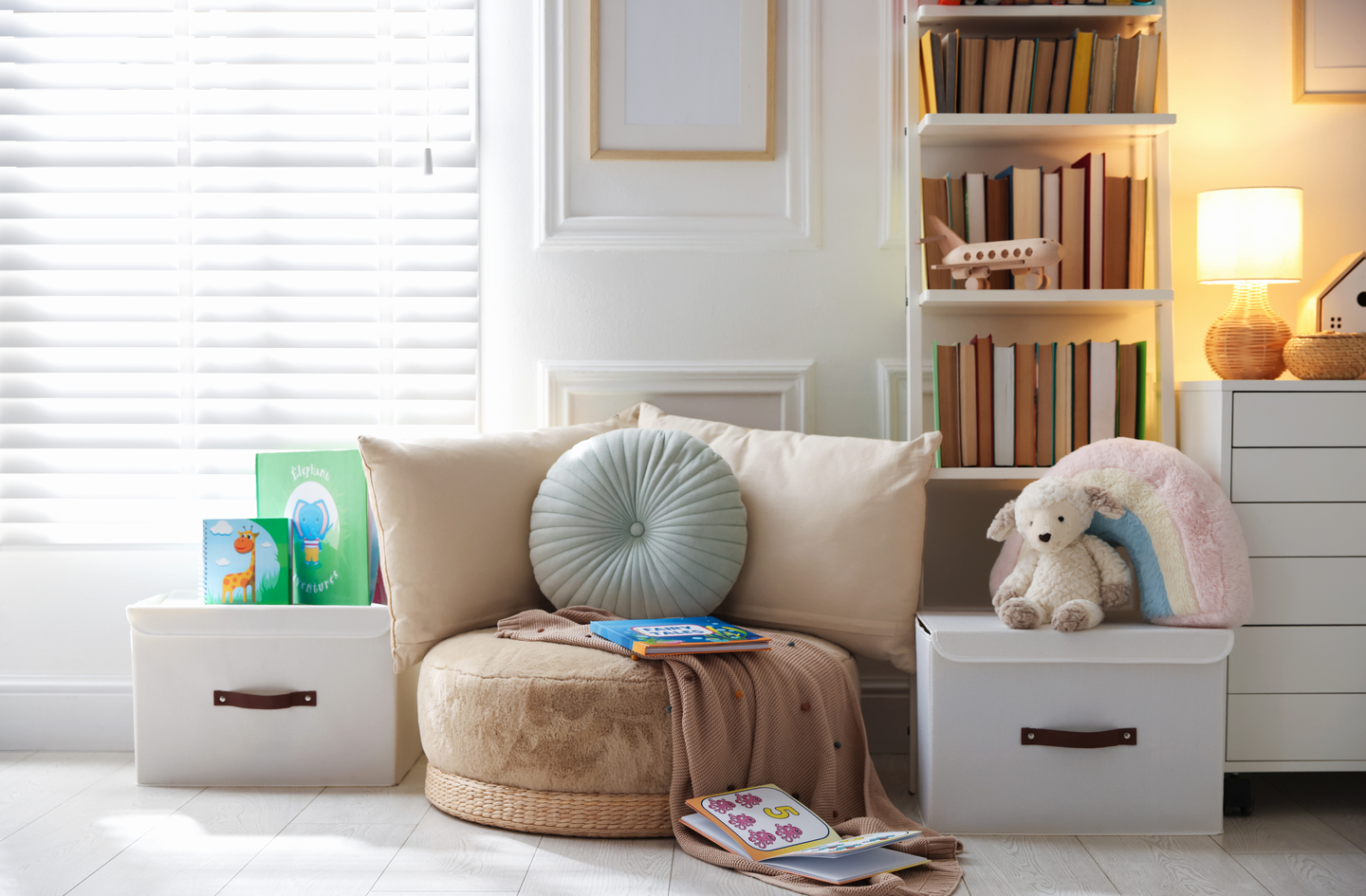
A children’s reading nook is a defined quiet zone with four parts. It needs seating that fits the child, books they can see and reach, focused light, and a clear edge that keeps it apart from active play. Placement comes first and furniture second. Any bookcase in the nook gets anchored, since tip-overs sent an average of 18,673 U.S. children a year to emergency rooms2.
Why it matters:
A nook that is easy to reach and fast to reset gets used every day. One built as a photo backdrop tends to become storage.
Key Takeaways
- Choose the spot before the furniture: quiet, visible from where adults spend time, and out of the main walking path.
- Children under 6 accounted for 69.9% of furniture and TV tip-over injuries in a 30-year study, so shelves near a nook are anchored to the wall2.
- Front-facing book display at child height does more for daily use than a large spine-out collection.
- Window nooks need cordless shades: blind cords were involved in 98.9% of entanglement injuries in young children4.
- The most common mistake is designing for the reveal photo instead of the daily reset.
Reading Nooks in 30 Seconds
| If you are… | Do this |
|---|---|
| Planning a nook for a toddler | Floor cushion, low front-facing ledge, clear adult sightline |
| Short on floor space | Wall ledge plus one floor cushion in a corner, nothing else |
| Sharing a living room | Portable basket of books, one lamp, a rug that marks the zone |
| Converting a closet or under-stairs space | Check headroom, airflow and visibility before adding anything |
| Planning for a tween | Supportive chair, stronger task lamp, higher-capacity shelving |
What Is a Reading Nook for Kids?
A reading nook is a small, bounded zone set up for one job: sitting down with a book. It has a defined floor area, a seat sized for the child, books within reach and light good enough to read by. The nook can be a corner, a window bay, a closet, the space under a loft bed or a basket-and-cushion spot in a shared room.
The scope is narrower than a library and broader than a chair. A reading nook includes the seat, the book display, the light, the boundary and the reset routine that keeps it usable. It does not include whole-room toy storage, homework desks or screen stations. Those zones share the room, and a good plan keeps them from leaking into the nook.
Reading nooks sit inside a wider idea of the room as a system. A quiet zone is any part of a room where the layout lowers noise, movement and visual clutter so a child can settle. A reading nook is usually the simplest quiet zone to add. It works best when planned alongside circulation, active play and storage, not bolted on after the furniture arrives.
Why Reading Nooks Matter
Reading nooks matter because access shapes habit. A book a child can see and reach gets picked up, while one behind a cabinet door mostly does not. The national data shows how fragile the habit is. In 2023, 13-year-olds who read for fun almost every day averaged a NAEP reading score of 275, higher than peers who read less often1.
The American Academy of Pediatrics frames shared reading as a foundation for development, not a bonus activity:
Reading together often with infants and young children strengthens their relationships with parents and caregivers at a critical time in child development, stimulating brain circuitry and early attachment.
The AAP recommends shared reading beginning at birth and continuing at least through kindergarten3. A nook gives that routine a fixed place.
Three gaps keep most nooks from working:
- The nook is placed for looks, so it sits in a busy path or next to loud play.
- The books are stored, not displayed, so the child has nothing to choose from.
- The setup takes too long to reset, so it drifts into overflow storage.
Each of these is a layout problem with a layout fix, so solving them does not require a bigger room or a bigger budget.
The Six-Layer Reading Nook Framework
The Six-Layer Reading Nook Framework breaks the topic into the six decisions every nook depends on. The layers were grouped from the 25 planning questions this cluster answers into the smallest set that still covers them all. Work through the layers in order: where, what space, what seat, which books, what light and safety, and how it grows.
Layer 1: Placement and Quiet Zones
Placement decides whether the nook gets used. A sightline is the direct line of view from where an adult usually sits or works to where the child reads. The best spot keeps that line open, sits outside the main walking path and puts some distance between books and loud play. Natural light helps, but a window spot needs cord-free shades and no climbable seat under an opening sash. Bedrooms, playroom corners and living rooms each follow different rules. A bedroom nook must stay distinct from sleep, while a living room nook must reset fast enough to share the room.
A plain corner with a clear sightline will outperform a styled window seat that sits in the busiest path in the house.
Deeper read: where to put a kids’ reading nook.
Deeper read: corner reading nook ideas for kids.
Deeper read: bedroom reading nook ideas for kids.
Deeper read: living room reading nook ideas for kids.
Deeper read: playroom reading corner ideas.
Deeper read: window reading nook ideas for kids.
Layer 2: Found Spaces
Closets, under-stairs pockets, attic slopes, basement corners and the floor under a loft bed can all hold a nook. Each one gets the same five checks before anything is bought: usable headroom, entry width, airflow, light and adult visibility. Basements add cold hard floors and moisture, while attics add heat and low ceilings. A loft bed adds the maker’s required clearances, which should never be traded for cushion space. Removable setups suit these spaces best, and any wall, ceiling, insulation or electrical change belongs with a licensed contractor or electrician.
A found space earns its place only when an adult can see in and a child can get out without help.
Deeper read: closet reading nook ideas for kids.
Deeper read: under-stairs reading nook ideas.
Deeper read: attic reading nook ideas for kids.
Deeper read: basement reading nook ideas for kids.
Deeper read: a reading nook under a loft bed.
Layer 3: Seating, Size and Build
Size the nook around the real seat, not a number from a photo. Entry clearance is the open floor a child needs to step in, sit down and get back out without climbing over furniture. Measure the seat footprint, add entry clearance, then check that the room’s walking path survives. Floor cushions and beanbags suit small spaces and young children, while chairs, benches and daybeds give more support but take more floor. Built-in benches fit the room exactly yet are hard to undo. A DIY plan starts with no-build moves and leaves wall or structural work to a contractor.
If the seat cannot be measured into the room with clearance to spare, the nook is too big for the space, not the space too small for a nook.
Deeper read: kids’ reading nook size and dimensions.
Deeper read: reading nook furniture for kids.
Deeper read: small-space reading nook ideas for kids.
Deeper read: built-in reading nook ideas for kids.
Deeper read: DIY reading nook ideas for kids.
Layer 4: Book Access, Display and Rotation
Books are the point of the nook, so their access gets planned, not left over. Front-facing display is shelving that shows book covers instead of spines, which lets a pre-reader choose by picture. Ledges, low bookcases and baskets at child height keep choices in reach, but display space is limited, so most of the collection lives elsewhere. Book rotation is the routine of swapping a small visible set for stored titles on a regular cycle. Spine-out storage becomes practical once a child reads titles, and any freestanding bookcase gets anchored to the wall.
A short shelf of covers a child can reach beats a full bookcase of spines they cannot read yet.
Deeper read: reading nook shelves for kids.
Deeper read: kids’ reading nook with storage.
Deeper read: how to rotate books in a kids’ reading nook.
Layer 5: Light, Boundaries and Safety
Light, enclosure and safety are one layer because each choice affects the others. A task lamp aimed at the page covers evenings and dark corners, and its cord is routed along the wall, never across the entry. Canopies and curtains define the nook but can make it dark or hard to supervise, and ceiling mounts need a sound fixing point checked by a qualified installer. Window cords are the sharpest risk near a nook, since blind injuries sent an estimated 16,827 U.S. children under 6 to emergency departments from 1990 to 20154. Decor comes last: washable textiles and calm colors.
Every enclosure or decor layer should pass one test: the nook stays bright, visible and easy to leave.
Deeper read: reading nook lighting for kids.
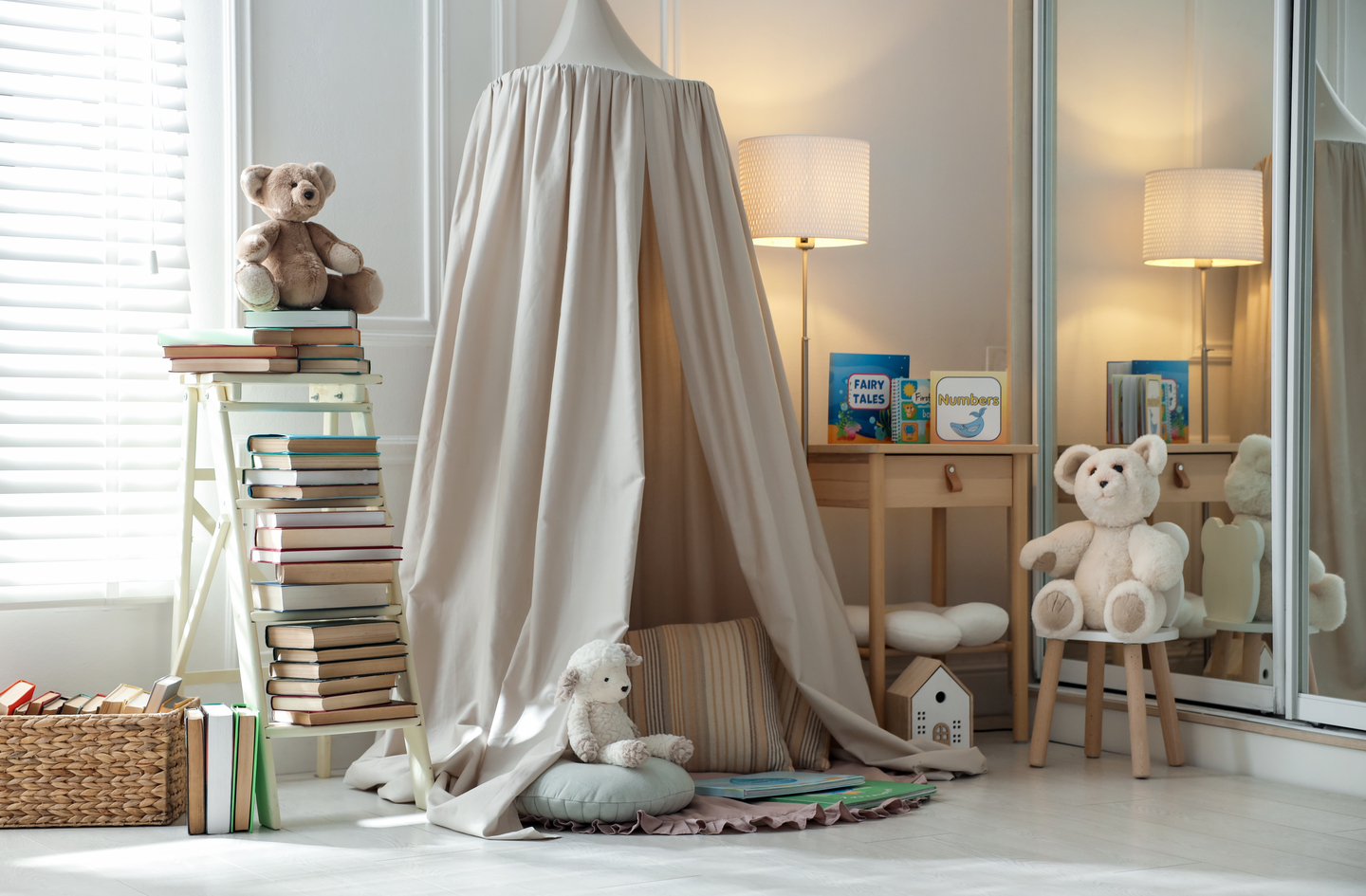
Deeper read: reading nook canopy ideas for kids.
Deeper read: reading nook decor ideas for kids.
Deeper read: a kids’ reading nook safety checklist.
Layer 6: Age and Growth
A nook that fits a toddler will not fit a ten-year-old unchanged. Toddler nooks rely on floor seating, board books at floor level and a parent who can see the whole zone. Older children need a supportive seat, stronger task light, more shelf capacity and a device-aware boundary. The American Academy of Ophthalmology notes people blink about 15 times a minute normally, but only 5 to 7 times a minute on screens5. Keeping the nook print-first gives eyes and attention a different mode. Styling should age down quietly, with fewer themes and more function.
Plan the toddler nook so the seat and light can be swapped later while the location and shelving stay.
Deeper read: toddler reading nook ideas.
Deeper read: reading nook ideas for older kids.
How to Choose the Right Reading Nook Setup
The location decides more than any product, so the choice starts with the room, not a shopping list. A circulation path is the route people use to cross a room, and a nook that blocks one gets walked through, bumped and abandoned. Observation before shopping keeps that from happening.
- Watch the room for a few days. Note where people walk, where noise peaks and where an adult usually sits. Those patterns point to the best place for a kids’ reading nook.
- Mark the floor area. Tape out the seat footprint plus entry clearance, then check that the walking path still works with the tape down.
- Match the seat to the child. A toddler needs a low, soft seat they can get onto alone. An older child needs back support for longer sessions.
- Plan the books before the shelf. Decide how many titles stay visible, then choose a ledge, basket or low bookcase that holds that set at child height.
- Add light and check power. Find the nearest outlet and the cord route. If none is close, a rechargeable lamp avoids a cord across the floor.
- Test the reset. A child should be able to put the nook back in order without help; if the reset needs an adult, simplify the setup.
Watch for four red flags. A nook should not block a door or closet, and a canopy should not hide the child from view. Shelves should be anchored, and a window seat should never offer a climb toward an open sash.
Compare All Reading Nook Locations
| Criteria | Room corner | Window area | Closet or under-stairs | Shared living room | Under a loft bed |
|---|---|---|---|---|---|
| Floor needed | Seat plus entry clearance | Seat plus path to the window | Fixed by the opening | Small, portable footprint | Fixed by the bed frame |
| Light | Lamp needed | Daylight plus evening lamp | Lamp always needed | Room light plus lamp | Lamp always needed |
| Supervision | Easy | Easy | Harder; door often removed | Easiest | Moderate |
| Main risk to plan for | Unanchored shelves | Cords and window access | Airflow and headroom | Trip hazards in a busy path | Bed clearances and headroom |
| Reset effort | Low | Low | Low once built | Must be fast | Low |
| Best fit | Most homes | Rooms with safe, cord-free windows | Kids who like a hideaway | Families without a spare room | Small shared bedrooms |
Choose a room corner if: the room has one quiet corner outside the walking path.
Choose a window area if: the window has cordless shades and the seat cannot be used to climb.
Choose a closet or under-stairs space if: the opening is wide enough for an adult to see in and help out.
Choose a shared living room if: the family wants reading close to where adults spend evenings.
Choose the space under a loft bed if: the bed maker’s clearances allow it and floor space is tight.
Deeper read: making an empty corner work as a reading nook.
Common Reading Nook Mistakes
Mistake 1: Buying Furniture Before Choosing the Spot
Why it is a mistake: A chair or daybed bought first forces the nook into whatever space it fits. That space is often a walking path or the corner nearest the loudest play, so the furniture looks right while the nook goes unused.
What to do instead: Pick the location using traffic, noise and sightlines. Tape out the footprint. Then choose seating that fits the taped area with entry clearance to spare. Layout first, products second.
Read more: sizing a kids’ reading nook.
Mistake 2: Storing Books Instead of Displaying Them
Why it is a mistake: A tall bookcase packed spine-out holds a lot but shows nothing to a child who cannot read titles. Picking a book becomes a chore, so the child stops picking, and overfull shelves also make the daily reset slower.
What to do instead: Keep a small set of books face-out at child height. Store the rest in a closed bin or another room and swap titles on a simple cycle. Let the child choose some of the swaps.
Read more: front-facing reading nook shelves.
Mistake 3: Skipping Anchors and Cord Checks
Why it is a mistake: A nook invites climbing, leaning and pulling, and a 30-year study counted an estimated 560,203 U.S. children treated in emergency departments for furniture or TV tip-overs2. In window blind entanglements among young children, 67.1% of investigated incidents ended in death4.
What to do instead: Anchor every freestanding shelf, route lamp cords along the wall and replace corded blinds near the nook. Ask a licensed installer about any ceiling or wall mount.
Read more: the reading nook safety checklist.
Mistake 4: Designing for the Reveal, Not the Reset
Why it is a mistake: Layers of pillows, garlands and themed props look finished on day one, but each item adds a step to the reset and pushes the nook toward clutter. Under the Playroom Architect review methodology, reset steps are counted the same way storage capacity is.
What to do instead: Limit the nook to the seat, the books, the light and one soft layer. Design for the reset, not just the reveal.
Read more: rotating books without clutter.
Best Reading Nook Setup by Use Case
Best for Toddlers
Toddler nooks work best at floor level. A firm floor cushion or low seat lets a toddler get in and out alone, and board books sit face-out on a low ledge or in a shallow basket. The zone stays open on at least one side so a parent can see it from the main room. Skip enclosures that hide the child and props that add reset steps. Plan the location and shelving to last into the preschool years, while the seat and books change with the child.
Deeper read: toddler reading nook planning.
Best for Small Spaces
Small rooms and apartments need the minimum working set: one seat, one book display, one light. A wall-mounted ledge saves floor area, and a floor cushion stores flat against a wall when the room needs the space back. Vertical space helps only where shelves are anchored and still reachable from the floor. A narrow bench with book storage underneath can double as seating for the room. If the nook starts to crowd the walking path, remove a layer rather than squeezing in a smaller version of every item.
Deeper read: small-space reading nook layouts.
Best for Shared Living Rooms
A living room nook shares space with adults, guests and screens, so its edges and its reset matter most. A rug or low basket marks the zone without walls, and the books live in one portable basket that can be lifted out of the way. A single lamp gives the corner its own light in the evening. Placing the nook within view of the sofa keeps supervision easy and makes reading part of family time. The reset target is simple: books in the basket, cushion against the wall.
Deeper read: a living room reading zone that resets easily.
Best for Older Kids and Tweens
Older readers stay longer, so comfort and light carry more weight. A chair or lounger with back support suits chapter books better than a floor cushion, and a stronger task lamp aimed at the page reduces evening strain. Shelving shifts to spine-out storage with more capacity as the collection grows. A clear rule about devices, such as charging elsewhere, keeps the nook a print-first zone. Styling can become simpler and less themed, which helps a tween feel the space is still theirs.
Deeper read: reading nooks that grow with older kids.
Frequently Asked Questions
How much space does a children’s reading nook need?
A children’s reading nook needs the seat footprint plus enough open floor to step in, sit down and get out, while the room’s walking path stays clear. There is no single correct size. A floor cushion against a wall can work in a tiny room, while a chair or bench needs more depth. Tape the outline on the floor and live with it for a few days before buying anything.
Should a children’s reading nook go by a window?
A window gives good daylight, but it suits a reading nook only when the shades are cordless and no seat lets a child climb toward an opening sash. Window blind injuries sent an estimated 16,827 U.S. children under 6 to emergency departments from 1990 to 20154. Plan a task lamp as well, since daylight fades by evening and direct sun can put glare on the page.
At what age should a child get a reading nook?
A reading nook can start in infancy as a floor cushion and a basket of board books. The American Academy of Pediatrics recommends shared reading from birth and at least through kindergarten3. The nook then grows with the child. The habit gets fragile later: only 14% of U.S. 13-year-olds read for fun almost every day in 20231. Updating the seat and light keeps the nook relevant.
Do bookshelves in a children’s reading nook need to be anchored?
Yes, any freestanding bookcase, cubby or dresser near a reading nook should be anchored to the wall, because children climb and pull on shelves to reach books. In a 30-year national study, children under 6 accounted for 69.9% of furniture and TV tip-over injuries2. Use the maker’s anchor kit and a stud or suitable wall fixing. For plaster, brick or uncertain walls, ask a licensed installer.
How This Guide Was Built
The methodology behind this guide maps the 25 planning questions in this reading-nook cluster against primary sources. Figures come from national education statistics, peer-reviewed injury research indexed in PubMed and medical society guidance, and each links to the page that carries it. The Six-Layer Framework was derived by grouping every question into the fewest decisions that still cover them all. Oded Feigin, founder of Playroom Architect, reviewed the guide on October 1, 2026, and it is rechecked when a cited source changes.
What This Hub Does Not Cover
- Whole-room toy storage and toy rotation systems belong to Playroom Architect’s storage and rotation planning topics, not this reading-nook hub.
- Structural or electrical changes, such as removing a closet wall, adding an outlet or insulating an attic, need a licensed contractor, electrician or structural engineer.
- Reading difficulties or developmental concerns for a specific child belong with a pediatrician or a pediatric occupational therapist.
References
- NAEP, National Center for Education Statistics – Long-Term Trend Reading and Mathematics Highlights, 13-year-olds, 2023
- Lu et al., Injury Epidemiology (2021) – Furniture and television tip-over injuries to children treated in United States emergency departments
- American Academy of Pediatrics, Pediatrics (2024) – Literacy Promotion: An Essential Component of Primary Care Pediatric Practice, Policy Statement
- Onders et al., Pediatrics (2018) – Pediatric Injuries Related to Window Blinds, Shades, and Cords
- American Academy of Ophthalmology – Computers, Digital Devices and Eye Strain
Next Read
A reading nook works when placement, seating, book access, light and safety are planned as one system, in that order, with furniture and decor added last. The room as a system, not the room as a photo, is what keeps a nook in daily use.
Start with the most common setting: plan a book-first bedroom reading nook.