
Sensory play spaces ask more of a home than most play zones, because water, sand, dough and loose fillers move, spill and sometimes end up in mouths. This guide is for parents who want hands-on sensory play without a daily cleanup battle or a supervision gap. It covers age fit, materials, containers, zones and the reset routine, and it routes each part to a deeper guide. Supervision runs through all of it: toddlers and preschoolers are out of view of a supervisor for about 20 percent of their awake time at home1.
Quick Answer
What are sensory play spaces?
A sensory play space is a defined spot at home, such as a bin, tray, table or corner, where children explore texture, sound and light with real materials. It works as a system: a material matched to age, a container that limits spills, an adult within reach and a fast reset. For children under age 3, loose pieces are judged against a small parts cylinder with a 31.7 mm diameter opening1.
Why it matters:
Most sensory materials are made to be poured, squeezed and scattered, so the space around them decides whether play stays contained and supervised. Planning that space first turns a stressful activity into one a family can repeat.
Key Takeaways
- The federal toy rule for water beads took effect on March 12, 2026, yet water bead products not marketed as children’s toys fall outside it1.
- Children aged under 5 years account for nearly a quarter of all drowning deaths, according to WHO, so a water bin is never independent play2.
- In a study of 36 toddlers, a room with four toys led to longer periods of play with a single toy than a room with sixteen3.
- The most common misconception is that a “taste-safe” label settles the question; edible ingredients still carry choking, allergy and hygiene concerns.
Sensory Play Spaces in 30 Seconds
| If you are… | Do this |
|---|---|
| Planning for a child around age 1 who still mouths objects | Skip loose-filler bins; offer large single-piece textures with an adult sitting beside the child |
| Setting up for a two-year-old | Use a shallow tray, one scooping task and a material you can sweep or wipe in minutes |
| Short on floor space | Put a lidded bin or tray on a table you already own instead of buying a dedicated sensory table |
| Supervising siblings of different ages | Run two separate trays and keep small parts on the older child’s side, off the floor |
| Working with a child who dislikes messy textures | Offer tools, dry textures and watching first, with a clear way to opt out |
| Planning water play | Fill a shallow amount near a sink, stay within arm’s reach and empty it the moment play ends |
What Sensory Play Spaces Are and What They Include
The difference between a sensory activity and a sensory play space is permanence: the space is a planned, repeatable setup with a home, a container and a reset routine.
Sensory play is hands-on exploration in which children touch, pour, squeeze, listen to or watch materials to learn how they behave. It is ordinary play, not therapy, and the setups in this guide make no developmental or treatment claims.
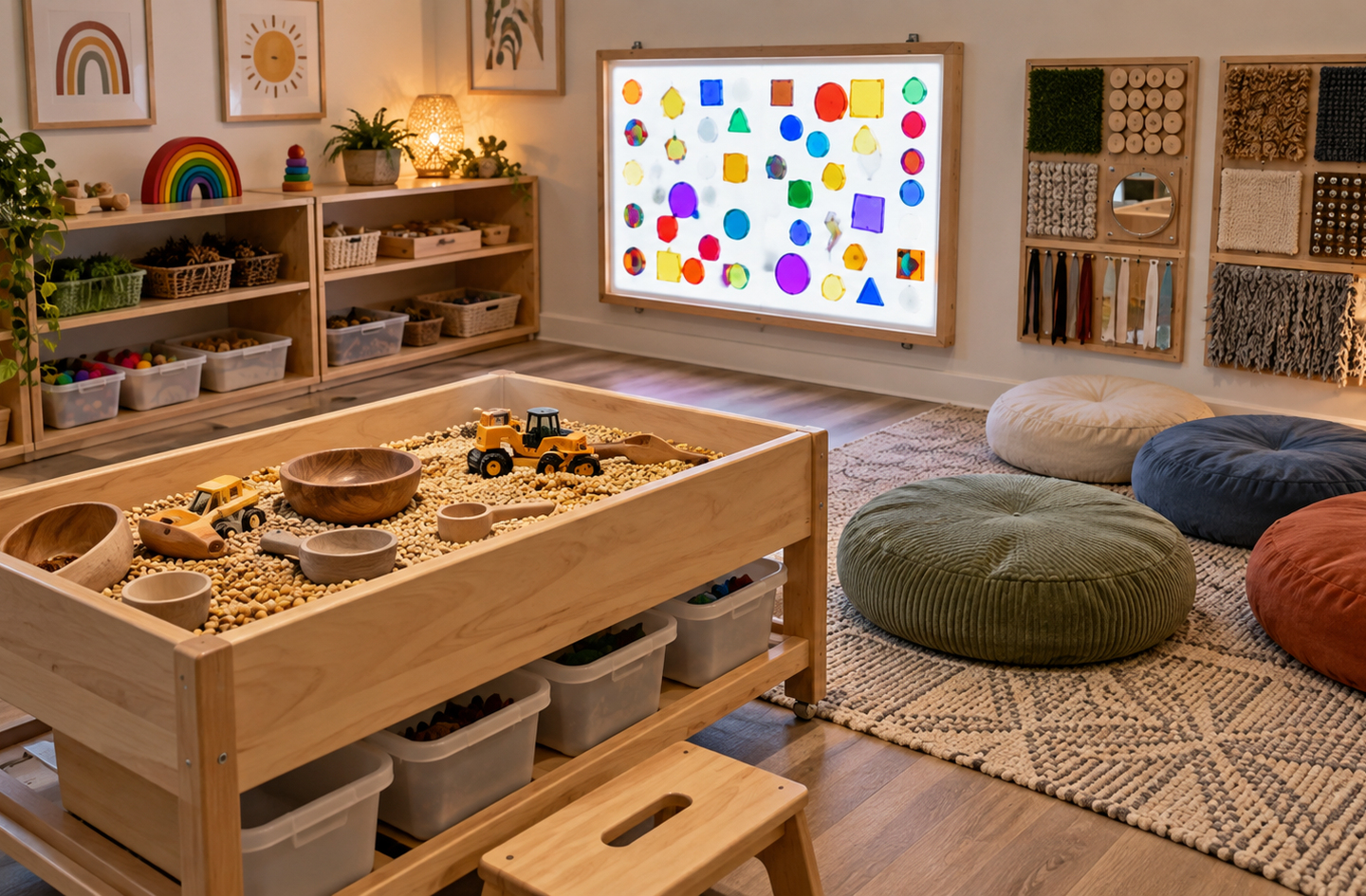
A sensory bin is a lidded or open container that holds one filler, such as dry pasta, sand, water or fabric scraps, plus a few tools for scooping and pouring. A sensory tray is its shallow cousin, and a sensory table raises the container to a fixed standing or seated height.
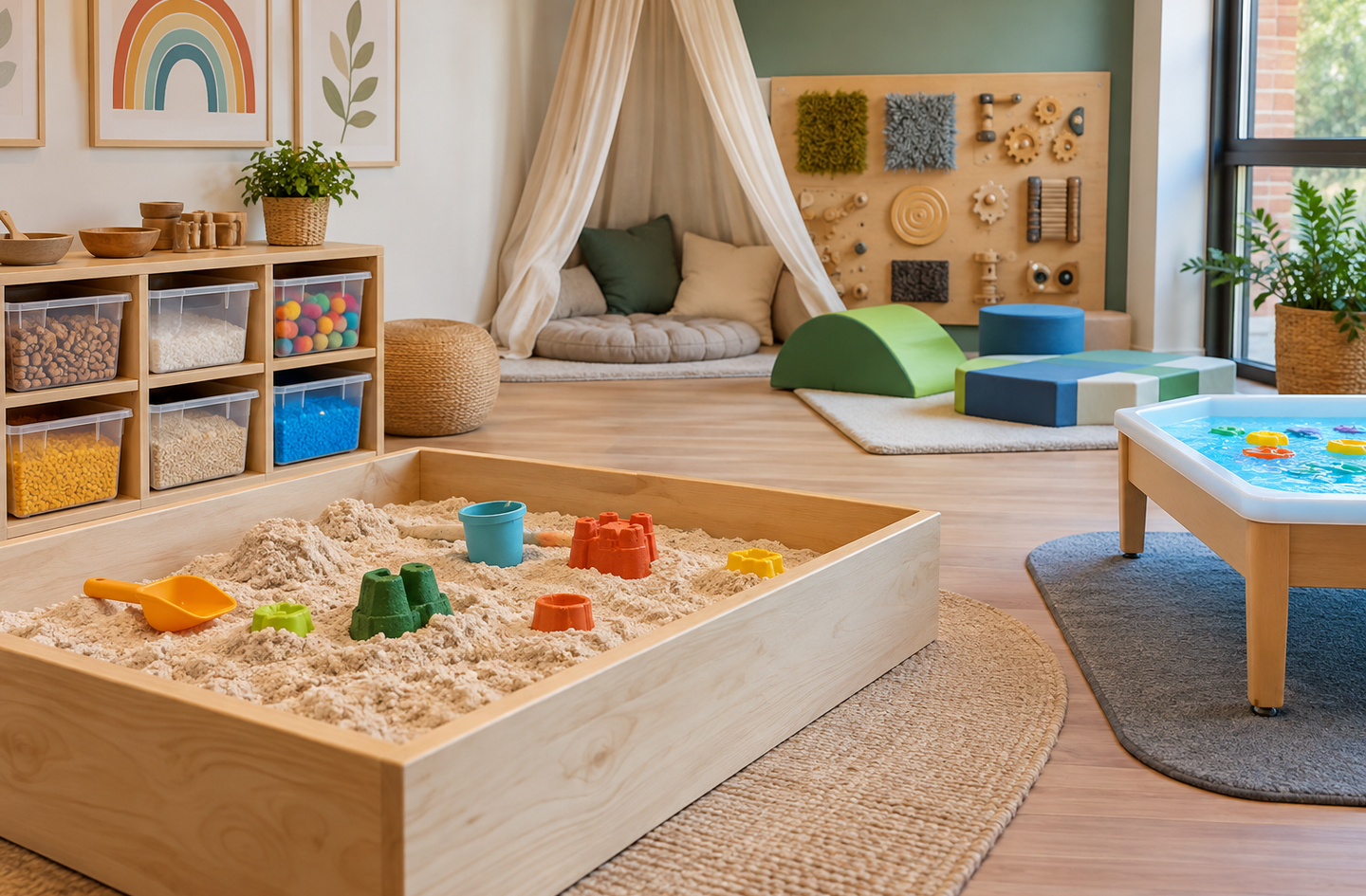
The scope runs from tabletop trays and bins to fixed tables, light tables, tactile wall panels and small sensory corners. It also covers the media that fill them: water, sand, oobleck, playdough, slime, sealed sensory bottles and seasonal fillers. Product rankings, recipe development and therapy plans sit outside it.
Loose fillers are small, pourable materials such as rice, beans or pebbles that fill a bin. They create most of the mess and most of the screening work, because each piece can scatter, be mouthed or be pushed into a nose or ear. That is why filler choice gets its own screening step before any theme or color scheme.
Each setup is also part of the room as a system. Where it sits, who supervises it and how fast it resets matter as much as what goes inside, and those three questions shape every section that follows.
Why Sensory Play Spaces Need Planning, Not Just Ideas
Sensory materials fail in predictable ways, and most failures come from the space around the material rather than the material itself. A bin on a carpet far from a sink, with no lid and no adult seat beside it, turns a short activity into a long cleanup.
The CPSC states the supervision point directly in its craft guidance:
Children need regular and consistent reminders of safety rules, and there is no substitute for direct supervision.
The U.S. Consumer Product Safety Commission publishes that line in its Art and Craft Safety Guide4.
Three friction points show up again and again in home sensory play:
- Supervision gaps: an adult across the room cannot stop a mouthed piece, a tipped bin or a child climbing into a water tub.
- Spills and wet floors: water, oobleck and slime travel farther than parents expect, and a wet hard floor becomes a slip point.
- Material drift: fillers migrate into rugs, vents and toy bins, where a younger sibling can find them later.
Water raises the stakes most. WHO notes that the risk of drowning increases when children interact with water outside of active adult supervision2. A shallow bin is not a pool, but the same rule applies whenever water sits within a young child’s reach.
Planning the space first is what turns sensory play from an occasional event into a routine. Structural reasoning first, decor inspiration second: the theme can change every month, while the container, the zone and the reset stay the same.
How Sensory Play Spaces Work: The Six-Part Contained Sensory Station Framework
The Contained Sensory Station Framework splits the topic into six parts: age fit, material screening, media stations, containers, zones and the reset. It was derived by grouping every planned guide in this cluster by the decision it answers, then ordering the parts the way a parent meets them.
Sensory Play by Age and Stage
Age decides the material before anything else, because mouthing behavior sets the risk. A child around age 1 explores with hands and mouth, so the setup is large single pieces with an adult beside the child, not a bin of loose filler. Two-year-olds can manage a shallow tray and one repeatable scooping task, while preschoolers can sort, compare and pour with more pieces. Children who avoid wet or sticky textures do better with tools, dry textures and the choice to watch. A pediatric occupational therapist is the right person for a specific child’s sensory concerns.
Pick the setup for the youngest child who can reach it, not the oldest child it was planned for.
Deeper read: Sensory Play for 1-Year-Olds.
Deeper read: Sensory Play for 2-Year-Olds.
Deeper read: Sensory Bin Ideas for Preschoolers.
Deeper read: Sensory Play for Mixed-Age Siblings.
Deeper read: Sensory Play for Kids Who Dislike Messy Textures.
Sensory Bin Fillers and Material Screening
A small parts cylinder is a test gauge that simulates the throat size of a young child. Regulators use it to determine what objects or pieces a child can potentially choke on1. Water beads add a second hazard: as expanding materials, they can cause gastrointestinal tract blockage if a child ingests them1. A “taste-safe” label speaks to ingredients only. It says nothing about choking, allergies or how long a material has sat out.
Treat filler choice as a pass or fail screen for the youngest child present, and leave water beads out of home sensory bins entirely.
Deeper read: Sensory Play Safety Tips.
Deeper read: Are Water Beads Safe for Sensory Play.
Deeper read: Sensory Bin Filler Ideas.
Deeper read: Taste-Safe Sensory Play Ideas.
Water, Sand, Dough and Light Stations
Each sensory medium has its own failure mode, so each needs its own station plan. Water spills and pools, sand drifts and dusts, oobleck and slime stick to surfaces, and playdough dries out or carries food allergens. Light tables add cords and warm surfaces to the list. The CPSC’s craft guidance gives the shared rule for all of them: give only small amounts to minimize spills and mishaps4.
Choose the medium by how far it travels when it spills, then size the station to contain that distance.
Deeper read: Water Sensory Bin Ideas for Indoor Play Without Uncontrolled Spills.
Deeper read: Sand Sensory Play Ideas.
Deeper read: Oobleck Sensory Play.
Deeper read: Playdough Sensory Play.
Deeper read: Slime Sensory Play.
Deeper read: Sensory Bottle Ideas for Toddlers.
Deeper read: Light Table Sensory Play Ideas.
Sensory Table vs. Bin vs. Tray: Containers and Tools
The container sets the mess boundary, the reach and the setup time. A tray suits short, small-quantity tasks, a lidded bin moves between rooms and stores closed, and a fixed table holds more material but takes permanent floor space. For wheelchair access in public buildings, the U.S. Access Board permits children’s work surfaces with tops 26 inches minimum and 30 inches maximum above the floor5. Tools follow the container: a few scoops, cups and funnels sized to the hand and checked for parts that twist off.
Start with a tray or lidded bin on furniture you already own, and buy a dedicated table only after the routine proves itself.
Deeper read: Sensory Table vs. Sensory Bin.
Deeper read: How to Make a Sensory Bin.
Deeper read: Sensory Play Tray Ideas for Small, Quick-Reset Activities.
Deeper read: Sensory Bin Table Guide.
Deeper read: Sensory Play Toys for Toddlers.
Deeper read: Low-Mess Sensory Play Ideas for Real Homes.
Deeper read: Accessible Sensory Table Setup.
Sensory Corners, Walls and Storage Zones
A sensory zone is the floor area the activity actually uses, including the spill ring, the adult’s seat and the path to the sink. In a small home that zone can be a bedroom or living-room corner with a washable mat and a clear sightline from where the adult sits. Wall panels and five senses stations add sight, sound and touch without loose filler, but mounted parts need secure attachment. Everyday scoops can sit on an open shelf at the child’s height. The CPSC’s rule to store surplus materials away from children4 carries over to sealed fillers.
Draw the zone on the floor before buying anything, and let the sightline from the adult’s seat decide where it goes.
Deeper read: Sensory Play Corner Ideas for Small Homes.
Deeper read: Sensory Wall Ideas for Kids.
Deeper read: Five Senses Sensory Station.
Deeper read: Sensory Play Storage Ideas for Fillers, Tools and Reusable Setups.
Cleanup, Rotation and Seasonal Bins
The reset is the part of sensory play most likely to end it, so it is planned before the first bin is filled. Wet, dry and sticky materials each need their own cleanup sequence, and anything washed must dry fully before it goes back in a lidded bin. EPA’s mold guidance, written for water-damaged areas and items, says to dry them within 24-48 hours to prevent mold growth6. Rotation keeps interest without clutter, and seasonal or holiday bins work best as a new theme on the same reusable base.
A bin that cannot be reset in the time you actually have will not be offered often, so size the material to the cleanup, not the photo.
Deeper read: Sensory Play Cleanup.
Deeper read: Sensory Bin Rotation Ideas.
Deeper read: Sensory Bin Ideas That Work at Home.
Deeper read: Fall Sensory Bin Ideas.
Deeper read: Winter Sensory Bin Ideas.
Deeper read: Christmas Sensory Bin Ideas That Are Reusable, Contained and Age-Aware.
Deeper read: Holiday Sensory Bin Ideas for Halloween, Easter and Valentine’s Day.
How to Choose a Sensory Play Setup for Your Home
The single most important criterion is the youngest child who can reach the activity, because that child sets the material rules for everyone. After that, the choice follows a fixed order, and observation before shopping applies here as much as anywhere in the playroom.
- Name the youngest child: note whether that child still mouths objects, and rule out loose fillers and small tool parts if the answer is yes.
- Pick the medium by spill distance: start with dry and lidded materials, move to sand and dough, and add water, oobleck and slime once the zone is ready.
- Choose the container: a tray for short tasks, a lidded bin for portability, and a table only for daily use with floor space to spare.
- Place the zone: near a sink for wet play, on a washable floor or mat, with the adult’s seat at arm’s reach and a clear path around it.
- Plan the reset and storage: decide where the material dries, where it is stored sealed and how long cleanup takes before the first session.
Red flags include a filler within a younger sibling’s reach, standing water after play, tools with twist-off parts and an open bin on the floor. Each one points back to a step that was skipped, so the fix is to return to that step rather than to buy a new product.
Mixed-age homes add one more rule: one bin does not need to fit all siblings. Parallel trays with separate materials let each child play at their own stage without the youngest inheriting the oldest child’s small parts.
Sensory Play Safety Standards Cross-Walk
A standards cross-walk is a table that maps what a named rule or guidance document says onto a different setting, here a home sensory station. None of the sources below was written for home sensory play, so the right-hand column is a planning inference, not a standard.
| What the source states | Source and its setting | What it means for a home sensory station |
|---|---|---|
| The ASTM F963 small parts cylinder has a 31.7 mm diameter opening1 | CPSC water bead rule, toys | Screen every filler piece and tool part before it goes into a bin for a child under age 3 |
| The water bead toy rule is effective on March 12, 2026, and non-toy water bead products are outside its scope1 | CPSC water bead rule, toys | A compliant toy does not cover craft-store or decor beads; leave water beads out of bins |
| Toddlers and preschoolers are out of view of a supervisor for about 20 percent of their awake time at home1 | CPSC water bead rule, home supervision research | Offer water and small-part activities only when an adult can stay beside the child |
| Children aged under 5 years account for nearly a quarter of all drowning deaths2 | WHO, global drowning data | Fill water bins shallow and empty them the moment play ends |
| Give only small amounts to minimize spills and mishaps, and keep food and drinks out of the art area4 | CPSC, art and craft materials | Portion dough, slime and fillers, and keep snacks at a separate table |
| Accessible children’s work surfaces have tops 26 inches minimum and 30 inches maximum above the floor5 | U.S. Access Board, public buildings | A reference height to compare when a seated child needs table access |
| Dry water-damaged areas and items within 24-48 hours to prevent mold growth6 | EPA, water-damaged homes | Dry washed fabric fillers, sponges and tools fully before sealed storage |
Read the table from left to right. The left column is what each source actually says. The middle column names whose setting it was written for, and the right column is the home planning step drawn from it. Where a source covers public buildings or water-damaged homes, its figure is a reference point, not a requirement for a playroom.
When to call a professional: for a child with feeding, swallowing or sensory-processing concerns, ask a pediatrician or a pediatric occupational therapist before choosing materials. For a wall-mounted panel or a heavy table in a specific room, ask a licensed contractor or installer.
Common Sensory Play Space Mistakes
Mistake 1: Treating a Water Bin as Independent Play
Why it is a mistake: Children aged under 5 years account for nearly a quarter of all drowning deaths worldwide2. A shallow bin feels harmless, yet a child can tip forward into it or carry water onto a hard floor in seconds.
What to do instead: Fill only a few inches of water, set the bin near a sink on a towel or mat, and stay seated within arm’s reach. Empty and tip the bin upside down the moment play ends.
Read more: Water Sensory Bin Ideas for Indoor Play Without Uncontrolled Spills.
Mistake 2: Choosing Fillers for the Oldest Child
Why it is a mistake: A bin planned for a preschooler is still within reach of a crawling or toddling sibling. Toddlers and preschoolers spend about 20 percent of their awake time at home out of view of a supervisor1, which is enough time for one mouthed piece.
What to do instead: Screen the filler for the youngest child who can reach it. When ages differ, run separate trays and keep small parts on a raised surface on the older child’s side.
Read more: Sensory Bin Filler Ideas.
Mistake 3: Trusting the Taste-Safe Label
Why it is a mistake: Edible ingredients still form lumps and crumbs a young child can choke on, and flour, grains or dairy matter for a child with food allergies. Food left out in a bin also spoils.
What to do instead: Treat taste-safe recipes as a backup for mouthing, not as permission to stop supervising, and wash hands after using materials4. Discard edible fillers after each session.
Read more: Taste-Safe Sensory Play Ideas.
Mistake 4: Buying a New Themed Bin Every Season
Why it is a mistake: More options do not mean deeper play. In a study of 36 toddlers, four toys led to longer periods of play with a single toy than sixteen did3, and every extra bin adds storage and reset work.
What to do instead: Keep two or three reusable bases, swap tools and themes between them, and dry and seal each one before it goes back on the shelf.
Read more: Sensory Bin Rotation Ideas.
Frequently Asked Questions
What age can children start sensory play?
Children can start simple sensory play in their first year, but the setup changes with age. Around age 1, play means large single pieces, fabric and sound objects with an adult beside the child, because mouthing is expected. Loose fillers wait until mouthing stops. For children under age 3, regulators use a small parts cylinder with a 31.7 mm diameter opening to judge choking risk1. Preschoolers can usually handle sorting and pouring with more pieces.
What do you put in a sensory bin?
A sensory bin holds one filler and a few tools. Common fillers include dry pasta, oats, sand, fabric scraps and water; common tools include scoops, cups, funnels and tongs. The right filler depends on the youngest child present and on how far the material travels when it spills. Start with a small portion, since the CPSC advises giving only small amounts to minimize spills and mishaps4, and add more only when play calls for it.
Should water beads be used in sensory bins?
Water beads are best left out of home sensory bins. CPSC notes that water bead ingestion, nasal and ear insertion, choking and aspiration can occur in seconds1. A federal toy rule now covers water bead toys, but some water bead products are not marketed as children’s toys and fall outside its scope1. Wet sponges, large fabric pieces or a shallow tray of water offer squeezing and pouring without expanding beads, under the same close supervision.
How do you keep sensory play from getting messy?
Containment starts before the bin opens. Put a tray or lidded bin on a washable surface, lay a mat that extends past the container’s edge, and portion the material instead of filling the bin. Dry, lidded and fabric activities spill least, while water, oobleck and slime spill most. End every session with the same reset sequence and dry wet items within 24-48 hours6, so cleanup becomes routine rather than a negotiation.
How often should you change a sensory bin?
Change a sensory bin when children stop returning to it, not on a fixed calendar. Research on toddlers supports fewer choices at once: with four toys instead of sixteen, the 36 toddlers studied played longer with a single toy3. A workable rotation keeps two or three reusable bases, swaps tools or themes between them, and dries and seals each base before it goes into storage.
How This Guide Was Built
The methodology behind this guide is documentary. Figures come from federal regulators (CPSC, the Access Board and EPA), the World Health Organization and one peer-reviewed study. Each figure links to the page that carries it. The six-part framework was derived by grouping this cluster’s planned guides by the decision each one answers. The cross-walk maps each cited rule onto a home setting. Playroom Architect editors hold editorial responsibility; the guidance is engineering-informed education, not a safety certification.
References
- Federal Register, U.S. Consumer Product Safety Commission – Safety Standard for Toys: Requirements for Water Beads, final rule, December 12, 2025
- World Health Organization (WHO) – Drowning fact sheet, May 1, 2026
- PubMed, National Library of Medicine – Dauch C, Imwalle M, Ocasio B, Metz AE. The influence of the number of toys in the environment on toddlers’ play. Infant Behavior and Development, 2018. DOI: 10.1016/j.infbeh.2017.11.005
- U.S. Consumer Product Safety Commission (CPSC) – Art and Craft Safety Guide, publication 5015
- U.S. Access Board – ADA Accessibility Standards, Advisory 308.1 and section 902.4.2
- U.S. Environmental Protection Agency (EPA) – A Brief Guide to Mold, Moisture and Your Home
Next Read
Sensory play spaces work when the material, the container, the zone and the reset are planned together, and when the youngest child present sets the rules. Design for the reset, not just the reveal, and start with the screening step before any theme.