
Most homeschool families face the same friction: curriculum stacked on every flat surface, back-stock mixed in with current materials, and a setup routine that eats into the first lesson. Good homeschool storage ideas solve this by separating what a child reaches for daily from what a parent manages monthly. This guide builds that system step by step, from a material audit to back-stock overflow rules. For a broader look at how storage fits into every learning zone, see the Homeschool Learning Zones overview. An estimated 3.408 million U.S. children were homeschooled in the 2024-2025 school year,1 and nearly every family accumulates more curriculum than it expects.
Quick Answer
What are the best homeschool storage ideas for books, supplies, and back-stock?
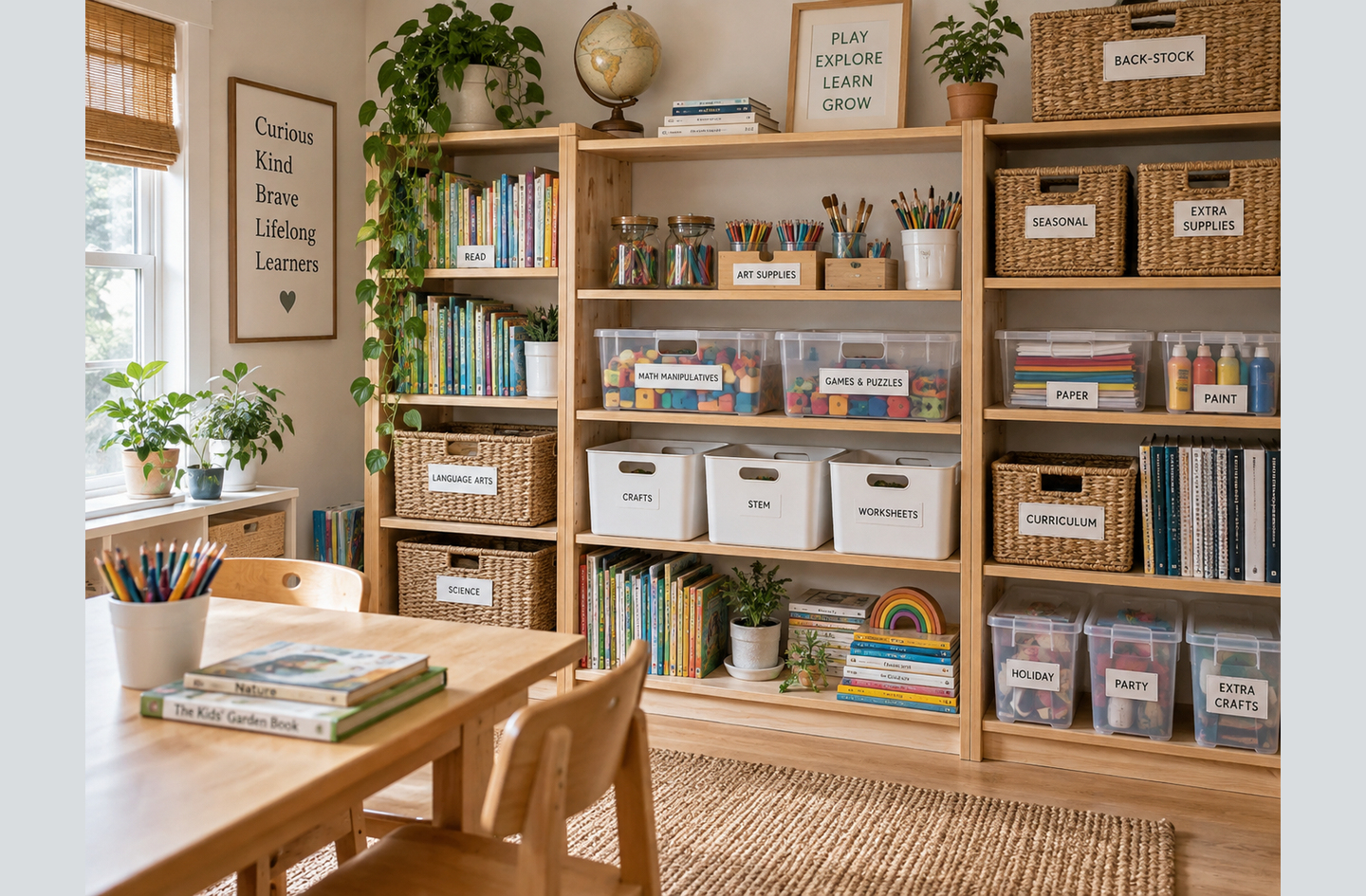
The most effective system divides materials into three zones: a child-accessible area (shelf height 12-48 inches) for daily curriculum, a parent-managed cabinet for reference books and weekly materials, and a separate back-stock area for surplus and archived work. A rolling cart handles active projects. The key is that each zone has a single clear function, so the daily reset takes minutes, not a search session.
Key Takeaways
- Mixing daily curriculum with back-stock on the same shelves is the most common reason homeschool storage breaks down within a semester.
- Child-accessible storage should sit between 12 and 48 inches from the floor so children can retrieve and return materials without adult help.
- Kindergarteners in a sparse, organized space spent 28.4% of time off-task, versus 38.6% in a cluttered room (Fisher, Godwin & Seltman, 2014).5
- A rolling cart solves the active-project problem: it keeps in-progress work together and moves without claiming permanent shelf space.
- Every item that enters back-stock needs a use-by decision: no unit goes in without a date or a condition for when it comes back out.
What You’ll Need Before You Begin
This system works in a dedicated room, a shared living space, or a portable homeschool setup. Before moving a single shelf, gather the following:
- A two-hour block to complete the material audit without interruption. Partial audits tend to stall permanently.
- A large surface (dining table or cleared floor) for sorting materials into five labeled piles at the same time.
- Sticky notes or a labeler for marking zones and containers from the first day of use.
- A tape measure for confirming shelf heights against the child’s actual reach range.
- A phone or camera to photograph the sorted piles before putting anything back.
- Estimated time: 2 hours for the audit; 1-2 hours for the initial zone setup.
- Difficulty: Beginner. The system works from category decisions, not from specialized containers.
Do not buy storage containers before completing Step 1. The audit tells you what you actually need: how many bins, in what sizes, for which categories. Buying first is the most common cause of storage that doesn’t fit the actual material volume.
Step 1: Map Your Materials Before You Choose Storage
By the end of this step, you’ll have a photographed inventory of everything you own, sorted into five categories by how often you actually use it.
Most homeschool storage failures are category failures. Workbooks and surplus supplies end up on the same shelf because no one decided in advance what “daily,” “weekly,” and “stored” mean in the house. The room as a system needs that decision made before the shelves fill up, not after.
How to run the audit
Bring every homeschool item into one room. Sort into five labeled piles: (1) current-unit workbooks and textbooks, (2) reference books (dictionaries, atlases, library books on loan, subject readers not in the active unit), (3) manipulatives and hands-on tools (math tiles, fraction bars, measuring tools, science kits), (4) art and project supplies (paper, paints, scissors, glue, project boards, dried-out items to discard), and (5) everything else.
Back-stock is the collection of unstarted curriculum sets, replacement consumables, and surplus supplies a family keeps on hand for future use. It is not a junk pile. It has a specific job: to stay out of the way until it is needed. Pile five is entirely back-stock.
Photograph each pile before putting anything away. The photograph is your reference for how much storage space each category actually requires. For families with more than one school year behind them, back-stock is almost always the largest pile by volume, even when families believe they have very little stored.
What to check for in the audit
Look for three specific category errors: reference books mixed in with active workbooks, manipulatives scattered across two or three rooms, and art supplies sharing the same shelf as daily curriculum. Each of these category errors will cause any storage system to degrade within weeks. Containers don’t cause storage failure. Categories do.
Families managing more than one child’s curriculum simultaneously should assign each child a separate “active pile” during the audit. Multi-child homes are where the daily-use zone and the back-stock zone get blurred most often, because one child’s current materials overlap with another child’s archived ones.
After the audit, you have the information you need to choose containers and assign zones. Not before.
Step 2: Build the Child-Accessible Zone First
By the end of this step, you’ll have a clearly bounded set of shelves, bins, and drawers where a child can independently retrieve and return daily materials, no adult assistance required.
The most consequential decision in homeschool storage is what a child accesses without help and what lives in parent-managed space. A child who cannot find or return their own workbook won’t use the system. A parent who becomes the retrieval system for pencils, manipulatives, and workbooks every morning will exhaust the routine within weeks.
Setting the height range
Child-accessible storage refers to shelves, bins, and drawers positioned between 12 and 48 inches from the floor, within an independent child’s reach zone without adult help or climbing. For children under age 7, treat 36 inches as the practical upper limit. For ages 7 to 12, the full 48-inch range applies.
Store the heaviest items (stacks of textbooks, completed-work binders) at the lower end of the zone, between 12 and 30 inches, where a child can lift them close to the ground. Light items (individual workbooks, folders, small manipulative bins) can sit anywhere in the accessible zone. This distribution reduces the risk of dropping heavy materials from height.
Why the visual organization of this zone affects learning
A 2014 Carnegie Mellon University study placed kindergarten students in two classroom conditions, sparse and heavily decorated, across six science lessons. In the decorated room, children spent 38.6% of their time off-task. In the sparse room, that figure dropped to 28.4%.5 Test accuracy followed the same pattern: 42% correct in the cluttered condition versus 55% in the organized one.
“Young children spend a lot of time, usually the whole day, in the same classroom, and we have shown that a classroom’s visual environment can affect how much children learn.”
Anna V. Fisher, Lead Researcher, Carnegie Mellon University5
The implication for the child-accessible zone is direct. A zone holding only the current week’s materials creates a sparse visual environment, the condition that produced the higher accuracy scores. Limiting the zone is not just a storage decision. It is a learning environment decision. With homeschool families averaging roughly $600 per student annually on curriculum,2 a well-organized zone makes the investment more effective.
For homes where the child-accessible zone shares wall space with adult-managed shelving, the article on small-space homeschool rooms covers how to use visual dividers and shelf labels to keep the two zones distinct on the same wall unit.
Step 3: Set Up the Daily Curriculum Station
By the end of this step, you’ll have a single, visually bounded section of the child-accessible zone that holds only this week’s active curriculum, nothing else.
The daily curriculum station is the engine of the storage system. When it is clear and stocked correctly, starting the school day takes about 30 seconds. When it holds two months of materials from three concurrent units, the first ten minutes go to a search session instead of a lesson.
Defining the station’s scope
The daily curriculum station is the specific shelf section, tray, or open drawer that holds only the current school week’s active materials, kept at the child’s reach height and refreshed at the end of each week. The station holds one active unit’s workbooks, one current reader, and the manipulatives in use this week. Nothing else lives there permanently.
Choose one shelf section or a two-tier shelf area that the child can see clearly from their seated position. A labeled divider, a small bin, or even a bookend at the station boundary marks where it ends and adjacent shelving begins. The physical boundary is what prevents the station from absorbing nearby materials over time. Without it, the station expands and loses function within two weeks.
Running the weekly rotation
At the end of each school week, run a 5-minute rotation: move completed work to a finished-unit binder or a back-stock shelf, confirm next week’s materials are correctly loaded into the station, and remove anything that doesn’t belong in the current lesson set. This rotation is the one maintenance step the whole system depends on.
For multi-child households, each child gets a clearly labeled section of the station, a separate bin color, or a dedicated small shelf. The station principle stays the same across all configurations: only current-week active materials occupy the space. One child’s curriculum doesn’t spread into another child’s section.
When a unit takes longer than one week to finish, the station still refreshes on Friday. Archive the finished pages in a binder, confirm the correct workbook pages are in place for the coming week, and return anything that belongs in reference or back-stock to its zone.
Step 4: Use Vertical Space for Books and Reference Materials
By the end of this step, you’ll have a shelving plan for reference books and curriculum sets that keeps them findable without occupying the child-accessible zone below 48 inches.
Books accumulate faster than shelf space in most homeschool homes. The wall above 48 inches is the most consistently underused storage area in a learning space, and it is specifically suited for materials a parent manages, not materials a child retrieves daily.
The case for systematic storage has grown with the number of families who homeschool. An estimated 3.408 million U.S. children were homeschooled in 2024-2025,1 and Pew Research Center data from early 2025 confirms 3.4% of K-12 students were homeschooled in 2022-2023.3 A homeschool family managing two or three grade levels simultaneously maintains a library that grows each year, which is why vertical storage planning becomes a standard household need rather than an optional upgrade.
How to assign the vertical zone
Assign all reference books (dictionaries, readers not in the active unit, subject texts between units) to shelves between 48 and 72 inches. This is the adult-managed zone. Items used weekly sit at the lower end of the zone (48-60 inches). Items used monthly or occasionally belong at the upper end (60-72 inches).
Group reference books by subject, not by height or size. A “math reference” section labeled and bounded with bookends is faster to scan than a height-sorted row. When a book moves out of the active unit into reference, it goes back to its subject group.
Labeling and dividers
Label every section on the vertical shelving. Labels should match the categories from the Step 1 audit: “Math Reference,” “Science Reference,” “History,” “Readers,” “Archived Work.” A shelf without labels is a shelf that will hold random items within a month, because the absence of a label is an implicit invitation.
Add bookends or shelf dividers between subjects. A row without boundaries collapses and wastes time during retrieval. Even a piece of foam or a small bin as a section marker is enough to hold the visual boundary.
For families without a dedicated room, a tall freestanding bookshelf placed against a hallway wall or living-room corner can serve as the vertical storage column. The portable homeschool learning guide covers how to manage vertical storage in shared spaces where the bookshelf must pull double duty for both curriculum and general household items.
Step 5: Add a Rolling Cart for Active Projects and Supplies
By the end of this step, you’ll have a dedicated mobile zone for in-progress project materials and art or craft supplies that don’t belong on a fixed shelf.
Fixed shelving solves most homeschool storage problems, but it cannot solve one specific problem: where to put something that is not finished. An in-progress science experiment, a half-assembled timeline poster, or a multi-day art project needs temporary, accessible storage. A fixed shelf used for in-progress work becomes a clutter zone within days, because “temporary” materials rarely leave on their own.
Choosing the right cart
A rolling cart is a wheeled, multi-tier storage unit that keeps active project materials together and can move between rooms without occupying permanent shelf space. A three-tier cart in a standard classroom size (roughly 17 by 13 inches per tier) holds a surprising amount without requiring floor space beyond its own footprint.
Assign each tier a clear category: the top tier for in-progress project materials or the current week’s art supplies, the middle tier for printed reference sheets and resource pages for the active unit, and the bottom tier for spare consumables (extra paper, pencils, erasers, tape). This three-tier structure covers most of what homeschool families need to keep at hand without shelving it.
Setting the cart’s routine
Park the cart next to the main work surface during the school day. Move it to a corner or hallway at the end of the day. The cart’s mobility is its main advantage, but it means the cart needs a designated parking spot. Choose a location that doesn’t block a traffic path or sit in the main sightline of the room. A cart that is in the way gets pushed aside and loses its assignment.
Set a weekly cart reset, parallel to the Friday station rotation. Clear the top tier at the end of the week: return finished project materials to their permanent location, discard scraps, and confirm the following week’s project supplies are loaded. The bottom tier restocks from back-stock when consumables run low.
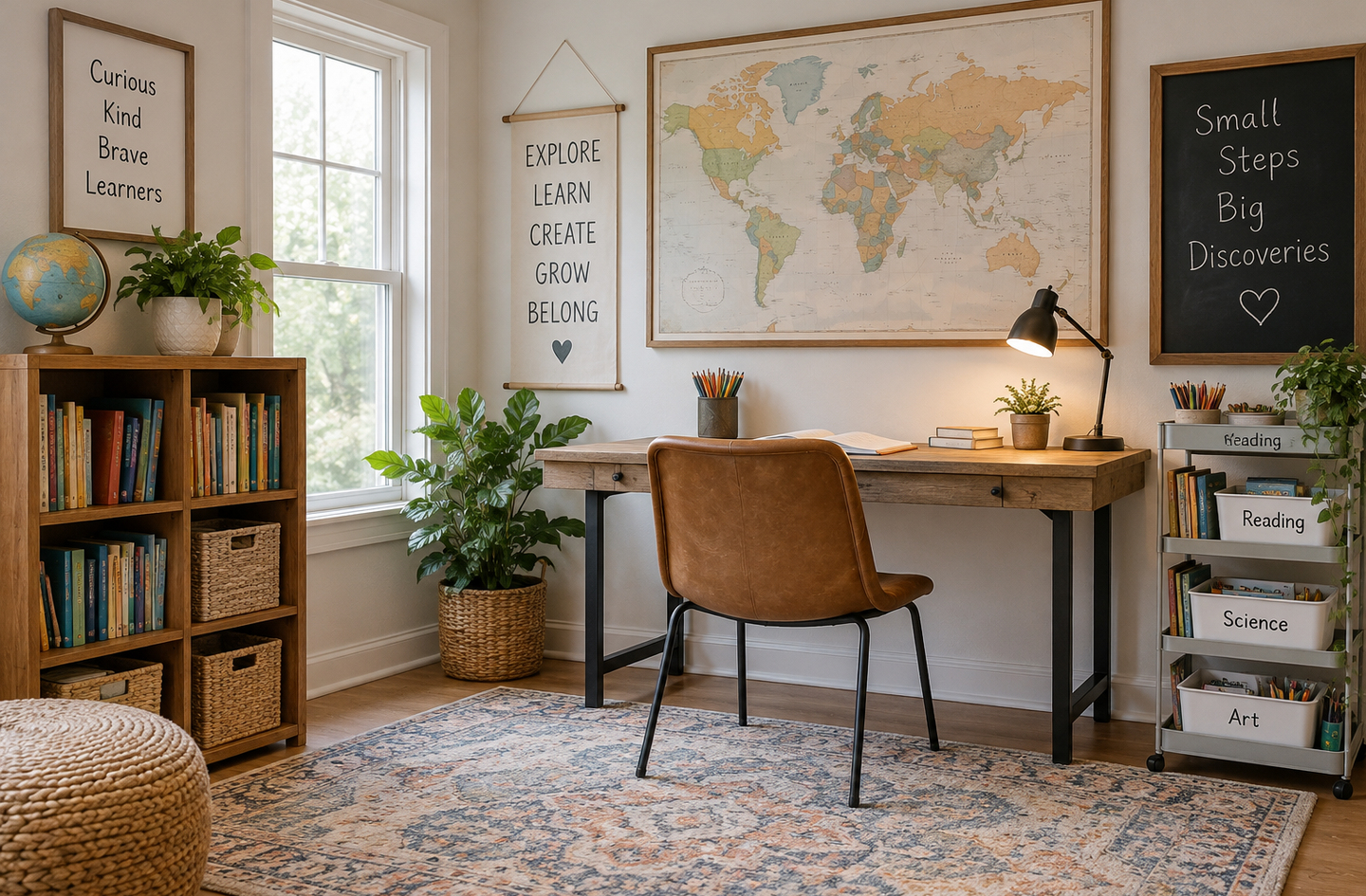
The cart earns its place because it separates “currently in use” from “stored for later” – a distinction that fixed shelving cannot maintain when in-progress work needs to stay out for multiple days. See the companion article on planning a homework station and daily reset for how to integrate the cart reset into a full end-of-day routine.
Step 6: Plan the Back-Stock System and Overflow Rules
By the end of this step, you’ll have a clearly bounded, inventoried back-stock area with a rule that governs what goes in, what comes out, and when.
Back-stock without rules becomes a holding zone for items no one wants to decide about. Families accumulate curriculum sets they never use, art supplies bought in bulk for one project, and replacement consumables that expire before they’re needed. Most homeschool storage systems collapse not at the daily zone but at the back-stock zone, where materials enter but rarely leave.
Assigning the back-stock zone
Designate one specific container, cabinet shelf, or clearly bounded section of shelving as back-stock only. A large lidded bin, a separate shelf on a lower unit, or a dedicated cabinet shelf all work. The key constraint is that back-stock storage is physically separate from the daily station and the reference zone. Proximity breeds mixing.
Label it “Back-Stock” and give it a written inventory. A sticky note inside the lid or a one-page list stored with the zone is enough. The inventory doesn’t need to be elaborate. It needs to be current. Update it when materials move in or out. Most families who run an annual back-stock review discover they own curriculum they forgot entirely.
Most homeschool families are managing a comprehensive subject load: 73% of parents who choose homeschooling cite dissatisfaction with academic instruction at other schools as a factor in their decision.4 A full-subject curriculum generates significant back-stock, particularly in consumables (workbook pages, printer paper, art materials) that arrive in quantities designed for a classroom, not a single student.
The use-by rule
Apply one rule to every item that enters back-stock: every item gets a note stating when it will be used (a grade level, a school year, or a project start date). If you cannot state a use-by condition, ask whether the item belongs in back-stock at all. Items without a use-by condition are items without a plan, and they are what turn a back-stock zone into a junk zone.
At the start of each school year, review the back-stock zone. Items whose use-by date or condition has passed, or items that have been in back-stock for two or more years with no clear plan, can often be donated, sold, or discarded. The review keeps the zone functional and prevents it from becoming a permanent home for indecision.
For curriculum sets that are two or more grade levels above the current student’s level, store them in a separate “future curriculum” bin, physically distinct from consumable back-stock. This distinction makes the annual review faster: you’re comparing apples to apples when you evaluate consumables, and you can make a separate, clearer decision about the long-range curriculum shelf.
Common Mistakes That Undermine Homeschool Storage
The most common homeschool storage mistake is putting back-stock where daily-use materials should live. It happens because it is faster to leave materials on the nearest available shelf than to carry them to a designated zone. Within a semester, the daily station is full of materials no one is using, and the weekly rotation stops. The fix is treating back-stock as if it belongs in a different room, even when it physically occupies the same wall. A distinct label and a separate container create enough visual and behavioral friction to prevent drift.
Buying storage before completing the audit
Storage products look helpful before you know what you’re storing. A set of matching bins bought before the audit almost always includes the wrong sizes, because the actual material volume is unclear until the audit is done. Step 1 always comes before any purchase. The audit determines what sizes you need, in what quantities, for which categories.
Making the system more complex than the problem
A seven-tier sorting system feels organized on day one and requires daily maintenance that most families do not sustain beyond two weeks. Three zones (child-accessible daily, adult-managed reference, back-stock) cover the needs of almost every homeschool setup. The simplest system that works is the right system. Additional categories are worth adding only when a specific recurring problem demands them, not in advance of a problem.
Skipping the reset routine
A storage system is set up once and expected to maintain itself. It does not. The daily station needs a Friday rotation to stay functional. The rolling cart needs a weekly clear. The back-stock zone needs an annual review. Without these reset cycles, every zone drifts toward clutter within weeks.
Design for the reset, not just the reveal. A system that looks organized in a photograph but has no reset routine will look cluttered within a month. The reset is not the cleanup after the system fails. It is the mechanism that prevents failure.
Frequently Asked Questions
What is the simplest homeschool storage setup for a small space?
Three zones in three containers covers the core need without requiring a dedicated room. A labeled set of bins or a small rolling cart serves as the active daily station. A low bookshelf holds child-accessible curriculum. A single lidded bin holds back-stock and consumables. Each zone has a clear boundary, and that boundary is what makes the setup functional. A mixed-zone system does not improve with more bins; it improves with clearer rules about what belongs where.
How do I keep homeschool supplies organized with multiple children?
Assign each child a bin color or labeled shelf section within the shared daily station rather than building a fully separate station per child. A different color bin per child inside the same unit keeps materials sorted while allowing a single Friday rotation to serve all children at once. The station works on one schedule, not one schedule per child. The reference zone and back-stock zone do not need to be divided by child; only the active daily station needs individual assignment.
How often should a homeschool storage system be reorganized?
The daily station needs a Friday rotation each week. The rolling cart needs a reset at the end of the school week. Reference shelves need a brief review at the start of each new unit to confirm the correct materials are accessible. The back-stock zone needs one annual review. Most homeschool storage problems come from skipping the weekly rotation rather than from failing to reorganize the entire system. A system that includes scheduled resets rarely needs a full overhaul.
Where should homeschool books and curriculum be stored?
Current-week materials belong in the active daily station at child height, below 48 inches. Reference books and between-unit curriculum belong on adult-managed shelves between 48 and 72 inches. Back-stock curriculum and replacement consumables belong in a physically separate, labeled zone away from the working area. Keeping these three categories in distinct physical locations is the organizing principle. When all three share the same shelf, each weekly rotation requires a sorting decision, and most families stop making that decision within a few weeks.
What do I do with completed homeschool work and finished workbooks?
Finished work belongs in a dated binder or portfolio that lives in the reference zone or a dedicated archive section. Completed workbooks can stay in the reference zone briefly for review, then move to a portfolio or be recycled. The active daily station should contain only current-week materials. When the station holds finished work, the station no longer reflects the current week, and the Friday rotation loses its purpose. Archive the finished work on Friday, confirm the station holds only the coming week’s materials, and the system continues to function.
Limitations and Edge Cases
This guide assumes one primary learning area or room. Families who homeschool across multiple rooms or shared living spaces can apply the same zone model, but each zone needs its own labeled boundary within the shared space. A bin or shelf section can define the zone even when there are no dedicated walls.
Families with preschool-age children may find the structured zone model more rigid than their current needs. A simplified version (one basket for active materials, one shelf for reference books) works for early learners and scales naturally as the curriculum load grows.
Some curriculum publishers ship materials on a rolling basis throughout the year rather than in a single shipment. In these cases, the back-stock zone inventory requires updates when new shipments arrive. The use-by rule still applies: note when each item will enter the active rotation before adding it to the shelf.
References
The research methodology for this article combined nationally representative enrollment surveys, peer-reviewed academic research on learning environment design, and publicly available federal education data. All statistics were verified against primary source documents before publication.
- National Home Education Research Institute (NHERI). Research Facts on Homeschooling. 2024–2025 enrollment estimate: approximately 3.408 million U.S. students. nheri.org/research-facts-on-homeschooling
- National Home Education Research Institute (NHERI). Annual homeschool household spending estimate: approximately $600 per student per year on educational materials. nheri.org/research-facts-on-homeschooling
- Pew Research Center. About 3.4% of U.S. K–12 Students Were Homeschooled in 2022–23. 2025. pewresearch.org
- National Center for Education Statistics (NCES). Parent and Family Involvement in Education Survey, National Household Education Surveys Program (NHES). Statistic: 73% of homeschooling parents cited concern about academic instruction quality as a reason for homeschooling. nces.ed.gov/nhes
- Fisher, A. V., Godwin, K. E., & Seltman, H. (2014). Visual environment, attention allocation, and learning in young children: When too much of a good thing may be bad. Psychological Science, 25(7), 1362–1370. psychologicalscience.org
- Chart enrollment figures compiled from NHERI (2026) historical and current estimates and Pew Research Center (2025) survey data. See references 1 and 3 above.
Build the System Once, Then Let the Resets Do the Work
Six steps, three permanent zones, and a weekly reset cycle. The audit in Step 1 tells you what you own and how much space each category needs. The zone plan in Steps 2 through 4 assigns everything a home based on how often it moves. The rolling cart in Step 5 handles the in-progress problem that fixed shelving cannot. The back-stock rules in Step 6 stop the zones from refilling with materials that don’t belong there.
A homeschool storage system is not a one-time project. It is infrastructure that you build once and maintain with scheduled resets. The Friday station rotation is the mechanism that keeps the whole system working. Without the reset, every zone drifts. With the reset, the system stays accurate to the current week’s curriculum without requiring a daily sorting decision.
For the broader context – how the storage zones fit into the full learning space, including layout, lighting, and zone separation – see the Homeschool Learning Zones hub. If you’re working with limited floor space, the small-space homeschool room guide covers how to fit all three zones into a shared family room or bedroom corner without losing any of the zone structure.