
Many toddler sensory setups go wrong at the tool shelf: a squeeze toy that never dries inside, a spoon that snaps, a bottle cap small enough to swallow. Our sensory play spaces overview covers planning the activity area as a whole. This article goes deep on one decision inside it: choosing sensory play toys for toddlers, and when a ready-made toy beats a household scoop, cup or texture object. Neither group wins every category. In one study of 19 bath toys used under real conditions, every toy examined carried a biofilm on its inner surface5.
Quick Answer
Should a toddler’s sensory tools be ready-made toys or household objects?
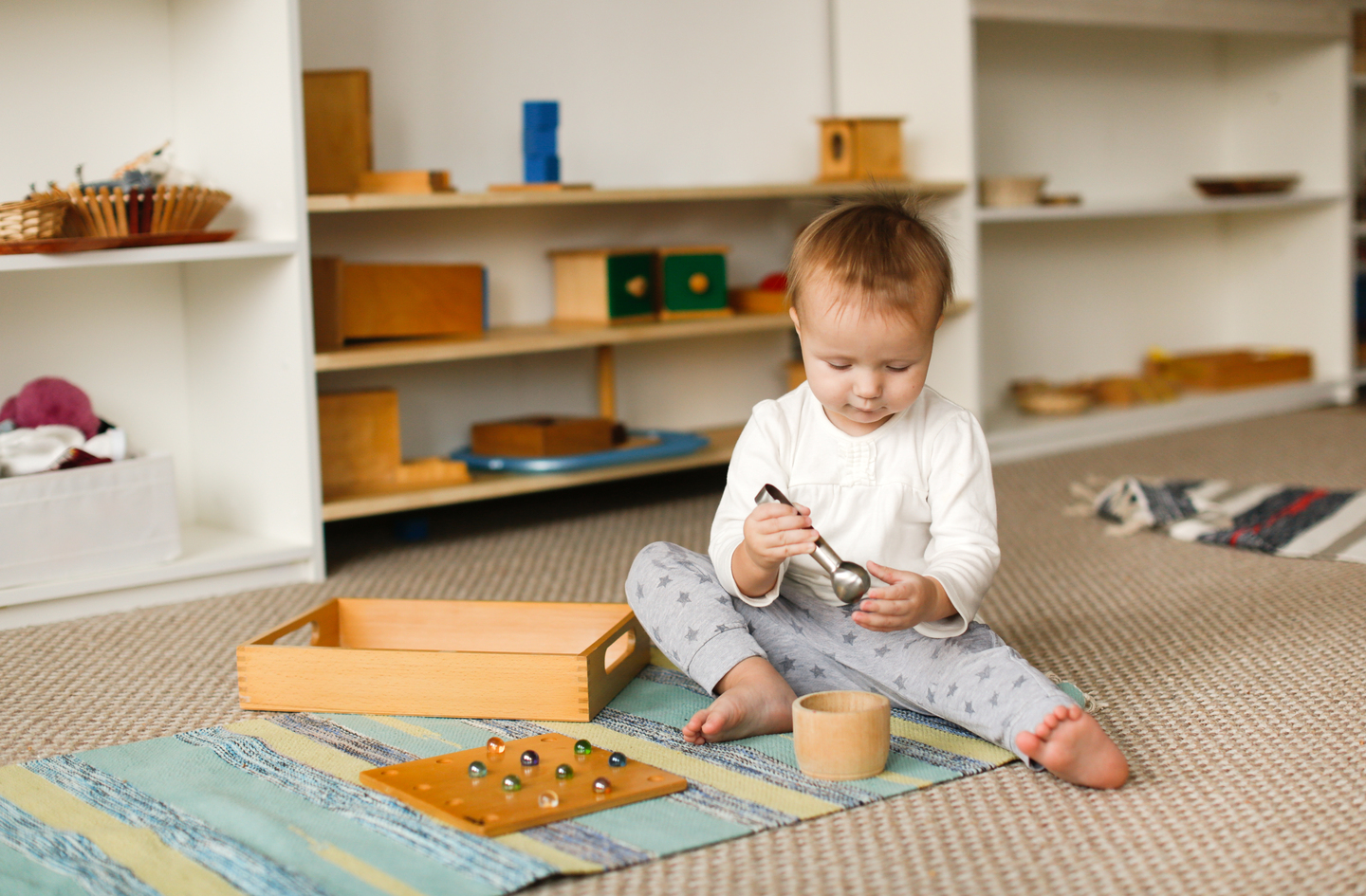
Use both, matched to the activity. Ready-made toys win on age labeling and testing, because federal rules ban small parts in toys intended for children younger than 31. Household tools tend to win on cleaning and storage, provided each piece is too large to swallow, made of one solid material and washable on every surface. Hollow squeeze toys that trap water lose on both counts.
Key Takeaways
- U.S. toy rules gauge small parts with a test cylinder that has a 31.7 mm opening1. A kitchen scoop sold for adults never goes through that test, so the parent runs the size check instead.
- Coins made up 61.7% of objects swallowed by young children in U.S. emergency-department data, against 10.3% for toys4. Household clutter needs the same part-size check as any toy.
- Sealed hollows are the cleaning weak point in both groups: fungi turned up in 58% of real bath toys in one study5.
- The common misconception is that more tools make a richer activity. Toddlers given 4 toys instead of 16 played longer with each one7.
How Sensory Play Toys for Toddlers Compare With Household Tools
Ready-made sensory play toys for toddlers and household tools split the six selection categories between them, and the split follows a clear pattern. Toys win where a federal rule does the checking before purchase. Only toys intended for a child 12 years of age or younger must be certified to the toy rules2. Household tools win where a parent can see and control the variable directly: cleaning and the space the kit takes up.
Sensory play is open-ended play built around touch, sight, sound and movement, such as pouring, scooping, squeezing, sifting and sorting materials like water, sand, rice or dough. The tools are the scoops, cups, funnels, molds and textured objects that move the material around. A tool that suits the activity does three jobs: it fits the child’s hand and stage, it survives the material, and it comes clean afterward.
| Category | Ready-made sensory toy | Household tool | Usually wins |
|---|---|---|---|
| Age labeling | Age grade on the package; certified when sold for children 12 and under | No age grade; sold for adult kitchen or craft use | Ready-made |
| Part size | Small parts banned when intended for children under 3 | No test; size is the buyer’s call | Ready-made, for under-3s |
| Materials | Lead, phthalate and element limits for children’s toys | Food-contact oversight for foodware, or none | Ready-made, unless stainless steel or unfinished wood |
| Cleanability | Varies; hollow squeeze and bath toys trap water | Solid, open kitchen tools wash fully | Household |
| Durability | Impact, tension and torque tests for toy components | Built for adult use, not for biting or throwing | Ready-made, for plastic and multi-part tools |
| Play-space fit | Sets add pieces and packaging | Uses what the kitchen already stores | Household |
The pattern gives a working rule. Buy where a test covers something you cannot check at home, and borrow from the kitchen where you can see and wash the whole object.
Age Labeling: What the Package Tells You
Ready-made toys win on age labeling, because the age grade is the switch that turns federal toy rules on. Under federal law, a children’s toy is a product the maker designs or intends for play by a child 12 years of age or younger2. A silicone muffin cup or a wooden spoon from the kitchen falls outside that definition.
Age grading is the manufacturer’s statement of the youngest age a toy is designed for, and it decides which tests the toy must pass. For toddlers, the line that matters most sits at the third birthday. Toys intended for children younger than 3 may not contain small parts, while toys for ages 3 to 6 that contain them must carry a choking warning1.
A stainless measuring cup, a pastry brush and a plastic funnel carry no age grade at all. They were made for adult hands, so no toy test ran on them before they reached the drawer. That is not proof of a problem. It means the checks a toy label would have covered become the parent’s job, one tool at a time.
The label is not the whole answer either. An age grade describes the typical child of that age, not a particular child’s habits. A toddler who still mouths everything needs the under-3 standard applied for longer, whatever the box says. Questions about a specific child’s mouthing or sensory needs belong with a pediatrician or a pediatric occupational therapist.
Treat the age grade as a floor, never a target. It tells you what a toy was tested for, and the child in front of you decides how long to keep the stricter under-3 standard.
Part Size: The Check Household Objects Skip
Part size is the category where household objects need the most care, because nothing screens them before they reach the floor. Toy rules gauge small parts with a small parts cylinder that has a 31.7 mm opening1. The Consumer Product Safety Commission describes the cylinder as a gauge that simulates the throat size of a child under age 31.
A small parts cylinder is a hollow test gauge used under federal toy rules. Any toy, or any piece that comes off one, that fits entirely inside it counts as a small part. The test asks one plain question of every piece: could it fit, whole, into the throat of a child that age?
Most swallowed objects in national emergency data are not toys. In U.S. emergency departments, an estimated 759,074 children under 6 were evaluated for swallowed foreign bodies from 1995 to 20154. Coins made up 61.7% of the objects, followed by toys at 10.3%, jewelry at 7.0% and batteries at 6.8%4. One-year-olds accounted for 21.3% of the cases4.
“Choking is a leading cause of morbidity and mortality among children, especially those aged 3 years or younger.”3
American Academy of Pediatrics, Committee on Injury, Violence, and Poison Prevention, policy statement in Pediatrics
Household tools fail the size check in predictable places: bottle caps, measuring-spoon rings, lid knobs, mini cookie cutters and the snap-on tips of squeeze bottles. A ready-made toy labeled for under-3s fails it less often, because the ban applies before sale. It can still fail with age, when a cracked scoop sheds a fragment that was never a small part when new.
The same academy lists shape, size and consistency among the features that make certain toys and foods more likely to cause choking3. Round, firm and smooth objects deserve extra suspicion even when they look too big. The screen for fillers, water, batteries and cords is a separate step, covered in our sensory play safety check; this section is about the tools alone.
Apply the toy rule to the kitchen drawer. If a tool, or any piece that could come off it, would be banned from a toy for under-3s, it stays out of a toddler’s bin.
Materials: What Goes in the Mouth
Ready-made toys win on materials when the tool is plastic, painted or soft, because federal chemical limits apply to children’s products. Federal law prohibits children’s toys and child care articles that contain more than 0.1 percent of the phthalates DEHP, DBP or BBP2. The ASTM F963 toy standard also sets solubility limits for eight elements in surface coatings and accessible substrates that a child can suck, mouth or swallow2.
Phthalates are plasticizers: chemicals added to some plastics to make them soft and flexible. Mouthing is why what a toy is made of matters. The Consumer Product Safety Commission notes that young children learn about texture, shape and taste through mouthing, and that teething children mouth objects to soothe discomfort1. For a toddler, every sensory tool is a mouthable tool.
Children’s products also face a lead content limit of 100 ppm2. The Commission has determined that certain materials do not exceed that limit, including wood, textiles and specified stainless steel, so they need no third-party lead testing2. Those same materials are common in the kitchen drawer.
Household tools sit under a different system, because foodware falls to the Food and Drug Administration. In December 2024, the agency told cookware sellers that certain imported products made from aluminum, brass and alloys known as Hindalium or Indalium may leach lead into food8. The agency also notes that lead used in pottery may leach into foods8. Painted metal, glazed ceramics, brass and soft unlabeled plastic are where a household tool carries unknowns that a toy label would have closed.
For mouthable tools, choose the material before the shape: stainless steel, unfinished wood, cotton cloth or labeled toy plastic, and leave glazed, painted and brass pieces in the kitchen.
Cleanability: Which Tools Wash and Dry Completely
Household tools tend to win on cleanability, because most kitchen scoops, cups and funnels are solid, open and made to be washed. The weak point in both groups is any sealed hollow that lets water in through a small hole. In a 2018 study, researchers at the Swiss aquatic research institute Eawag examined 19 bath toys used under real conditions5. All of them carried notable biofilms on their inner surfaces, and fungi appeared in 58% of them5.
Biofilm is a slimy layer of bacteria, fungi and other microbes that builds up on a surface that stays wet. The Eawag team argues these biofilms are shaped by carbon leaching from the flexible plastic, by tap water quality, and by nutrients and microbes added in the bath5. Squeeze toys used for water play share that design: soft plastic, a pinhole and a dark interior that never fully dries.
Cleaning has limits too, and the evidence is honest about them. Researchers randomized 12 Danish nurseries caring for 587 children. Washing and disinfecting toys and linen every two weeks reduced the presence of three respiratory viruses, yet sickness absence did not change6.
“Although cleaning and disinfection of toys every two weeks can decrease the microbial load in nurseries, it does not appear to reduce sickness absence among nursery children.”6
Tobias Ibfelt and colleagues, Copenhagen University Hospital (Rigshospitalet), Journal of Hospital Infection
For a sensory kit, cleanability comes down to a short set of questions. Can every surface be reached with a brush or a dishwasher spray? Can it dry fully, inside and out, before it goes back on the shelf? Is it one material, with no glued joints or printed faces that peel in water?
Ready-made tools that pass include one-piece silicone or hard plastic scoops, open sand molds and stacking cups with no hidden cavity. Household tools that pass include stainless measuring cups, silicone muffin cups, plastic funnels and wooden spoons that get dried after wet play. Squeeze bottles that cannot be opened and hollow bath animals fail in both groups, so they belong in dry play only, or out of the kit.
Choose open over hollow. A tool you can see inside is a tool you can actually clean, whether it came from a toy shop or a kitchen drawer.
Play-Space Fit: How Many Tools the Activity Needs
Household tools win on play-space fit, because the best toddler kit is small and the kitchen already stores most of it. In a University of Toledo study, 36 toddlers played in two conditions, with 4 toys and with 16 toys available7. With fewer toys, they played longer with each one and played with toys in a greater variety of ways7.
The study looked at toys in a room, not tools in a bin, but its logic carries over. The authors suggest that fewer toys let toddlers settle into longer play with a single toy, with better focus and more creative exploration7. For a sensory activity, that argues for two to four tools chosen for the material, not a large set poured in at once. The rest of the kit waits on a shelf for the next activity.
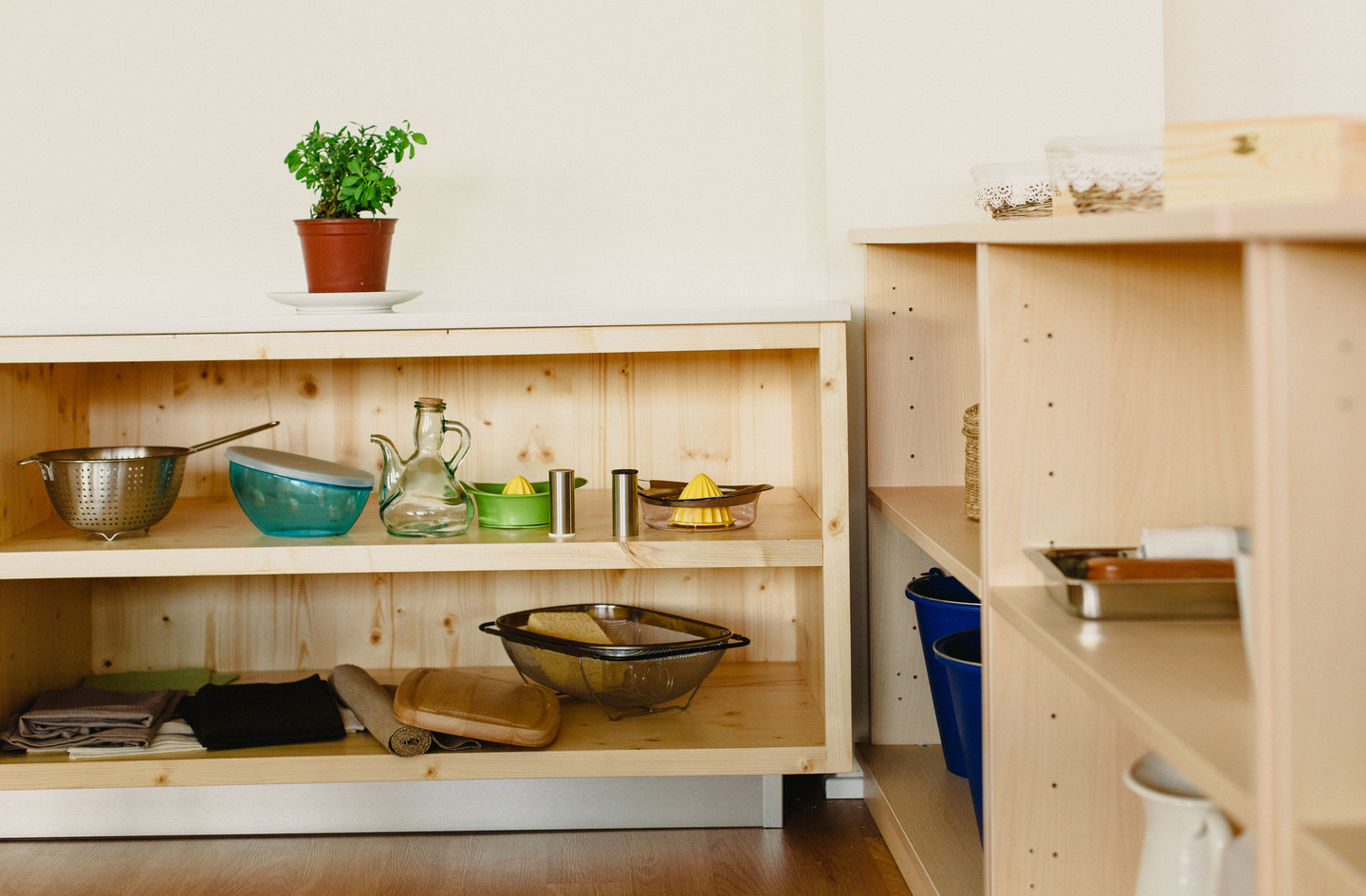
Fit also means where the kit lives between sessions, and tools need two homes. The first is a low open shelf or tray holding the few tools in rotation, where a toddler can see and choose them. The second is a lidded tub on a higher shelf for small pieces and anything kept for older siblings. Wet-play tools dry on an open rack or towel first. A low shelf with one tool per spot also makes the reset visible, because an empty spot shows what is missing.
Design for the reset, not just the reveal. Three tools that share one shelf spot reset in a minute; a boxed set of twenty pieces rarely goes back the same way twice.
Durability: What Survives Toddler Handling
Ready-made toys win on durability for plastic and multi-part tools, because toy rules test how a toy holds up to a child before it is sold. Use-and-abuse testing under the federal toy rules, also required by the ASTM F963 standard, includes impact, tension and torque tests that check whether toy components become accessible1.
Use-and-abuse testing refers to standardized drops, pulls and twists applied to a toy to see whether its components come loose or become reachable. A kitchen tool has had no such test for a toddler’s use. That matters less for solid steel or thick silicone, which have no parts to shed. It matters more for thin plastic measuring spoons, ring-bound sets and anything with a printed scale that can flake.
An adult-hand check catches most of the difference, and it costs nothing. Pull on every joint, twist every handle, flex the thinnest edge, and look for stress whitening in plastic, the pale streak that shows up before a crack. Repeat the check at each reset, because a scoop that was sound when new can split after a season of sand.
Durability is a maintenance question as much as a purchase question. A tool checked at every reset is more trustworthy than one tested once in a lab and never looked at again.
Which Tools Suit Which Sensory Activity
The best way to choose sensory play toys for toddlers is to match the tool to the material first. Then decide whether to buy it or borrow it from the kitchen. The table pairs five common toddler activities with tools that suit each one, the better source for those tools, and the single check that matters most.
| Activity | Tools that suit it | Better source | Check first |
|---|---|---|---|
| Water pouring | Cups, open funnels, a small jug | Household: stainless or hard plastic cups, open funnels | Can every part dry fully inside? |
| Dry scooping and transfer | Wide scoops, bowls, a tray | Either; kitchen bowls and measuring cups work well | Is every tool and loose piece too large to swallow? |
| Sand and dough | Molds, rollers, blunt cutters | Ready-made, labeled for the child’s age | One piece, with no handle that pulls off |
| Texture exploration | Fabric squares, wooden spoons, silicone brushes, texture balls | Household cloths and spoons; ready-made texture balls | Age grade present, no loose stuffing or beads |
| Squeeze and squirt | Wide-mouth squeeze bottles | Ready-made bottles that open wide for cleaning | Can it be opened and dried, and is the cap too large to swallow? |
A toddler under age 3 who still mouths everything: start with ready-made tools labeled for the age. Add only large, one-piece household items such as wooden spoons and stainless cups.
A family short on storage: use household tools that already have a kitchen home, and keep one tub for the few toy pieces that have none.
A shared room with a preschooler: the older child’s tools may include small parts labeled for ages 3 to 6. Those tools need their own closed container and a separate activity time.
Height and surface are part of the match as well. A toddler pours more steadily at a low table or a floor tray than reaching up to an adult counter. A low work surface with a raised lip also keeps dry fillers closer to the tools. If neither tool group seems to suit a child, for example a toddler who strongly avoids or seeks certain textures, that question belongs with a pediatric occupational therapist.
Verdict: Category Winners
| Category | Winner | Condition |
|---|---|---|
| Age labeling | Ready-made | Always, for children under 3 |
| Part size | Ready-made | When labeled for under-3s |
| Materials | Ready-made | Unless the household tool is stainless steel or unfinished wood |
| Cleanability | Household | When solid and open, with no sealed hollow |
| Durability | Ready-made | For plastic and multi-part tools |
| Play-space fit | Household | When the tool already has a kitchen home |
| Overall | A mixed kit | Ready-made for mouthable and multi-part tools; household for open, solid ones |
The overall verdict is a mixed kit, chosen activity by activity. Ready-made tools earn their place where a federal test covers what a parent cannot check at home: small parts, chemical content and abuse resistance. Household tools earn theirs where the whole object is visible, washable and too large to swallow. The room as a system matters more than the source of any single scoop.
The question to ask of each tool is not “toy or kitchen?” but “what would a toy test have checked here, and have I checked it?”
Frequently Asked Questions
Are kitchen utensils a good choice for toddler sensory play?
Many are, when each one passes the checks a toy label would have covered. Toy rules ban small parts in toys intended for children younger than 31, but nobody runs that test on a kitchen drawer. Large, one-piece, single-material tools such as stainless cups, wooden spoons and silicone muffin cups pass more often than multi-part gadgets.
What does the age label on a sensory toy actually mean?
It names the youngest age the toy was designed for, and it decides which federal tests apply. Toys for ages 3 to 6 that contain small parts must carry a choking warning1. For a toddler who still mouths objects, read the label as a floor and keep tools from the under-3 category.
How often should toddler sensory tools be cleaned?
Wash wet-play tools after each session and let them dry fully before storage. In a Danish nursery trial, washing and disinfecting toys and linen every two weeks reduced the presence of three respiratory viruses but did not change sickness absence6. Cleaning keeps a kit in good order; it does not make tools sterile.
How many sensory toys does a toddler need for one activity?
Two to four tools per activity is a practical number. In a University of Toledo study, toddlers offered 4 toys instead of 16 played longer with each toy and in more varied ways7. Keep the rest of the kit on a shelf and rotate it between activities.
Are squeeze bath toys a good choice for water play?
Rarely. A pinhole and a soft hollow body let water in but not out. In a study of 19 bath toys used under real conditions, every toy examined held a biofilm inside, and 58% carried fungi5. Open cups, funnels and toys that pull apart for drying are far easier to keep clean.
Limitations and Edge Cases
- The rules compared here are U.S. federal rules for toys and foodware. Other countries use their own standards and age labels, so a label printed for another market does not map neatly onto these categories.
- This comparison covers typical toddlers. A child with feeding, oral-motor or sensory-processing differences needs individual guidance from a pediatrician or a pediatric occupational therapist, not a general tool list.
- Tools are judged as sold or as found in the kitchen. Homemade toys such as sealed sensory bottles or stuffed texture bags bring their own seams, glues and fillers, and sit outside this comparison.
References
Methodology: every figure in this article comes from an independent published source, linked below. The sources are two U.S. Consumer Product Safety Commission rules in the Federal Register, five papers indexed in PubMed and one FDA guidance page. Each figure was checked against its source text on October 22, 2026. Playroom Architect founder Oded Feigin holds editorial responsibility for the article.
- Federal Register – Safety Standard for Toys: Requirements for Water Beads, U.S. Consumer Product Safety Commission final rule, document 2025-22643, December 12, 2025.
- Federal Register – Children’s Products, Children’s Toys, and Child Care Articles: Determinations Regarding Lead, ASTM F963 Elements, and Phthalates for Engineered Wood Products, U.S. Consumer Product Safety Commission final rule, document 2018-13392, June 22, 2018.
- PubMed – American Academy of Pediatrics, Committee on Injury, Violence, and Poison Prevention. Prevention of choking among children. Pediatrics, March 2010. DOI 10.1542/peds.2009-2862.
- PubMed – Orsagh-Yentis D, McAdams RJ, Roberts KJ, McKenzie LB. Foreign-Body Ingestions of Young Children Treated in US Emergency Departments: 1995-2015. Pediatrics, May 2019. Nationwide Children’s Hospital Center for Injury Research and Policy. DOI 10.1542/peds.2018-1988.
- PubMed – Neu L, Banziger C, Proctor CR, Zhang Y, Liu WT, Hammes F. Ugly ducklings: the dark side of plastic materials in contact with potable water. npj Biofilms and Microbiomes, March 2018. Eawag, Swiss Federal Institute of Aquatic Science and Technology. DOI 10.1038/s41522-018-0050-9.
- PubMed – Ibfelt T, Engelund EH, Schultz AC, Andersen LP. Effect of cleaning and disinfection of toys on infectious diseases and micro-organisms in daycare nurseries. Journal of Hospital Infection, February 2015. DOI 10.1016/j.jhin.2014.10.007.
- PubMed – Dauch C, Imwalle M, Ocasio B, Metz AE. The influence of the number of toys in the environment on toddlers’ play. Infant Behavior and Development, February 2018. DOI 10.1016/j.infbeh.2017.11.005.
- U.S. Food and Drug Administration – Lead in Food and Foodwares, Environmental Contaminants in Food guidance page.
Conclusion
Choosing sensory play toys for toddlers comes down to matching each tool to its activity, then asking what a toy test would have checked. Buy where a federal rule covers what a parent cannot check at home. Borrow where the whole object is visible and washable, and keep the kit at the sensory bin or table small enough to reset quickly.
For where the tools sit within the wider activity area, return to the sensory play spaces overview.