
Closet reading nook ideas for kids start with a test, not a cushion. Can this closet hold a child, a light and a stack of books, with moving air and an adult able to see in? Our reading nooks guide is the broader overview of quiet reading corners at home. This article covers one conversion: turning an unused or underused closet into a book hideaway. Making books easy to reach is one small lever. In 2023, only 14 percent of students reported reading for fun almost every day in the NAEP sample of 13-year-old students1.
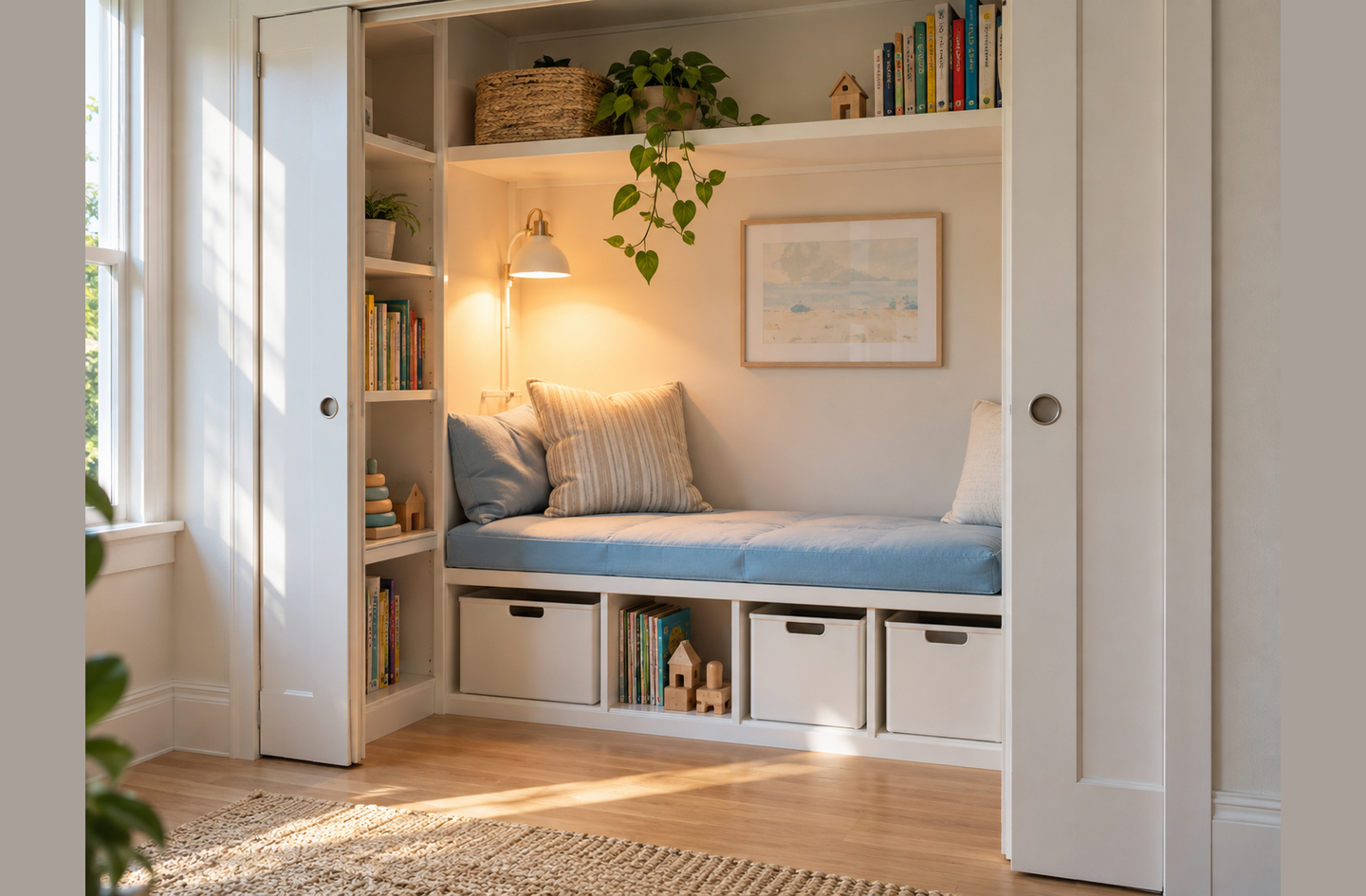
Quick Answer
How do you turn a closet into a reading nook for kids?
Measure the opening first, then check the air, light, floor and book reach before buying anything. For public buildings, the ADA Standards require door openings with a clear width of 32 inches minimum2, a useful yardstick for a home closet rather than a rule. Keep candles and heaters out, take the door off or fix it open, and place the nook where an adult can see in.
- Measure the closet opening and interior.
- Decide what happens to the closet door.
- Check air, moisture and heat.
- Light the page without heat or loose cords.
- Build a floor and seat the child can leave easily.
- Shelve books inside the child’s reach.
- Keep the nook visible and plan the reset.
Key Takeaways
- For public buildings, the ADA Standards set door openings at 32 inches minimum and openings more than 24 inches deep at 36 inches minimum2. A home closet can borrow both as reference points.
- Moisture is the first air check: the EPA advises keeping indoor humidity below 60 percent, ideally between 30 and 50 percent3.
- Shelves between 20 and 36 inches sit inside all three of the Access Board’s advisory reach ranges for children ages 3 to 122. Those ranges are written for public buildings, but one shelf band can serve years of growth.
- Restrain every freestanding unit and fix wall shelves into studs. From 1990 to 2019, U.S. emergency departments treated an estimated average of 18,673 children a year for furniture or TV tip-over injuries4.
- Design for the reset, not just the reveal: a closet nook that clears in a minute is ready for the next reader.
Before You Start: What a Closet Reading Nook Needs
A closet reading nook needs five things before any decor: a usable opening, moving air, a cool light, a soft floor and books within reach. A reach-in closet is a shallow closet used from outside, with a rod and a shelf behind a door. A walk-in closet is a closet deep enough to step into, with storage on one or more walls. Either can become a reading nook, but they fail in different ways, so name the type first. Gather these before buying anything:
- A tape measure and a notepad to sketch the opening, the depth, the fixed shelf and every outlet, vent and light.
- A flashlight to check the back corners and the floor for stains, damp patches or a musty smell.
- A hygrometer, a small meter that reads the humidity of the air, left in the closet for a week.
- Painter’s tape to mark where the cushion, the shelf and the room’s walking path will sit.
- Time: an evening to measure, a stretch of humidity readings and a weekend to set up.
Observation before shopping keeps a cushion purchase from deciding the plan, and the room as a system decides whether a child uses the closet. Playroom Architect founder Oded Feigin, a mechanical engineer (M.Sc., UCLA) who plans residential renovations, wrote this guide. It is engineering-informed planning, not structural, electrical or developmental advice for a specific home or child.
Step 1: Measure the Closet Opening and Interior
Step 1 decides whether the closet can work at all, by measuring the clear opening, the depth and the free floor inside. The opening matters most, because it is where a child climbs in, a parent kneels to help and the light from the room enters.
No home code sets a size for a reading nook, so public-building figures make a useful yardstick. For public buildings, the ADA Standards require door openings with a clear width of 32 inches minimum, and openings more than 24 inches deep need 36 inches minimum2. Those figures are written for accessible design in public buildings, not for home closets. They still give a concrete comparison: a closet opening narrower than 32 inches is tighter than a standard accessible doorway.
- Measure the opening at its narrowest point, which is often the trim, a door track or a folded bifold panel.
- Measure the depth from the back wall to the line of the door.
- Measure the height to the underside of the fixed shelf, and note the rod height.
- Mark every outlet, vent, light fixture, pipe and access panel on the sketch.
Reach-in and walk-in closets measure differently
A reach-in closet is usually wide and shallow, so the nook runs along the back wall and the child sits facing out into the room. A walk-in closet is deeper, so the nook sits at the far end and the doorway becomes a short passage. That passage is the part to check, because a child and an adult both need to pass through it.
Look for anything that rules a closet out. A closet holding a water heater, a furnace, an electrical panel or a plumbing access panel is a utility space, not a nook candidate. Removing a closet wall or widening a framed opening is structural work for a licensed contractor.
The step is complete when the sketch shows the opening, depth, shelf height and every fixed item, with any ruling-out feature circled.
Measure the opening before anything else, because a closet with a pinched or blocked entrance stays unused however soft the cushion is.
Step 2: Decide What Happens to the Closet Door
Step 2 settles the door, because a closet reading nook works best when a child cannot be shut inside it and the room’s light can reach the page. Most closet doors were chosen to hide clothes, not to frame a reading spot, so each type needs a decision.
- Hinged door: take it off and store the hinges and pins with the door, or fix it fully open with a doorstop that holds it against the wall.
- Bifold door: remove it, because the folded panels narrow the opening and the hinge gap between panels can catch small fingers.
- Sliding door: lift it off its track, or leave one panel fixed and open the other, so the nook does not sit behind a moving panel.
- No door, or a curtain: a tension rod and a light curtain give a sense of a hideaway while staying easy to push aside.
Check the hardware too. A passage knob is a door handle with no lock, the type used on most hall closets. If the closet door stays on and has a locking knob, swapping it for a passage knob keeps the nook from ever being locked from either side.
The step is complete when the door is off, fixed open or replaced by a curtain, and no lock remains on the opening.
Treat the door as part of the nook’s safety reasoning, not as decor: an open or removed door costs nothing and helps keep the child in view and within reach.
Step 3: Check Air, Moisture and Heat in the Closet
Step 3 checks the air, because a closet is a small, closed box that holds moisture and heat in a way an open room does not. Closets on outside walls or beside a bathroom or laundry deserve the closest look.
Moisture and mold
Relative humidity is the amount of water vapor in the air, shown as a percentage of the most the air could hold at that temperature. The EPA advises keeping indoor humidity below 60 percent, ideally between 30 and 50 percent3. Leave the hygrometer in the closet for a week, with the door open as it will be in use, and compare its readings with the room outside.
Moving air is the fix for a closet that reads higher than its room. Keep the door off or open, leave a gap behind cushions and shelves, and avoid sealing the opening with a heavy curtain. If the closet still reads high, ask an HVAC professional about airflow before the nook goes in.
“The key to mold control is moisture control.”
U.S. Environmental Protection Agency (EPA)3
A musty smell, staining at the base of the walls or damp carpet signals excess moisture, whether from a leak or from condensation in still air. The EPA advises drying water-damaged areas and items within 24 to 48 hours to prevent mold growth3. A cushion soaked by a hidden leak comes out at once. Find and fix the source first, with a licensed plumber or contractor where a pipe or an outside wall is involved.
Heat sources and fire
A reading nook fills a small space with things that burn: cushions, blankets, paper books and fabric. The U.S. Fire Administration advises keeping anything that can burn at least 3 feet from all heat sources, including space heaters and candles5. Few closets offer that much distance from every surface, so candles, space heaters and heat lamps stay out of a closet nook entirely.
The step is complete when a week of readings sits inside the EPA range, no moisture source remains and nothing in the plan produces open flame or heater heat.
A closet that stays damp is not a reading nook yet: fix the moisture first, because cushions and paper books turn a small humidity problem into a mold problem.
Step 4: Light the Page Without Heat or Loose Cords
Step 4 adds light that reaches the page without adding heat, hot surfaces or cords a child can pull. A closet usually has one ceiling fixture or none, and that fixture sits behind and above the reader, which puts a shadow on the book.
- Plug-in wall sconce: mount it to one side at the height of the seated child’s shoulder, and run the cord down the wall in a cord cover.
- Battery LED lights: stick-on lights under the fixed shelf need no wiring; choose units whose battery cover closes with a screw.
- String lights: use LED strings only, keep them on the wall or the shelf edge, never draped across fabric, and keep plugs out of the nook.
- Existing fixture: keep it as background light, with an LED bulb no stronger than the fixture’s labeled maximum.
Hardwired changes belong with a professional. Electrical codes limit closet fixture types and their clearance from stored items, and a licensed electrician confirms what applies. A new or moved fixture, a new outlet or a dimmer is a job for a licensed electrician. A plug-in or battery light needs no change to the wiring and comes out when the nook does.
The step is complete when the child can read a page from the seat without a shadow across it, and no cord crosses the floor or hangs within reach.
Light from the side at shoulder height does more for reading than a brighter ceiling bulb, and plug-in or battery lights keep the closet easy to reverse.
Step 5: Build a Floor and Seat the Child Can Leave Easily
Step 5 builds the floor and seat, which decide whether a child settles in for a chapter or climbs out after a page. The test is simple: the child should get in, sit and get out again without climbing over anything or asking for help.
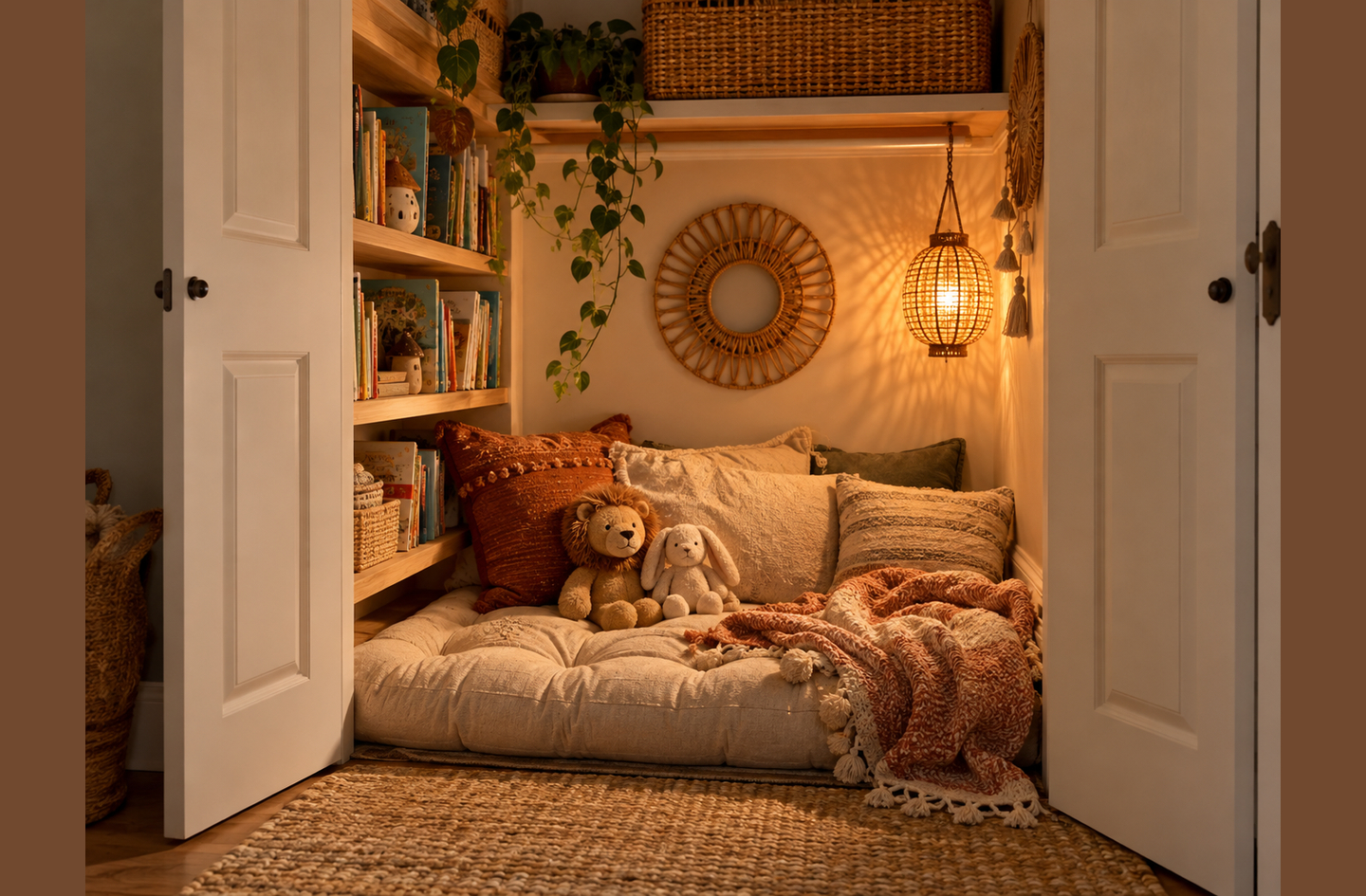
The floor layer
A floor nook is the most reversible option and suits a shallow reach-in closet. Lay a non-slip rug pad first, then a firm floor cushion or a folded mat, then two or three pillows against the back wall. Choose covers that unzip and wash, because a closet holds dust and spills longer than an open room.
Air new foam cushions in the room before they go into the closet, and stand them on edge now and then so the underside dries. Keep the layer low and flat at the opening, so nothing at the threshold trips a child stepping in.
A bench seat
A bench suits a wider reach-in or a walk-in closet and adds storage underneath. A freestanding low bench is semi-permanent and moves with the family; a built-in bench fixed to the walls is a carpentry job. Keep the seat low enough that the child’s feet reach the floor or a cushion, and keep the front edge clear of the door line.
Seating types trade footprint against support and cleanability, and our guide to reading nook furniture for kids compares chairs, floor cushions, benches and daybeds by those measures.
The step is complete when the child can sit, read and leave three times in a row without help, and every cover comes off for washing.
Start with a floor layer even if a bench is the plan, because watching the child sit, sprawl or lie down decides the bench.
Step 6: Shelve Books Inside the Child’s Reach
Step 6 places the books, and the useful band for a closet book nook sits lower than most closet shelving. For public buildings, the U.S. Access Board publishes advisory reach ranges for children: 20 to 36 inches for ages 3 and 42. The ranges widen to 18 to 40 inches for ages 5 through 8, and 16 to 44 inches for ages 9 through 122. A reach range is the band between the lowest and highest point a child can reach forward or to the side, as the Access Board table labels it.
Median height for boys rises faster than the top of that reach band. WHO growth tables put the median height of boys at 103.3 cm at age 4, about 40.7 inches6. The WHO median reaches 127.3 cm at age 8, about 50.1 inches, and 149.1 cm at age 12, about 58.7 inches7.
Where the books go
By our reading of the Access Board table, the 20 to 36 inch band of the youngest group sits inside both older groups’ ranges2. Shelves placed there keep working as a child moves through the grades, so confirm the top shelf from the child’s actual seat. Put a face-out ledge or rail in that band for the books in current use, with covers showing. Keep the closet’s original high shelf for the rotation stock, which an adult swaps in every few weeks.
A forward-facing display lowers the effort of choosing, because a child picks by cover, not by spine. For deeper storage built around the seat, our guide to a reading nook with storage compares benches, cubbies and low bookcases.
Anchor every shelf
A child who reads in a closet may also climb, and a closet leaves little room to step clear of a falling shelf. From 1990 to 2019, U.S. emergency departments treated an estimated average of 18,673 children a year for furniture or TV tip-over injuries4. In that study, children younger than 6 accounted for 69.9% of furniture and TV tip-over injuries4. A tip restraint is a strap or bracket that ties a freestanding unit to the wall framing so it resists pitching forward.
Fix wall shelves and ledges into studs, and restrain any freestanding unit. Plaster, brick or a wall with unknown framing needs a licensed installer before anything heavy goes up.
The step is complete when the child can reach every current book from the seat, and every shelf passes a firm pull test without moving.
Build the book band low and anchor it once, because a 20 to 36 inch band suits a preschooler and still suits the same child years later.
Step 7: Keep the Nook Visible and Plan the Reset
Step 7 connects the closet nook to the room around it, so an adult can see in and the nook resets in about a minute. A hideaway works for a child when it feels enclosed, and works for a parent when the opening still faces the room.
“Reading together often with infants and young children strengthens their relationships with parents and caregivers at a critical time in child development, stimulating brain circuitry and early attachment.”
American Academy of Pediatrics (AAP), Council on Early Childhood8
Leave room at the opening for an adult to sit beside the child, which keeps shared reading possible for younger readers. Keep the room’s walking path past the closet clear. For public buildings, the ADA Standards set walking surfaces at 36 inches minimum2, a fair target for that path. In a bedroom, keep the closet nook distinct from the bed, and our bedroom reading nook ideas cover that separation in more depth.
- Give books in use one basket or one ledge, and the rest a single return shelf.
- Fold the blanket onto the cushion and stand the pillows against the back wall.
- Switch off the light at the end of each session, and check that no cord has moved.
The step is complete when an adult can see the reader from the room, and the child can reset the nook alone.
Design for the reset, not just the reveal: one basket and one return shelf keep a nook in use, while five storage spots turn it back into a closet.
Removable and Permanent Closet Reading Nook Ideas
Closet reading nook ideas fall into three groups: removable setups, semi-permanent furniture that moves with the family, and built-in work that changes the closet. The right group depends on whether the closet will ever store clothes again and on who does the work.
| Approach | What it involves | Reverses by | Who does the work |
|---|---|---|---|
| Floor nook | Rug pad, floor cushion, pillows, battery or plug-in light, face-out ledge | Lifting it out | Parent |
| Curtain nook | Door removed, tension rod and curtain, floor nook inside | Rehanging the door | Parent |
| Freestanding bench | Low bench or storage bench, wall ledges fixed into studs | Moving the bench, filling screw holes | Parent, with a stud finder |
| Built-in bench and shelves | Bench fixed to the walls, shelves replacing the rod | Carpentry to remove | Carpenter or contractor |
| Wider opening or new wiring | Reframed opening, new fixture or outlet | Not practical to reverse | Licensed contractor and licensed electrician |
Small closet reading nook ideas
A small or shallow reach-in closet works best as a floor nook. Keep the rod out, run a single face-out ledge along one side wall, light the page from the other side and leave the full width of the opening clear. A curtain on a tension rod adds a sense of enclosure without narrowing the way in.
If the closet fails Step 1 or Step 3, an open corner of the same room can do the job. Our corner reading nook ideas show how to define one.
Call a qualified professional before any change to the structure or the wiring. A licensed contractor handles removing a closet wall, widening a framed opening or work under a stair. A licensed electrician handles a new fixture, outlet or switch. For a specific child’s reading, sensory or motor needs, ask a pediatric occupational therapist.
Start removable and earn the built-in: a floor nook lets a family judge the closet over a season, and only a nook still chosen every day justifies carpentry.
Closet Reading Nook Checklist: Reference Figures Mapped to a Home Closet
A closet reading nook checklist can borrow published figures, as long as each one is read for the setting it was written for. The table below maps each check from the steps above onto its source figure and states whose setting that figure comes from.
| Closet check | Reference figure | Whose setting | How to use it at home |
|---|---|---|---|
| Opening width | Door openings 32 inches minimum clear width2 | ADA Standards, public buildings | Compare with the narrowest point of the closet opening |
| Walk-in passage | Openings more than 24 inches deep: 36 inches minimum2 | ADA Standards, public buildings | Compare with the doorway passage of a walk-in closet |
| Path past the nook | Walking surfaces 36 inches minimum clear width2 | ADA Standards, public buildings | Keep the room’s path past the opening at least this clear |
| Humidity | Below 60 percent, ideally between 30 and 50 percent3 | EPA guidance for homes | Compare with a week of hygrometer readings |
| Leaks and spills | Dry within 24 to 48 hours3 | EPA guidance for homes | Pull out wet cushions and books at once |
| Heat sources | Anything that can burn at least 3 feet from heat sources5 | U.S. Fire Administration, homes | No candles, heaters or heat lamps in the closet |
| Book band | Ages 3 and 4: 20 to 36 inches2 | Access Board advisory, public buildings | Keep current books in this band for ages 3 through 12 |
The ADA figures describe public buildings and wheelchair access; at home they are comparison points, not requirements. The EPA and Fire Administration guidance is written for homes and fits a closet as stated.
Read every figure for its setting: the EPA and USFA guidance fits a closet as stated, while the ADA widths only compare a closet with an accessible doorway.
Common Mistakes When Converting a Closet Into a Reading Nook
The most common closet nook mistakes come from treating the closet as a photo set instead of a small room with its own air, light and access. Each one below has a cheap fix.
- Buying the cushion first. A cushion sized from a photo rarely fits the measured depth. Measure in Step 1, then shop.
- Keeping a lockable door. A locking knob or a heavy sliding panel can close a child in. Remove the door or fit a passage knob.
- Draping lights over fabric. String lights on a canopy or blanket add heat and loose cord to the softest part of the nook. Mount lights on the wall or shelf edge.
- Shelving at adult eye height. Books on the closet’s original high shelf are out of a child’s reach. Keep current books in the low band from Step 6.
- Ignoring a musty smell. A smell is a moisture signal, and fabric hides it. Run the Step 3 humidity check before the cushion goes in.
Most of these mistakes cost nothing to avoid, because each one comes from skipping a check that takes a tape measure, a hygrometer or a minute of thought.
What a Working Closet Book Nook Looks Like
A working closet book nook is one the child enters alone, reads in and leaves tidy, while an adult can see in. These signals show the conversion is doing its job:
- The child chooses the nook without being sent there.
- An adult can see the reader from the room or the doorway.
- The hygrometer still reads inside the range from Step 3 a month later.
- Current books sit on the low ledge, and the high shelf holds the rotation stock.
- The nook resets in about a minute, with nothing hot and no loose cord.
Judge the nook by use, not by how it looks: a plain closet nook that gets used daily beats a styled one that waits for a photo.
Frequently Asked Questions
How do you make a reading nook in a closet?
Measure the opening, remove or fix open the door, then check the air for a week before adding anything soft. The EPA advises indoor humidity below 60 percent3. Add a plug-in or battery light at the side, a floor cushion and a low face-out ledge anchored into studs.
How wide should a closet reading nook be?
No home code sets a width for a reading nook. For public buildings, the ADA Standards require door openings with a clear width of 32 inches minimum2, a handy comparison for a closet opening. A narrower reach-in closet can still hold a floor nook if a child sits comfortably and an adult can see in.
Can a walk-in closet work as a reading nook?
Yes, when the doorway passage stays clear and clothes storage is moved or screened off. For public buildings, openings more than 24 inches deep need 36 inches minimum under the ADA Standards2, a fair yardstick for a walk-in passage. Put the seat at the far end, facing the door.
Is a reading nook in a closet under the stairs a good idea?
It can work if the space stays dry and the stair structure is left alone. Never cut stair framing to gain headroom; that is work for a licensed contractor. The U.S. Fire Administration advises keeping anything that can burn at least 3 feet from heat sources5, so keep heaters and candles out.
Limitations and Edge Cases
- The ADA widths and Access Board reach ranges describe public buildings. No U.S. code sets sizes for a home reading nook, so they serve only as comparison points.
- The WHO heights are medians for boys; girls’ tables differ, and any one child can sit well above or below the median.
- Closets holding a water heater, furnace, electrical panel or plumbing access are outside this guide. Seating and storage outside the closet belong to the Reading Nooks overview.
References
Methodology: the figures in this article were gathered in October 2026 from U.S. accessibility standards, federal home-safety guidance, WHO growth tables and peer-reviewed research, and each was checked against its source page. Playroom Architect founder Oded Feigin holds editorial responsibility.
- The Nation’s Report Card (NAEP) – Highlights of the 2023 Long-Term Trend Reading and Mathematics Assessments at Age 13, National Center for Education Statistics, 2023.
- U.S. Access Board – ADA Accessibility Standards (2010 ADA Standards for Accessible Design with advisories), sections 403.5.1, 404.2.3 and Advisory 308.1.
- U.S. Environmental Protection Agency (EPA) – A Brief Guide to Mold, Moisture and Your Home.
- PubMed – Lu C, Badeti J, Mehan TJ, Zhu M, Smith GA. Furniture and television tip-over injuries to children treated in United States emergency departments. Injury Epidemiology, 2021. DOI 10.1186/s40621-021-00346-6.
- U.S. Fire Administration – Heating fire safety outreach materials, FEMA.
- World Health Organization (WHO) – Child Growth Standards, simplified field tables: Height-for-age, boys, 2 to 5 years (percentiles).
- World Health Organization (WHO) – Growth reference 5 to 19 years: Height-for-age, boys (percentiles), 2007.
- PubMed – Klass P, Miller-Fitzwater A, High PC; American Academy of Pediatrics Council on Early Childhood. Literacy Promotion: An Essential Component of Primary Care Pediatric Practice: Policy Statement. Pediatrics, 2024. DOI 10.1542/peds.2024-069090.
Conclusion
A closet becomes a reading nook when its opening, air, light, floor and book band all pass a simple check, and when an adult can still see in. Start removable, keep the books low and anchored, and keep heat and locks out of the closet. The room as a system decides whether the nook gets used, more than the cushion does.
See the broader overview in our practical guide to reading nooks for how a closet nook fits the wider topic of quiet reading corners at home.