
Most corner reading nook ideas start with a chair and a stack of pillows. Then they stall within a week, because the corner blocks a path or the books sit out of reach. This article sits under our Reading Nooks guide, the overview of quiet reading corners for kids. Here the focus is narrower: 11 layouts for square, narrow and awkward corners, each checked against reach, circulation and reset. The stakes are real. In 2023, only 14% of 13-year-olds reported reading for fun almost every day1, so a corner that removes friction from reading earns its floor space.

Quick Answer
What makes an empty corner work as a kids reading nook?
A corner works as a reading nook when four parts line up. The seat faces out of the corner, and a rug or low boundary marks the floor area. Books sit between 20 and 36 inches off the floor for ages 3 and 42. The fourth part is a clear walking path past the nook, plus a light source beside the reader rather than glare from above.
Key Takeaways
- The shelf band every child from 3 to 12 can reach runs from 20 to 36 inches off the floor, based on the U.S. Access Board’s advisory reach ranges for children2.
- The federal dresser stability rule does not cover bookcases, so anchoring a corner bookcase is the family’s job, not the manufacturer’s test result4.
- Children under 6 account for 69.9% of furniture and TV tip-over injuries treated in U.S. emergency departments3.
- The corner itself is not the nook. The nook is the system of seat, boundary, books, light and path, and each corner shape changes which part is hardest.
- Pushing the seat deep into the corner is a layout trap: it turns the reader’s back to the room and puts the books behind them.
Square Corner Reading Nook Ideas: Using Both Walls
A square corner is the easiest shape to turn into a reading nook because two walls give the seat a back and the books a home on either side. A reading nook is a small, defined area set aside for reading, with its own seat, its own books and its own light. The corner supplies the shelter. The layout decides whether a child actually sits there.
Measure the corner as a floor area, not as a wall: the free length along each wall, minus the walking path that runs past it. That footprint picks the idea.
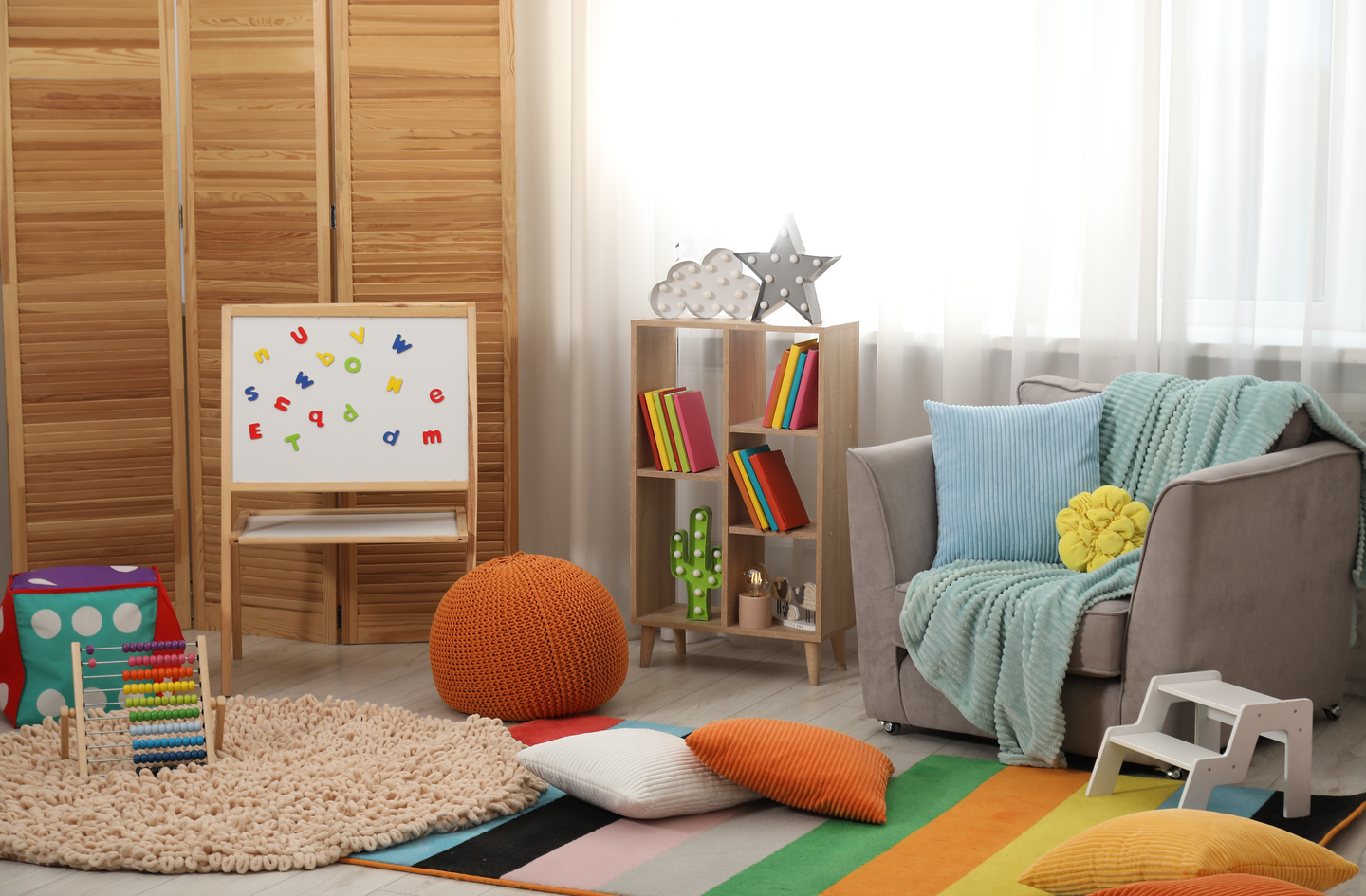
1. The Diagonal Armchair With a Lamp Behind It
Setting one armchair at a 45-degree angle across a square corner gives the reader a view of the room and leaves a triangle of floor behind the chair. That triangle is the most useful space in the nook. It holds a floor lamp, a basket or a plant, and it keeps the lamp cord out of the walking path.
The angle also helps supervision. A child facing out of the corner stays in a parent’s line of sight from the doorway, and the lamp light falls over the reader’s shoulder onto the page.
Best for: children about 5 and older who can climb in and out of a chair on their own. It needs a square corner with roughly 4 feet free along each wall. A child-sized chair shrinks that footprint. For a side-by-side look at chairs, beanbags and benches, see our reading nook furniture comparison.
Reset logic: one basket beside the chair arm, with a fixed limit of books. When the basket is full, a book goes back to the shelf before a new one comes out.
2. The L-Shaped Floor Cushion Corner
Two long floor cushions laid along both walls form an L that seats a toddler, a preschooler and a parent at the same time. Floor seating removes the climb, removes the fall height and makes the nook a shared reading spot rather than a single-child perch.
The books go on a low, face-out shelf along one wall, so covers sit at a toddler’s eye level. For ages 3 and 4, the Access Board’s advisory reach range runs from 20 to 36 inches above the floor2. A shelf that tops out near 30 inches keeps every cover inside that band with room to spare.
Best for: toddlers and preschoolers, shared parent-child reading, and corners that must convert back to open floor for play.
Reset logic: cushions lean against the wall each evening, and the shelf holds only as many books as it can show face-out.
3. Two-Wall Picture Ledges Inside the Reach Band
Picture ledges mounted on both walls of the corner turn the walls into a cover display that a child can scan from the seat. Each ledge holds a single row of books facing out, so a child chooses by cover instead of pulling spines from a packed shelf.
The height rule is simple and sourced. The U.S. Access Board’s advisory children’s reach range is 18 to 40 inches for ages 5 through 8 and 16 to 44 inches for ages 9 through 122. Mount the lowest ledge near 20 inches and the highest near 36 inches, and every child from 3 to 12 can reach every cover.
Best for: corners with tight floor area but free wall space, and families with children of different ages.
Watch the visual load. Two or three ledges of covers read as a menu. Six ledges on both walls read as wallpaper, and the corner stops being a calm place to focus.
“Children were more distracted by the visual environment, spent more time off task, and demonstrated smaller learning gains when the walls were highly decorated than when the decorations were removed.”
Anna V. Fisher, Karrie E. Godwin and Howard Seltman, Carnegie Mellon University, Psychological Science (2014)5
That study placed kindergarten children in a laboratory classroom for six science lessons and compared highly decorated walls with walls whose decorations were removed5. A reading corner is not a classroom, but the mechanism carries over: a nook wrapped in color, signs and stickers competes with the page.
4. The Canopy or Tent Corner
A fabric canopy or a freestanding play tent gives the corner a soft roof and a doorway, which tells a child exactly where the nook begins and ends. That boundary is the canopy’s real job. It turns two walls and a rug into a place.
A light ceiling hoop for a fabric canopy is a different load from a hanging chair. A hanging chair carries a child’s moving weight, so the ceiling mount, the joist and the hardware need evaluation by a licensed contractor or structural engineer before installation. A floor-standing frame avoids the question entirely.
Best for: preschoolers and early readers who like a “den” feeling. Keep fabric clear of radiators, baseboard heaters and lamps.
Reset logic: the tent floor is the boundary for books too. Anything that leaves the tent goes back to the shelf at cleanup, so the inside stays a reading space and not a storage bin.
For a square corner, age decides the idea. Floor cushions and ledges serve the youngest readers, while a diagonal chair suits a child who can climb in alone.
Small Corner Reading Nook Ideas for Narrow and Shallow Corners
A narrow corner works as a reading nook when the seat runs along the longer wall and the walking path stays at its full width. The constraint here is not the nook. It is the path beside it. A circulation path is the route people already use to cross a room, from door to closet or from desk to window. A nook that pinches it gets moved within a month.
A useful benchmark comes from accessibility design. Under the 2010 ADA Standards, the clear width of a walking surface is 36 inches minimum2. A home is not bound by that rule, but it is a sound target for the main path past a nook.
5. The Wall-Hugging Single Seat
In a corner where one wall is short, the seat turns to run parallel with the longer wall instead of facing out of the corner. A slim lounge chair, a firm floor mattress or a single long cushion works. The short wall then carries the books, and the reader sits side-on to the room.
This layout protects the path. The nook depth stays near 2 feet, which leaves the rest of a narrow room open. It also fits a bedroom, where the narrow corner beside a closet or window is often the only free spot. Our bedroom reading nook ideas cover how to keep that kind of nook separate from sleep.
Best for: narrow rooms, hallway-facing corners and bedrooms where the bed already takes the main wall.
Reset logic: a single wall-mounted rail or a narrow basket on the short wall. With one place for books, a child can see at a glance whether the nook is “done.”
6. The Corner Bench With a Book Rail Above
A low bench along one wall gives a shallow corner a seat, and a book rail mounted above it puts the books within arm’s reach of the reader. A storage bench also turns the space under the seat into a home for rotated books.
Two height checks keep this idea working. The seat should let a child’s feet reach the floor, and the rail should sit inside the reach band for the youngest reader. For a 3- or 4-year-old, the high reach is 36 inches2, so a rail above that line is a parent-only shelf.
Best for: shallow corners of about 18 to 24 inches, and families who want storage built into the nook. For capacity and access height by storage type, see our guide to reading nook storage benches.
Reset logic: books on the rail are “out”; books in the bench are “resting.” Swapping the two sets is the whole rotation routine.
7. The Rug-Defined Micro Nook
A small rug is the cheapest way to define a nook in a corner that cannot take furniture. A 3-by-5-foot rug, one floor cushion and one basket of books mark a clear reading spot without blocking anything. The rug edge is the boundary, and children read boundaries well.
This idea suits corners that must stay flexible, such as a living room corner or a playroom corner that doubles as building space. Use a non-slip rug pad, since a sliding rug creates a trip hazard at the edge of the path.
Best for: rentals, shared rooms and corners under 3 feet per wall.
Reset logic: the rule is “nothing on the rug but the reader, the cushion and the basket.” Toys that drift onto the rug go back to their own zone.
8. The Rotating Crate Nook
A single crate of books, swapped on a fixed schedule, keeps a small corner fresh without adding shelving. The crate faces out of the corner with covers up, and the rest of the family’s books live elsewhere.
The case for fewer choices has some evidence behind it, though it comes from toy research. In a University of Toledo study of 36 toddlers, children given 4 toys rather than 16 played with each toy longer and in a greater variety of ways6. Books are not toys, so treat this as a reason to try a smaller selection, not as proof that it works for reading.
Best for: any small corner, and families who already rotate toys.
Reset logic: the crate holds a set number of books, and the swap happens on the same day each week. A child can help choose the next set, which builds ownership of the nook.
In a narrow corner, protect the path before you choose the seat. A nook that keeps the full walking width survives daily traffic; one that pinches it rarely does.
Cozy Corner Reading Nook Ideas for Awkward Corners
Awkward corners make some of the coziest reading nooks once their one hazard or conflict is solved. The corner by a window, behind a door or under a slope each has a single feature that decides the layout. Plan around it, and the rest follows the square-corner rules.
9. The Window Corner
A corner beside a window offers the best reading light in the house, and it also brings the corner’s biggest hazard: blind and shade cords. From 1990 to 2015, an estimated 16,827 window blind-related injuries among U.S. children under 6 were treated in emergency departments7. Entanglement made up 11.9% of those cases, and 98.9% of entanglement cases involved blind cords7.
The layout answer is to remove cords from the nook, not to manage them. Cordless shades or a fixed panel solve it. Then keep the seat beside the window rather than under it, so the window does not become a climbing target. A seat placed below an opening window raises a child closer to the sill, so window guards or opening limits belong in the plan before the bench goes in.
Best for: rooms with good daylight and a cordless window treatment. Daylight from the side, not from behind the page, reduces glare on glossy picture books.
Reset logic: keep books off the windowsill. Sun fades covers, and a sill shelf invites climbing.
10. The Corner Behind a Door
A door swing is the quarter-circle of floor a door sweeps as it opens, and the corner behind a door sits inside or beside it. That corner is often the only unused one in a small bedroom, which is why it gets picked. The question is whether the nook clears the swing.
Measure the door width, since the swing radius equals it. A 30-inch door sweeps a 30-inch radius. If the corner beyond that arc is at least 2 feet deep, a floor cushion or a slim chair fits without the door striking the reader. If it is not, the door wins: a nook that gets hit by the door every morning does not last.
Best for: small bedrooms and offices where every other corner is taken. Floor seating suits it best, since it sits below the door handle.
Reset logic: a wall-hung pocket or a single rail on the far wall holds the books, so nothing sits in the door’s path.
11. The Sloped-Ceiling or Under-Stair Corner
A corner under a sloped ceiling or a staircase has low headroom, which is exactly what makes it feel like a den to a child. The usable area is the part where the reader can sit up straight, so measure headroom at the seat, not at the wall.
Floor seating suits these corners best, because it uses the low zone that an adult cannot. Lighting needs more thought than in an open corner: a slope blocks ceiling light, so add a clip-on or wall-mounted reading light with the cord routed along the wall. Before cutting into an under-stair closet or a knee wall, have a licensed contractor confirm what the framing carries.
Best for: attic bedrooms, finished basements and under-stair spaces.
Reset logic: one low basket at the open end, where an adult can reach it during cleanup without crawling in.
An awkward corner is not a worse corner; it is a corner with one problem to solve first, and the nook only works once that problem is gone.
Comparison Table: Which Corner Book Nook Fits Your Corner
The fastest way to choose a corner book nook is to match the idea to the free floor area and the youngest reader who will use it. The table below lists the planning footprint for each idea, along with the age band it suits and the single tool that keeps it reset. Footprints are Playroom Architect planning estimates for a typical layout, not product dimensions.
| Idea | Corner shape | Free floor per wall | Best age band | Reset tool |
|---|---|---|---|---|
| 1. Diagonal armchair | Square | About 4 ft | 5 and up | One basket at the chair arm |
| 2. L-shaped floor cushions | Square | 3 to 4 ft | 1 to 5 | Low face-out shelf |
| 3. Two-wall picture ledges | Square | 2 to 3 ft | 3 to 12 | Ledges between 20 and 36 in |
| 4. Canopy or tent | Square | About 3 ft | 3 to 7 | Tent floor as boundary |
| 5. Wall-hugging single seat | Narrow | About 2 ft deep | 4 and up | One rail on the short wall |
| 6. Bench with book rail | Shallow | 18 to 24 in deep | 3 and up | Rail out, bench resting |
| 7. Rug-defined micro nook | Any small | Under 3 ft | 2 and up | Single basket on the rug |
| 8. Rotating crate | Any small | About 2 ft | 2 and up | Fixed-size crate, weekly swap |
| 9. Window corner | Window wall | 3 to 4 ft | 4 and up | No books on the sill |
| 10. Behind the door | Door corner | 2 ft past the swing | 3 and up | Rail on the far wall |
| 11. Sloped or under-stair | Low headroom | Sitting headroom | 3 to 10 | Low basket at the open end |
If the free floor is under 3 feet per wall, start with idea 7 or 8. If the youngest reader is under 3, start with floor seating rather than a chair.
The best corner nook is the one that fits the smallest measurement in the room, whether that is the floor area, the path width or the youngest child’s reach.
How We Selected These Kids Corner Reading Nook Ideas
Each kids corner reading nook idea on this list passed three filters: structural safety reasoning, developmental fit, and buildability in real homes. If an idea failed one filter, it did not make the list. This was a research and design review, not a hands-on product test, and no item here is a paid placement.
Filter 1: Structural Safety Reasoning
Corners attract tall furniture, because a bookcase tucked into a corner looks tidy. That is the corner’s main structural risk. An estimated 18,673 children under 18 were treated in U.S. emergency departments each year for furniture or TV tip-over injuries from 1990 to 20193. Children under 6 accounted for 69.9% of those injuries3.
The federal rule that covers dressers will not help with a bookcase. The 2023 Safety Standard for Clothing Storage Units applies its stability tests to units 27 inches and above in height, using weights that simulate children up to 60 pounds4. The same rule states that it does not cover shelving units such as bookcases4. A tip restraint is a strap or bracket that ties the top of a unit to the wall framing. For a corner bookcase, installing one is the family’s job.
Every idea on this list either keeps furniture low or puts the books on wall-mounted ledges and rails fixed into studs. Where an idea depends on the ceiling or the framing, as with a hanging chair or an under-stair cut, it names the professional to involve.
Putting the two height figures on one wall shows why corner shelving needs a plan. The children’s reach bands run from 16 to 44 inches across ages 3 to 122, and every band crosses the 27-inch line where the federal dresser stability test begins4. A bookcase tall enough to serve all those reach bands is therefore above that line, yet outside that rule.
Filter 2: Developmental Fit
Each idea was matched to the youngest reader who would use it. Floor seating and low shelves serve toddlers, while chairs and taller rails suit children who can climb in and reach on their own. Shared reading also shaped the list, which is why several ideas seat a parent beside the child.
“Reading together often with infants and young children strengthens their relationships with parents and caregivers at a critical time in child development, stimulating brain circuitry and early attachment.”
American Academy of Pediatrics Council on Early Childhood, Literacy Promotion policy statement, Pediatrics (2024)8
For a specific child with motor, sensory or attention needs, a pediatric occupational therapist can advise on seating and position. This list offers general planning ideas, not individual advice.
Filter 3: Buildability in Real Homes
Every idea had to work with ordinary furniture, ordinary walls and a realistic cleanup routine, so built-in window seats and custom millwork were left out. Each item names one reset tool rather than a storage system.
The guiding rule is to design for the reset, not just the reveal. A nook that looks finished on day one but takes a long time to tidy will not stay a reading spot.
The three filters explain why this list leans on floor seating, ledges and rails: they lower avoidable risk for the youngest reader and let that child reset the nook alone.
Frequently Asked Questions
How high should books sit in a kids corner reading nook?
Place the books a child should reach between about 20 and 36 inches off the floor. That band sits inside the U.S. Access Board’s advisory reach range for every age group from 3 to 122. Books above it become parent-managed storage, which works well for the next rotation.
How much space does a small corner reading nook need?
A small corner reading nook can work in the space of a 3-by-5-foot rug with one cushion and one basket. The bigger constraint is the path beside it. The ADA Standards set 36 inches as the minimum clear width of a walking surface2, a useful target for the main route past a nook at home.
Does a bookcase in a reading corner need to be anchored?
Anchoring a corner bookcase to the wall framing reduces avoidable risk, and no federal stability test covers it. The 2023 clothing storage unit rule tests units from 27 inches tall but excludes bookcases4. Children under 6 account for 69.9% of furniture and TV tip-over injuries treated in U.S. emergency departments3.
Is a window corner a good place for a reading nook?
A window corner offers the best natural light, provided the cords go first. In a study of window blind injuries to U.S. children under 6, 98.9% of entanglement cases involved blind cords7. Choose cordless shades, keep the seat beside the window rather than under it, and keep books off the sill.
How many books should a corner book nook hold at once?
A corner book nook works best with a small, visible set that rotates, often one crate or one ledge of covers. Toy research points the same way: toddlers offered 4 toys instead of 16 played longer with each one6. Books are different from toys, so adjust the number to the child.
Limitations and Edge Cases
- The reach ranges are advisory guidance for buildings that serve children. Individual children vary, so check the band against the actual child before mounting anything.
- The injury figures are U.S. emergency department estimates for specific age groups and years. They describe patterns across many homes, not the risk in one room.
- Built-in window seats, custom millwork and structural changes are outside these ideas. Any change to framing, ceiling mounts or window openings belongs with a licensed contractor or structural engineer.
References
Methodology: every statistic in this article comes from an independent published source linked below; dimensions, footprints and the shared 20 to 36 inch reach band are Playroom Architect planning estimates.
- NAEP, National Center for Education Statistics – Long-Term Trend Reading and Mathematics Highlights, 13-year-olds, 2023
- U.S. Access Board – 2010 ADA Standards for Accessible Design, Advisory 308.1 Children’s Reach Ranges and 403.5.1 Clear Width
- Lu et al., Injury Epidemiology – Furniture and television tip-over injuries to children treated in United States emergency departments, 2021
- Federal Register, U.S. Consumer Product Safety Commission – Safety Standard for Clothing Storage Units, direct final rule, May 4, 2023
- Fisher, Godwin and Seltman, Psychological Science – Visual environment, attention allocation, and learning in young children, 2014
- Dauch et al., Infant Behavior and Development – The influence of the number of toys in the environment on toddlers’ play, 2018
- Onders et al., Pediatrics – Pediatric Injuries Related to Window Blinds, Shades, and Cords, 2018
- American Academy of Pediatrics, Pediatrics – Literacy Promotion: An Essential Component of Primary Care Pediatric Practice, Policy Statement, 2024
Conclusion
An empty corner becomes a reading nook when the seat faces the room and a boundary marks the floor. The books sit in the 20 to 36 inch band, and the path stays clear. Pick the idea by the smallest measurement in the room, then anchor anything tall. Treat the room as a system, and the corner keeps working after the first week.
For how the corner fits the wider picture of quiet reading spaces, see our reading nooks overview.