
An art drying rack for kids works when wet paintings leave the table right away and the rack never sits in the walking path. Our Art & Craft Stations guide is the overview of planning a home art station. This article covers one step of it: the drying zone. Floor space is the real constraint. Federal accessibility standards set 36 inches as the minimum clear width of a walking surface1, and a loaded rack can take that space fast. Here, tabletop, freestanding and mobile racks are compared on paper size, capacity, footprint, airflow, stability, child access and location.
Quick Answer
Which art drying rack for kids fits a home playroom best?
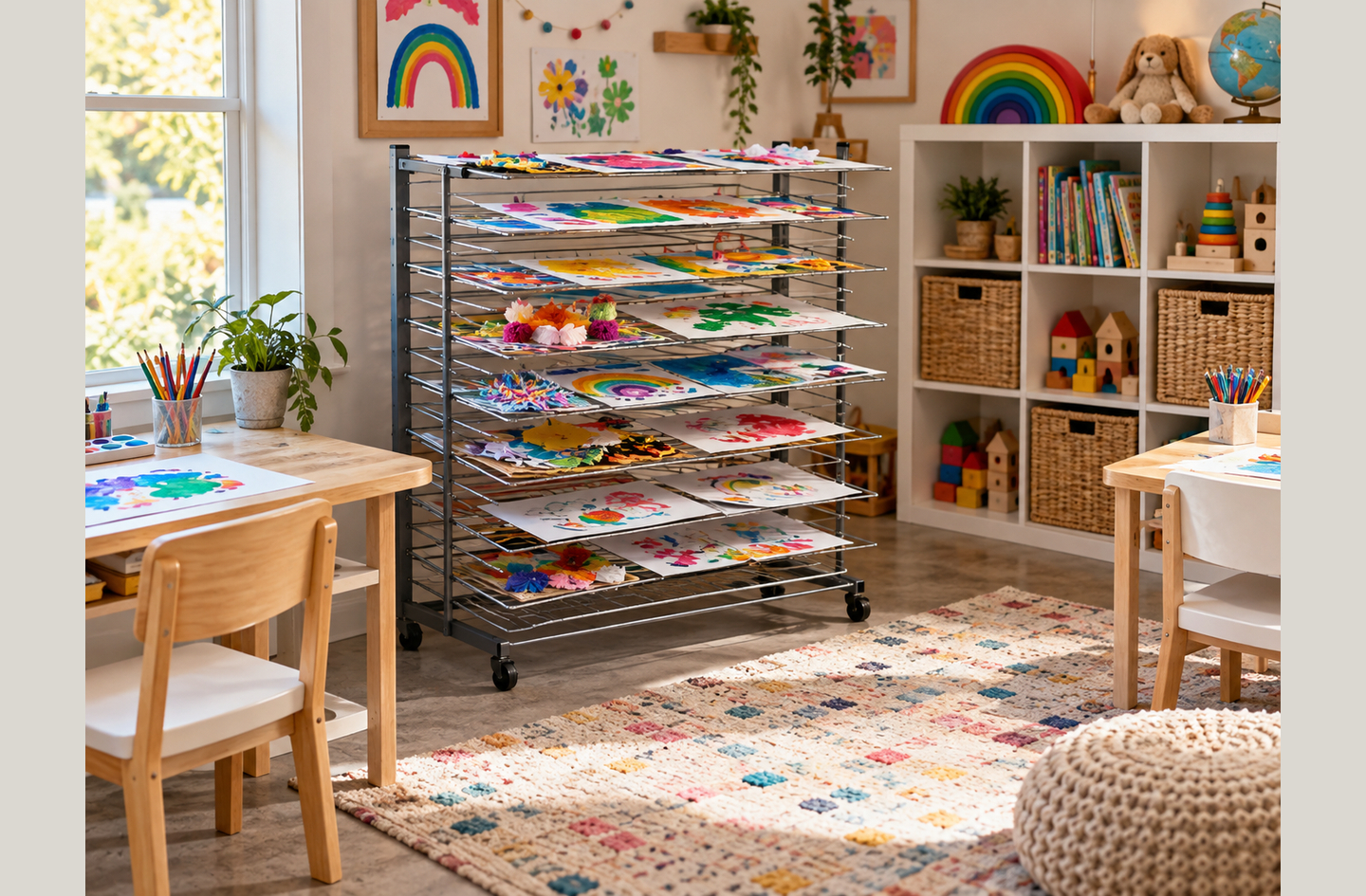
A freestanding wire rack suits most families who paint every week, because it holds a whole session flat on a small patch of floor. A tabletop rack suits small batches and tight rooms. A mobile rack suits shared rooms where the zone must clear away. In its guidance for drying flood-damaged papers, the National Archives describes well-supported screens, stacked with space between them, as an excellent compact drying surface2.
Key Takeaways
- Size the rack by the largest sheet your child paints on and the number of wet pieces from one session, not by the shelf count on the box.
- Keep the drying zone out of the walking path. Accessibility standards set 36 inches as the minimum clear width of a walking surface1.
- Humidity sets drying speed. The EPA advises keeping indoor humidity below 60 percent, ideally between 30 and 50 percent3.
- Freestanding and mobile racks add a tip-over question. An estimated 18,673 children a year were treated in U.S. emergency departments for furniture or TV tip-overs from 1990 to 20194. That study did not cover drying racks, but a loaded floor rack is also a tall object.
- Keep paper at least 3 feet from radiators and space heaters, as the U.S. Fire Administration advises for anything that can burn5.
- A common misconception is that a fan aimed at the rack is the best way to dry work. National Archives drying guidance positions fans for maximum air circulation and does not aim air flow directly at drying materials2.
Art Drying Rack for Kids Compared: Tabletop, Freestanding and Mobile
Three rack types cover most home drying zones, and each one trades floor space against capacity and stability. Store names overlap, so this comparison defines each type before it rates them.
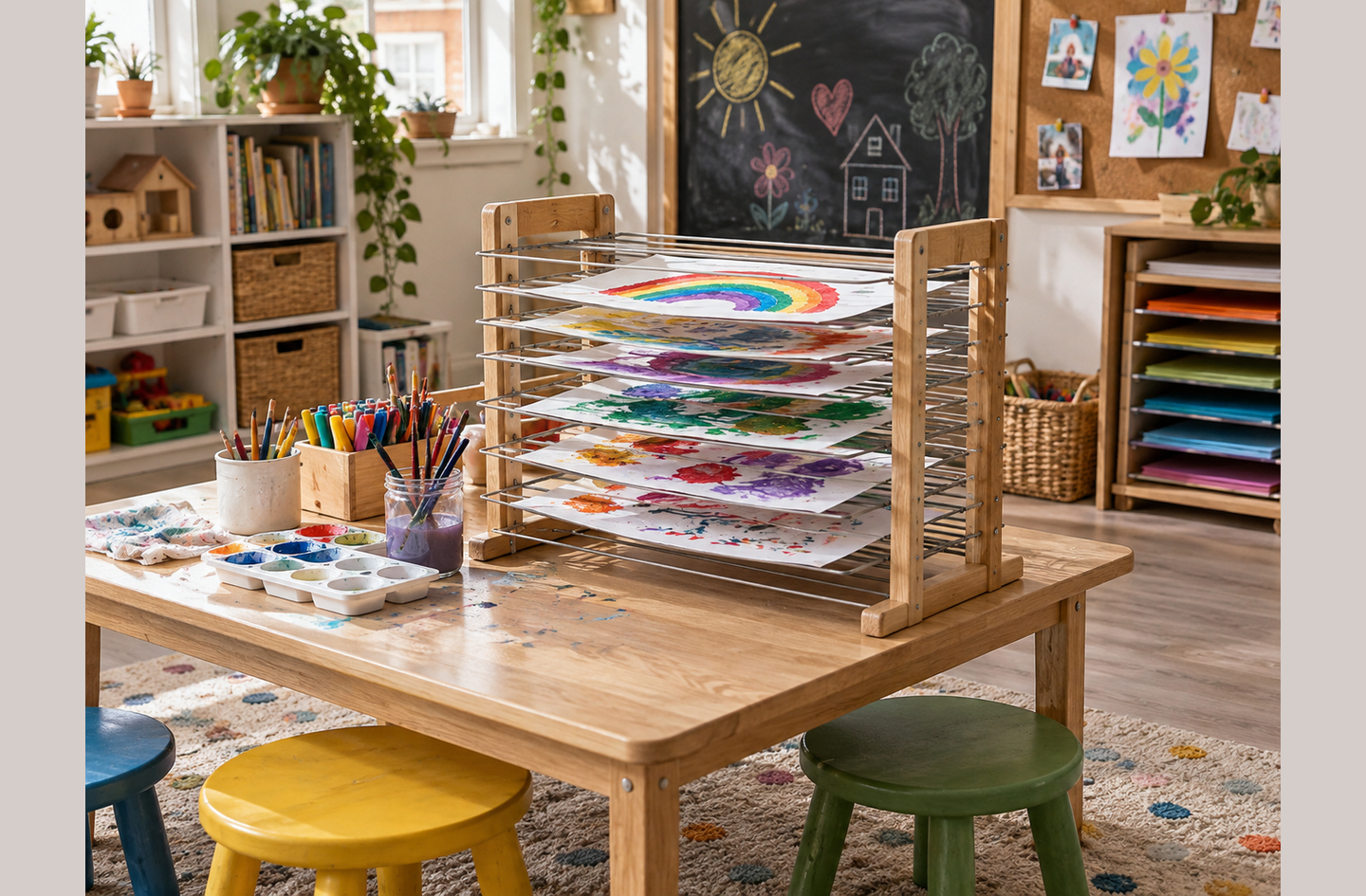
A tabletop drying rack is a short stack of hinged wire shelves that sits on a table or counter. A freestanding drying rack is a taller frame of wire shelves that stands on the floor on fixed feet. A mobile drying rack is a freestanding rack on casters, so it can roll to the table during a session and away afterward. Wall-mounted racks, pull-out shelves in cabinetry and clip lines appear as alternatives inside the sections where they fit.
| Category | Tabletop rack | Freestanding rack | Mobile rack |
|---|---|---|---|
| Best for | One or two children, small batches | Weekly painting, larger batches | Shared rooms where the zone must clear away |
| Planning range of shelves | 8 to 15 | 15 to 25 | 15 to 25 |
| Largest sheet to check for | 12 x 18 in | 18 x 24 in | 18 x 24 in |
| Floor footprint | None, but uses table space | About 2 x 2 ft plus loading space | About 2 x 2.5 ft plus a rolling path |
| Airflow | Limited on the side facing the table surface or a wall | Open on all sides when placed off the wall | Open on all sides and can roll to better air |
| Stability | Low and compact, little height to tip | Taller; check the base width and anchoring | Taller and wheeled; locking casters needed |
| Child can load it | Top shelves sit high once the rack is on a table | Middle shelves within a child’s reach | Middle shelves within a child’s reach |
| Clears away after use | Lifts off, but needs a shelf to live on | No | Yes |
| Verdict | Wins on footprint | Wins on capacity per square foot | Wins on flexibility |
No rack wins every row, so the right choice starts with the floor plan and the family’s painting rhythm rather than the shelf count printed on the box.
Paper Size: Which Kids Art Drying Rack Fits the Biggest Sheets?
A freestanding or mobile rack wins on paper size, because floor racks have room for wider shelves than a rack built to sit on a table. The largest sheet a child paints on sets the minimum shelf size. When a sheet is wider than its shelf, the edges droop through the wires or onto the work below, and wet paint transfers.
| Sheet | Size | Typical use | Rack type that holds it flat |
|---|---|---|---|
| Letter | 8.5 x 11 in | Drawing, marker work, worksheets | Any of the three |
| Small construction paper | 9 x 12 in | Collage, crayon and light paint | Any of the three |
| Large construction or painting paper | 12 x 18 in | Tempera and watercolor at the table | Many tabletop racks; most floor racks |
| Easel pad | 18 x 24 in | Easel painting, large group work | Freestanding or mobile racks sized for it |
Easel paintings decide the shelf size
The easel pad is the largest common sheet in a home art station. If the household has an easel, size the rack for 18 by 24 inch paper from the start, or large paintings end up on the floor.
Heavy and soaked work needs firm support
Thick tempera, glue-heavy collage and watercolor on thin paper all sag when wet, so a shelf with closely spaced wires supports them better than one with wide gaps.
Buy the shelf size for the biggest sheet in the house, since one oversized painting per session is enough to defeat a small rack.
Capacity: How Many Shelves Does a Kids Art Drying Rack Need?
A drying rack needs one shelf for every wet piece a session produces, plus shelves for work still drying from the session before. The shelf count on the box is the upper limit, not the useful number.
A simple planning rule works for most homes. Multiply the number of children by the wet pieces each makes per session, then by the sessions that overlap on the rack, and add one spare shelf. Two children making three paintings each, with the last session still damp, need twelve shelves plus a spare.
One wet piece per shelf
Stacking two wet sheets on one shelf transfers paint and glues them together. For wet documents, the National Archives advises air drying them flat, in small piles about half an inch high or individually if possible2. A painted face picks up color from anything touching it, so each painting gets its own shelf.
Shelves by child, not by first come
In a sibling household, give each child a band of shelves. Younger children get the shelves they can reach, and older children or adults take the high and low ones. Each child then knows where their work is, and the rack is easier to clear at the end of the week.
Clay and models need a tray, not a wire shelf
Clay pieces, cardboard models and thick collage do not belong on a wire paper rack. They need a flat tray or a solid shelf while they dry, then a ledge or box once they are finished. The rotating gallery comparison covers ledges for finished three-dimensional work.
Size the rack for the busiest normal session, not the average one, because overflow from a busy day ends up on the floor.
Footprint and Clearance: Keep the Drying Zone Out of the Walking Path
A tabletop rack wins on floor footprint because it uses no floor at all, but it takes table space the next session needs. A freestanding rack takes a patch of floor about two feet square, and a mobile rack needs that patch plus a clear route to roll along.
The walking path is the space to protect first. Federal accessibility standards set 36 inches as the minimum clear width of a walking surface1. The rule governs public buildings, not homes, but it is a useful reference: a rack that leaves less than that between itself and the table is likely to get bumped.
| Approach | Rack footprint | Loading space in front | Floor zone to reserve |
|---|---|---|---|
| Tabletop rack | None on the floor; about 14 x 20 in of table | None extra | Table space only |
| Freestanding rack | About 24 x 24 in | About 24 in | About 24 x 48 in |
| Mobile rack | About 24 x 30 in | About 24 in, plus a 36 in route to roll | About 24 x 54 in where it parks |
| Wall-mounted fold-down rack | None when folded | About 24 in when in use | A strip along the wall |
Wall-mounted racks and the protrusion rule
Wall racks save floor space but stick out from the wall when open. Federal standards limit objects with leading edges between 27 and 80 inches above the floor to 4 inches of protrusion into a circulation path1. An open drying rack sticks out far more than that, so mount it beside the table rather than along a route people walk.
Corners, doors and closets
A corner beside the art table suits a floor rack because few people walk through it, provided the rack stays clear of door swings. Tape the floor zone before buying and live with the tape for a few days.
Reserve the floor zone before choosing the rack, because a rack that blocks the path gets moved, and a moved rack stops being used.
Airflow and Humidity: Where a Paint Drying Rack for Kids Works Best
A mobile rack wins on airflow because it can roll to the spot with the best air, but any rack dries well when air moves around all its sides. Open wire shelves let air reach both faces of a sheet. The National Archives describes well-supported screens, stacked with space between them, as an excellent compact drying surface, and notes that the porous surface helps air circulate2.
“To provide optimal air drying conditions, fans should be positioned for maximum air circulation (do not aim air flow directly at drying materials).”
U.S. National Archives and Records Administration, Emergency Salvage of Flood Damaged Family Papers2
That guidance was written for flood-damaged family papers, but the physics carries over to children’s paintings. Moving room air carries moisture away from every shelf, while a fan aimed straight at the rack can lift light sheets off it.
Humidity matters as much as airflow. The EPA advises keeping indoor humidity below 60 percent, ideally between 30 and 50 percent3. A laundry room, a bathroom or a damp basement corner is a poor drying spot for that reason. The EPA also notes that a humidity meter is a small, inexpensive instrument costing $10 to $503, which takes the guesswork out of choosing the spot.
Relative humidity is the amount of water vapor in the air compared with the most the air could hold at that temperature, given as a percent. The lower it is, the faster wet paper gives up its water.
Two days is the outer limit
Two federal sources use a similar two-day window for water-damaged material. The EPA says water-damaged items should be dried within 24 to 48 hours to prevent mold growth3. The National Archives says wet records that cannot be air dried within two days should be frozen2. A child’s painting carries far less water than a flooded document, so the window is a ceiling, not a target. Work still damp after two days points to the spot, not the rack.
Tabletop racks and the wall
A tabletop rack pushed against the wall dries slowest on its blocked side. Pull it forward a hand’s width, or turn its open sides toward the room, so air reaches the back of every shelf.
Choose the drying spot for its air before choosing the rack for its shelves. A large rack in a damp, still corner loses to a small one in moving air.
Stability: Which Drying Rack Stays Put Around Children?
A tabletop rack wins on stability, because its low, compact frame has little height to tip, provided it sits well back from the table edge. Floor racks are taller and carry weight high up once the top shelves fill. A mobile rack adds wheels, which is useful at clean-up time and a liability when the casters are left unlocked.
Tall furniture that tips is a well-measured risk. A study of U.S. emergency department data from 1990 to 2019 found an average of 18,673 children a year treated for furniture or TV tip-over injuries4. Children under 6 accounted for 69.9% of those injuries4. The study did not look at drying racks. Still, a loaded floor rack is also a tall object a child can pull, lean on or climb.
Freestanding racks: wide base, low weight
Choose a floor rack whose base is wide for its height, and fill it from the bottom shelf up so the weight stays low. Where a tall rack stands in a play area, a wall strap reduces avoidable risk. Have a licensed installer match the strap and fixings to the wall.
Mobile racks: locked unless moving
Locking casters should stay locked except while an adult rolls the rack. Move it before the session, while the shelves are empty, because a loaded rack jolts over a rug edge and wet sheets slide together.
Hardware does not replace an adult in the room. The federal art and craft safety guide, written about art materials, makes the same point about supervision.
“Children need regular and consistent reminders of safety rules, and there is no substitute for direct supervision.”
U.S. Consumer Product Safety Commission, Art and Craft Safety Guide8
The taller the rack, the more its base, casters and climbing rules matter, so families with toddlers gain most from a low rack set back on the table.
Child Access: Can Kids Load the Drying Rack Themselves?
A floor rack wins on child access, because most of its shelves fall within the reach ranges federal guidance lists for children. Federal guidance gives a forward or side reach range of 20 to 36 inches for ages 3 and 4. The ranges widen to 18 to 40 inches for ages 5 to 8 and 16 to 44 inches for ages 9 to 121. These are design ranges for building elements, not a measure of one child’s reach.
A tabletop rack changes the math because the table lifts it. Federal accessibility standards place accessible work surfaces for children’s use at 26 to 30 inches above the floor1; home tables vary, so measure yours. A tabletop rack about 15 inches tall on that table puts its top shelf near 41 to 45 inches above the floor. That is well above the 36 inch high reach for ages 3 and 4.
The Third Teacher is the idea, from the Reggio Emilia approach to early education, that the room itself teaches, alongside parents and teachers, by making good routines easy to follow. A drying rack a child can load is a small example. When putting a wet painting away is something the child does alone, the art session ends with the child’s own reset instead of a parent’s chore.
Low shelves for younger children
Reserve the shelves inside the youngest child’s reach for that child. Give the top and very bottom shelves to adults or older siblings, and label each band with a color dot.
Hands, sleeves and wet paint
Children carry a wet sheet by its dry corners, lift the shelf, slide the paper in and lower the shelf, and painty hands leave prints on the frame. The painting station plan covers water and hand washing near the table.
Put the rack where the child who paints can also put the painting away, because a rack only an adult can load turns every session into an adult’s job.
Location: Connect the Drying Zone to the Table, Display and Storage
The drying zone works best within a few steps of the painting table, on the route finished work already travels: table, rack, display, storage. When the rack sits in another room, wet paintings wait on the table, and the next session starts by moving them. The room as a system decides the spot, not the empty wall.
Heat sources are the first thing to keep away from the rack. The U.S. Fire Administration advises keeping anything that can burn at least 3 feet from all heat sources, including radiators and space heaters5. Portable heater fires were only 3% of home heating fires in 2017 to 2019, yet they accounted for 41% of fatal heating fires in homes5. A rack of paper is fuel, so a heater is never a drying aid.
In its storage guidance for works on paper, the Library of Congress also lists distance from radiators and vents and no exposure to direct or intense light7. A spot across the room from a sunny window, with moving air, serves both needs.
From the table to the rack
Place the rack on the side of the table away from the walking path, so a child carrying a wet sheet never crosses traffic. The kids art table comparison covers the space the table itself needs.
From the rack to the box
Dry work moves on to the display or to storage, and only dry work goes into a box. The National Archives advises keeping stored papers below 75 degrees Fahrenheit, with relative humidity below 65% to prevent mold growth6. The kids artwork storage guide covers what happens to each piece after it leaves the rack.
Design for the reset, not just the reveal: the best drying spot empties the table in seconds and feeds the display and the box without a detour.
Cost and Hidden Costs
A tabletop rack costs the least and a freestanding wire rack costs more, while a mobile rack adds casters and a heavier frame. Wall-mounted and built-in racks cost the most once installation is counted. The hidden costs are floor space occupied all year, paintings ruined on an undersized shelf, and wall repair after a wall rack comes down.
Judge each rack by the cost per usable shelf over a school year, not the price on the package.
Who Should Choose Which Drying Rack?
A family that paints every week and has a spare corner should choose a freestanding rack. Where floor space is the hard limit, a tabletop rack fits, and where the room changes jobs after the session, a mobile rack with locking casters works best.
- One preschooler who paints a few times a week: a tabletop rack set back from the table edge.
- Siblings who paint together: a freestanding rack in the corner beside the table, with a band of shelves per child.
- A shared living room or dining room: a mobile rack that rolls to the table for the session and parks in a closet or corner afterward.
- A small apartment with no free floor: a wall-mounted fold-down rack beside the table, or a tabletop rack stored on a shelf.
- An easel painter: any floor rack with shelves sized for 18 by 24 inch paper.
Pick the rack for the room’s busiest normal day and the child who will load it, not for the photo of a full rack on the box.
Verdict: Category Winners
A freestanding wire rack wins most categories for a home that paints every week. A tabletop rack wins where floor space is the limit, and a mobile rack wins where the room must clear.
| Category | Winner |
|---|---|
| Paper size | Freestanding or mobile rack |
| Capacity per square foot | Freestanding rack |
| Floor footprint | Tabletop rack |
| Airflow | Mobile rack, or any rack off the wall |
| Stability | Tabletop rack set back from the edge |
| Child access | Freestanding or mobile rack |
| Clearing the room | Mobile rack |
| Overall | Freestanding rack for weekly painters; tabletop for small rooms; mobile for shared rooms |
Start by taping the floor zone and counting a busy session’s wet pieces, then let those two numbers pick the rack type.
Frequently Asked Questions
How much space does a kids art drying rack need?
A floor rack needs a patch about two feet square, plus about two feet in front for loading. Keep the walking path beside it clear: accessibility standards set 36 inches as the minimum clear width of a walking surface1. A tabletop rack needs no floor but takes table space.
Where should a drying rack for kids’ paintings go?
Within a few steps of the painting table, away from heat and direct sun. The U.S. Fire Administration advises keeping anything that can burn at least 3 feet from radiators and space heaters5. Avoid humid rooms; the EPA advises indoor humidity below 60 percent3.
How long can kids’ artwork stay damp on a drying rack?
Treat two days as the outer limit. The EPA says water-damaged items should be dried within 24 to 48 hours to prevent mold growth3. A painting holds far less water than a flooded document, so work still damp after two days points to a humid or still spot.
Is a rolling drying rack a good idea with toddlers?
It can work if the casters stay locked and the rack is not climbed. Children under 6 accounted for 69.9% of furniture and TV tip-over injuries in a 30-year U.S. emergency department study4. With toddlers, a low tabletop rack set back from the table edge is the simpler choice.
Should a fan point at the drying rack?
No. Circulate the room air instead. National Archives guidance for drying wet papers says to position fans for maximum air circulation and not to aim air flow directly at drying materials2. A direct blast can lift light sheets off the shelves.
Limitations and Edge Cases
- The reach ranges and clear widths come from accessibility standards for public buildings and describe groups of children, not one child. Watch where your own child can reach, and for a specific child’s motor needs, consult a pediatric occupational therapist.
- The drying guidance from the EPA and the National Archives was written for water-damaged buildings and papers, not art paint. Oil-based or solvent paints are outside this comparison; follow the product label and ventilate the room.
- Wall-mounted racks, built-in pull-out shelves and wall straps need fixings matched to the wall. Before installation, evaluate the wall and hardware with a licensed installer or contractor.
References
Methodology: every cited figure comes from a published source listed here, each checked live on October 5, 2026. The comparison tables, the shelf-count rule, the floor-zone estimates and the humidity chart are Playroom Architect planning syntheses built from those sources, not product tests.
- U.S. Access Board – ADA Accessibility Standards (2010), sections 307.2, 403.5.1 and 902.4.2 and Advisory 308.1 on children’s reach ranges.
- U.S. National Archives and Records Administration – Emergency Salvage of Flood Damaged Family Papers, Preservation, Conservation.
- U.S. Environmental Protection Agency – A Brief Guide to Mold, Moisture and Your Home.
- PubMed – Lu C, Badeti J, Mehan TJ, Zhu M, Smith GA. Furniture and television tip-over injuries to children treated in United States emergency departments. Injury Epidemiology, August 2021.
- U.S. Fire Administration – Heating Fire Safety, Home Fire Prevention, FEMA.
- U.S. National Archives and Records Administration – Storing Family Papers and Photographs, How to Preserve Family Archives.
- Library of Congress – Care, Handling and Storage of Works on Paper, Collections Care, Preservation.
- U.S. Consumer Product Safety Commission – Art and Craft Safety Guide, publication 5015.
Conclusion
An art drying rack for kids earns its place when it empties the table in seconds, stays out of the walking path and sits in moving, moderately dry air. Size it by the biggest sheet and a busy session’s wet pieces. Then choose the type: freestanding for weekly painters, tabletop for tight rooms, mobile for shared rooms.
To see how the drying step fits the wider art space, return to the art station planning overview, the summary of planning a home art station.