
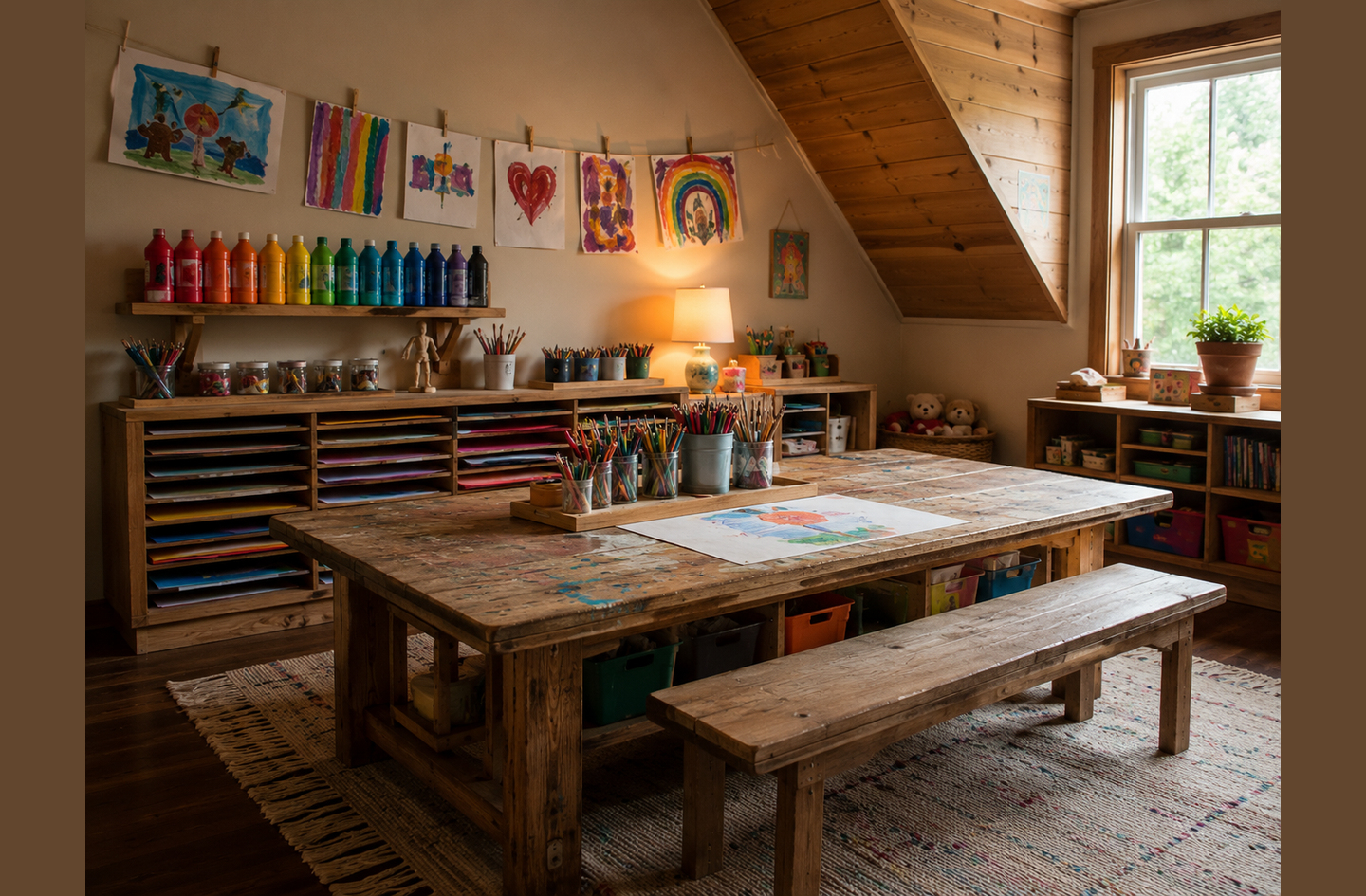
The best kids artwork display ideas are the ones a family can update in seconds, because a gallery that is hard to change stops changing. Our Art & Craft Stations guide is the overview of planning a home art station. This article covers one part of it: the display. More is not always better on a wall. In one lab study, kindergartners spent 38.6% of lesson time off-task in a heavily decorated classroom, against 28.4% in a sparse one1. The sections that follow compare clip systems, front-opening frames, ledges and boards.
Quick Answer
Which kids art display is easiest to keep updated?
A clip system mounted within a child’s reach is the fastest to update, and a ledge is the best fit for clay and other three-dimensional work. Front-opening frames suit the few pieces worth protecting. Federal accessibility guidance lists a reach range of 20 to 36 inches above the floor for children aged three and four2. A rail at that height lets children swap their own work.
Key Takeaways
- Update speed decides whether a gallery rotates. Clips and ledges take one step per swap; a standard frame takes several.
- A shared reach zone exists: every children’s reach band from age three to twelve covers 20 to 36 inches above the floor2.
- Fewer pieces can work better. Kindergartners scored 55% correct in a sparse lab classroom and 42% in a decorated one1.
- Light can fade and darken artwork, including marker drawings. The National Archives advises displaying copies and keeping originals in a box7.
- A common misconception: a bigger display wall solves the paper pile. A fixed number of slots, swapped on a schedule, is what keeps finished work moving.
Kids Artwork Display Ideas Compared: Clips, Frames, Ledges and Boards
Four display types cover most home galleries, and each one trades update speed against protection and wall impact. The names are used loosely in stores, so here is how this comparison defines them.
A clip system is a wire, cable, rail or strip of wood fitted with clips that grip paper without piercing it. A front-opening frame is a frame whose face hinges or lifts open, so the artwork can be swapped while the frame stays on the wall. A picture ledge is a narrow wall shelf with a lip, used to lean flat work or stand small objects. A display board is a cork, fabric, magnetic or pegboard panel that holds work with pins, magnets or clips.
| Category | Clip system | Front-opening frame | Picture ledge | Display board |
|---|---|---|---|---|
| Best for | Frequent rotation of flat paper | A few favorite pieces kept longer | Clay, collage and mixed sizes | Many small pieces, notes and photos |
| Steps to swap one piece | One: unclip, clip | Two to three: open, swap, close | One: lift, lean | One to two: unpin or unstick, refasten |
| Wall fixings | Two to four small fixings per run | Two per frame, so many for a grid | Two to four, ideally into studs | Four per board, or one rail |
| Flat work | Good | Good, size-limited by the opening | Good when stiff enough to lean | Good |
| Three-dimensional work | Light pieces only | Shallow pieces in deep frames | Best of the four | Light, flat collage only |
| Light and dust protection | None | UV glazing filters UV and keeps dust off | None | None |
| Child can update alone | Yes, when mounted low | Rarely; hinges need care | Yes, when mounted low | Yes with clips; pins need an adult |
| Overload risk | Medium | Low: fixed slots | Medium | High: no visible limit |
| Verdict | Wins on speed | Wins on protection | Wins on three-dimensional work | Wins on capacity, loses on restraint |
No single type wins every row, so most working galleries pair a fast type for rotation with a slower, protective type for the keepers.
Update Speed: Which Kids Art Display Changes Fastest?
A clip system wins on update speed, because a swap is one motion and nothing comes off the wall. A ledge comes a close second: the old piece lifts away and the new one leans in its place. Both let a gallery change on the same day a drawing comes off the table.
Front-opening frames sit in the middle. The frame stays up, but the face has to open and close, and the piece must fit the opening. A standard frame is the slowest by far. It comes off the hook, the back opens, the piece is trimmed or centered, and the frame goes back up. That is why standard frames tend to hold the same drawing for years.
Rotation means showing a fixed number of pieces and swapping them on a schedule. The display becomes a stop on the route rather than the end of it. Rotation only survives if the swap costs less effort than leaving the old piece up. Design for the reset, not just the reveal: a gallery that looks finished on day one but takes ten minutes to change will soon stop changing.
Boards: fast with clips, slow with pins
A display board can be as fast as a clip rail or as slow as a frame, depending on the fastener. Clips and large magnets are quick. Push pins take longer, mark the paper, and are small enough that many families keep them away from toddlers.
Set the rhythm, not just the hardware
Pick a swap moment that already exists, such as the end of each week or the day new work comes home from school. A regular moment matters more than the exact interval. The kids artwork storage guide covers where pieces go after they leave the wall.
Choose the main display by how fast one piece can be swapped, because the slowest step in the routine sets how often the gallery changes.
Wall Impact: How Many Holes Does Each Display Need?
A single clip rail or board wins on wall impact, because one run of two to four fixings can hold a whole row of art. A grid of frames loses, since every frame needs its own hook and its own level line. A picture ledge needs few fixings, but they carry more weight and work best when they reach the studs.
Depth matters too, not only holes. Federal accessibility standards limit objects mounted between 27 and 80 inches above the floor to a 4 inch protrusion into a walking path2. The rule is an accessibility standard for circulation paths, not a home building code. At home it is a useful reference: a deep ledge loaded with clay pieces beside a busy path is easy to bump.
Renters and plaster walls
A tension cable between two points, or a rail held with removable adhesive strips, suits light paper and leaves little trace. Heavier ledges and boards need proper anchors. For plaster, brick or an unknown wall, have a licensed installer or contractor choose the fixings.
Freestanding easels and display shelves
A freestanding board or shelf avoids wall holes but adds a tip-over question. U.S. emergency departments treated an estimated average of 18,673 children a year for furniture or television tip-overs between 1990 and 20193. Children under six accounted for 69.9% of those injuries3. A tall display shelf should be anchored to the wall, and an easel should have a wide, stable base.
For most rooms, one long rail or board beats a scattered grid. It concentrates the wall work in one place and keeps the gallery reading as a single unit.
Capacity: How Many Pieces Should a Kids Art Display Wall Hold?
A display board wins on raw capacity, but capacity is the wrong goal for a home gallery. A board sized for fifteen sheets can easily end up holding twenty-five, layered and curling. A clip rail or a set of frames shows its limit at a glance, which makes the swap rule easy to keep.
| Display type | Layout assumed | Letter-size pieces shown | Visible limit? |
|---|---|---|---|
| Clip system | Three rows of clips, four sheets per row | 12 | Yes: every clip is a slot |
| Front-opening frames | Two rows of three frames | 6 | Yes: one piece per frame |
| Picture ledges | Two ledges, four leaning pieces each | 8, or fewer with clay pieces | Partly: pieces can stack |
| Display board | One 48 x 36 in board, five across and three down | 15 | No: pieces layer easily |
The case for a limit comes from attention research. In a Carnegie Mellon lab study, 24 kindergarten children took six science lessons, three in a heavily decorated room and three in a sparse one1. They answered 55% of test questions correctly in the sparse room and 42% in the decorated room1.
“Therefore, I would suggest that instead of removing all decorations, teachers should consider whether some of their visual displays may be distracting to young children.”
Anna V. Fisher, associate professor of psychology, Carnegie Mellon University1
The study tested a lab classroom during lessons, not a playroom during free play. Its lead author also stressed that more research is needed in real classrooms. The practical reading for a home is modest: a wall can carry children’s work without covering every surface.
Set a slot count before buying hardware
Decide how many pieces the wall shows per child, then buy that many clips or frames and no more. When a new piece goes up, an old one comes down and moves to the sort. Siblings each get their own row, so nobody’s work is buried under someone else’s.
The right capacity is the number of pieces a child will still notice; a visible slot limit protects that number better than a large board.
Flat vs Three-Dimensional Work: Which Display Handles Clay and Collage?
A picture ledge wins for three-dimensional work, because clay, cardboard models and heavy collage need a surface to stand on rather than a clip to hang from. Clips handle paper and light collage well. Front-opening frames handle flat work and shallow pieces, if the frame is deep enough. Boards hold flat work best, since thick pieces pull pins loose.
Ledge depth is the trade-off. A shallow ledge holds leaning paper but tips a clay bowl off its edge. A deeper ledge holds objects but sticks further into the room. Federal accessibility standards limit objects mounted between 27 and 80 inches above the floor to a 4 inch protrusion into a walking path2. That is a good reason to keep deep ledges off the main path, such as above a low cabinet or at the end of a table.
Shadow-box frames for keepsake objects
A shadow box is a deep frame with space between the glazing and the back, made for objects. It suits a single keepsake, such as a first clay handprint, that will stay up for a long time. It is slow to change, so it belongs in the keepers zone rather than the rotating gallery.
Mixed walls: one rail, one ledge
Many families get the most from a clip rail for paper with a ledge directly beneath it for objects. The pair reads as one gallery and covers both kinds of work. Keep the ledge low enough for children to reach, and keep heavy or breakable pieces at the back of the shelf.
If the household makes clay or cardboard work often, plan a ledge from the start. Objects forced onto a paper display tend to end up on the floor.
Child Access: Can Kids Update the Gallery Themselves?
A low clip rail or ledge wins on child access, because children can only maintain a display they can reach without climbing. Federal guidance lists a reach range of 20 to 36 inches for ages three and four. The range is 18 to 40 inches for ages five to eight, and 16 to 44 inches for ages nine to twelve2. The range between 20 and 36 inches falls inside all three.
Children’s height changes quickly across that span. WHO data puts median height for boys at 103.3 cm at age four4, and at 127.3 cm at age eight and 149.1 cm at age twelve5. A gallery hung at adult eye level suits the twelve-year-old far better than the preschooler.
The Third Teacher is the idea that the room itself teaches, alongside parents and teachers, by making good routines easy. A gallery in the shared reach zone is a small example. When children can take down a piece and put up a new one, curating their own wall becomes part of the art routine instead of a parent’s chore.
Two heights, two jobs
A practical split is a low rotating rail that children manage and a higher row of frames that adults manage. The low rail changes weekly. The high row holds the few pieces the family has chosen to keep up longer.
Magnets: choose large ones
Magnetic boards and strips make swapping easy, but small, powerful magnets are an ingestion hazard. The CPSC estimated that 26,600 magnet ingestions were treated in U.S. hospital emergency departments from 2010 through 20216. The same rule names posting items on a refrigerator door as one everyday use of magnets from magnet sets6. Use large, single magnets made for children’s displays, and keep small loose magnets out of a child-managed gallery.
Put the rotating part of the gallery where children can reach it, because a display only adults can update becomes an adult’s job, and adult jobs get postponed.
Preservation: Which Display Protects Original Artwork?
A front-opening frame with UV-filtering glazing wins on preservation. It is the only one of the four types that filters ultraviolet light and keeps dust off the surface. Visible light still fades work over time. Clips, ledges and boards leave work fully exposed. That is fine for a drawing that will rotate off the wall soon, and a problem for a piece the family wants to keep for decades.
“The best protection from light is to display copies of the originals and keep the originals in a box.”
U.S. National Archives and Records Administration, Displaying Family Papers and Photographs7
The National Archives illustrates the risk with two overlapping drawings: light faded a purple marker everywhere except where the other sheet covered it7. The Library of Congress recommends minimal exposure to all kinds of light for works on paper, and no exposure to direct or intense light8.
UV-filtering glazing is glass or acrylic treated to block much of the ultraviolet light that fades pigments. The National Archives advises it for originals displayed in a room with sunlight or fluorescent light7. It also warns that acrylic can generate static, so it should be avoided for pastels and other powdery media7.
Copies on the rail, originals in the box
For a keepsake, a color scan or photocopy can go on the rotating rail while the original goes straight to the archive. Color scans and color photocopies can make good display copies7, and a copy can be printed again if it fades or tears.
Placement beats hardware
Keep the gallery off a wall that takes direct sun, and avoid hanging work over a radiator or vent8. A wall facing away from the window reduces light exposure for every display type at no extra cost.
Treat exposure as a budget: rotating pieces can spend it freely, and keepers should be framed behind UV-filtering glazing or shown as copies.
Keep the Kids Art Display Wall Connected to the Art Station
A gallery on the same wall as the art station, or the wall facing it, works best, because finished pieces travel only a few steps. When the display sits in a hallway or another room, work piles up on the table while it waits for someone to carry it. The route should run table, drying spot, gallery, then sort.
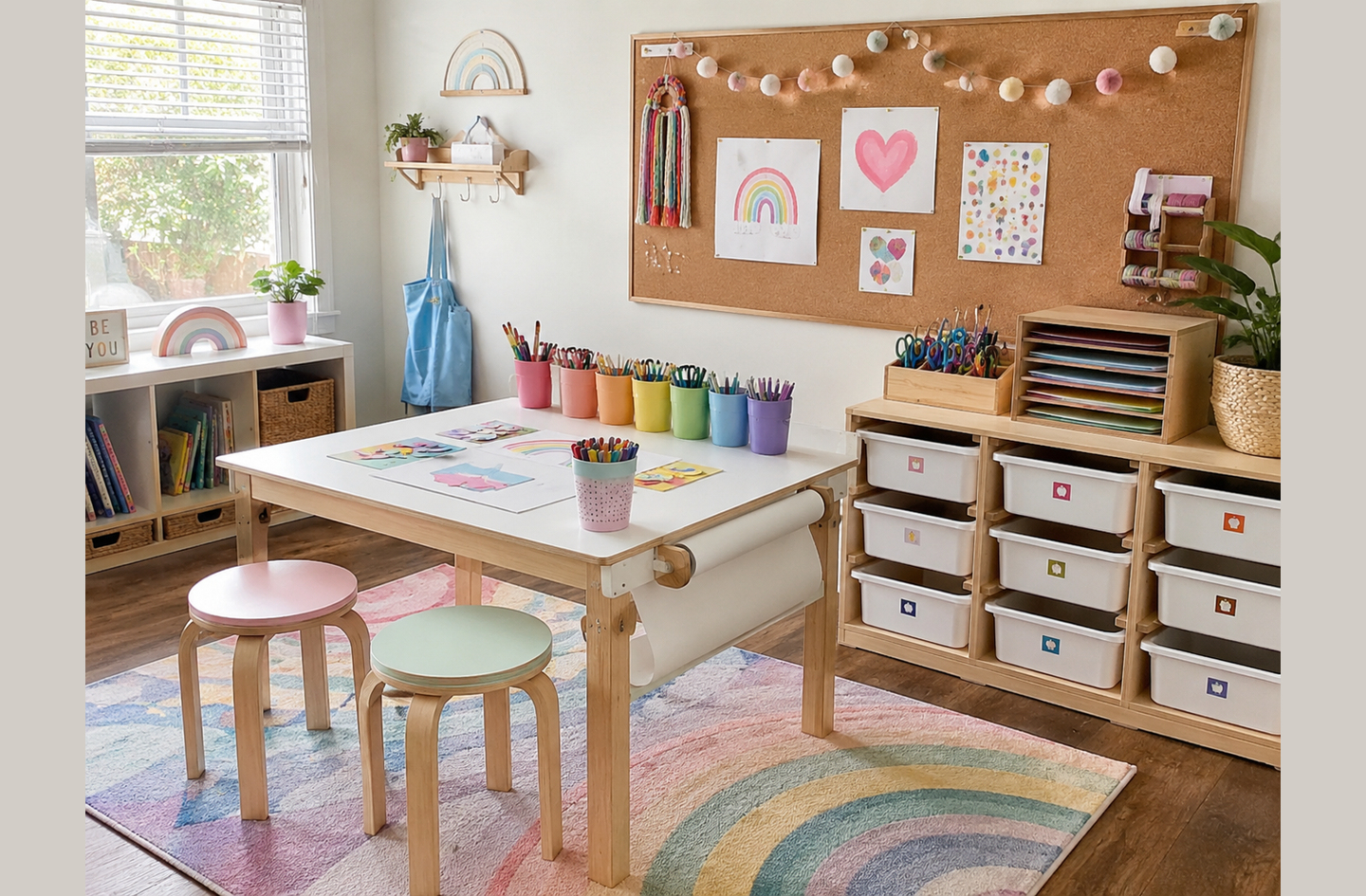
Wet work needs a stop before the wall. Paintings and glue-heavy collage go to a drying rack or line first, then to the gallery once they are flat. The painting station plan covers drying space for wet media in detail.
Keep the table clear
Finished work left on the table blocks the next session. A small landing tray beside the station gives each piece a temporary home until the next swap. The kids art table comparison explains how much floor and edge space the table itself needs.
The room as a system decides where the gallery goes: put it on the route finished work already travels, not on the wall that happens to be empty.
Cost and Hidden Costs
A clip system usually costs the least to set up and to run, because one rail and a bag of clips serve every piece. Frames cost the most per slot, since each displayed piece needs its own frame and, for keepers, its own glazing. Ledges and boards fall in between.
The hidden costs are rarely the hardware. They are wall repair after a grid of frames comes down, replacement clips and magnets, and the time a slow display takes to update. A cheap board that nobody updates costs more in clutter than a slightly dearer rail that changes every week.
Judge each option by the cost per swap over a school year, not the price on the package.
Who Should Choose Which Display?
If the goal is a gallery that changes weekly, choose a low clip system. If the goal is keeping a few favorites in good condition, choose front-opening frames. Most homes combine the two, and these profiles cover the common cases.
- Preschooler with a daily drawing habit: a low clip rail inside the shared reach zone, with large magnets or clips only.
- School-age child who builds and sculpts: a clip rail with a picture ledge beneath it, placed away from the main walking path.
- Siblings of different ages: one row per child on the same rail, plus a higher frame row for the pieces the family keeps up longer.
- Renters or plaster walls: a tension cable or adhesive-strip rail for paper, and a freestanding board with a wide, weighted base.
Some children make large paintings that no standard slot fits. For them, one oversized front-opening frame or a long clip line can serve as a temporary feature wall.
Pick the display for the child who will update it, not for the adult who will look at it.
Verdict: Category Winners
A low clip system wins most categories for a rotating gallery, and front-opening frames win where protecting a few originals matters more than speed.
| Category | Winner |
|---|---|
| Update speed | Clip system |
| Wall impact | Clip rail or single board |
| Capacity with restraint | Clip system or frames (visible slots) |
| Three-dimensional work | Picture ledge |
| Child access | Low clip rail or ledge |
| Preservation | Front-opening frame with UV-filtering glazing |
| Cost per swap | Clip system |
| Overall | Low clip rail for rotation, plus a few frames for keepers |
Start with one low rail and a fixed slot count, then add a ledge or frames only when the work coming home calls for them.
Frequently Asked Questions
How high should a kids art display be?
Mount the rotating part low enough for children to reach. Federal guidance gives a reach range of 20 to 36 inches for ages three and four2, and that zone sits inside the ranges for older children too. Keepers can hang higher, where adults manage them.
How many pieces should a kids art display wall hold?
Fewer than the wall can fit. In a lab study, kindergartners answered 55% of questions correctly in a sparse classroom and 42% in a heavily decorated one1. Set a fixed slot count per child and swap one piece out for each piece that goes up.
What is the best way to display kids artwork without damaging walls?
One clip rail or one board needs only a few fixings, while a grid of frames needs one per frame. Tension cables and adhesive-strip rails suit light paper. Freestanding boards avoid holes but add a tip-over question. An estimated 18,673 children a year were treated in U.S. emergency departments for furniture or TV tip-overs from 1990 to 20193.
Should I frame the original or a copy of my child’s art?
Frame a copy when the piece is a keepsake. Light can fade and darken artwork, and the National Archives advises displaying copies while originals stay boxed7. If the original goes up, use UV-filtering glazing and keep it out of direct sun.
Are magnetic boards a good playroom art display?
They are quick to update when the magnets are large. Small, powerful magnets are an ingestion hazard: the CPSC estimated 26,600 magnet ingestions treated in hospital emergency departments from 2010 through 20216. Keep loose small magnets out of a child-managed gallery.
Limitations and Edge Cases
- The reach ranges come from accessibility guidance for public buildings and describe groups of children, not one child. Watch where your own child can reach comfortably, and for a specific child’s motor needs, consult a pediatric occupational therapist.
- The attention study tested 24 kindergartners in a lab classroom during lessons1. Home playrooms and free play were not tested, so treat its findings as a reason for restraint, not a rule.
- Ledges, boards and rails on plaster, brick or tile need fixings matched to the wall. Before installation, evaluate the wall and hardware with a licensed installer or contractor.
References
Methodology: every cited figure comes from a published source listed here, each checked live on October 5, 2026. The comparison table, the wall-panel capacity table and the reach chart are Playroom Architect planning syntheses built from those sources, not product tests.
- Association for Psychological Science – Heavily Decorated Classrooms Disrupt Attention and Learning in Young Children, reporting Fisher AV, Godwin KE, Seltman H, Psychological Science, 2014.
- U.S. Access Board – Guide to the ADA Accessibility Standards (2010 ADA Standards), sections 307.2 and 308.2.1 and Advisory 308.1 on children’s reach ranges.
- PubMed – Lu C, Badeti J, Mehan TJ, Zhu M, Smith GA. Furniture and television tip-over injuries to children treated in United States emergency departments. Injury Epidemiology, August 2021.
- World Health Organization – Child Growth Standards: length/height-for-age, simplified field tables for boys aged 2 to 5 years (percentiles).
- World Health Organization – Growth reference data for 5-19 years: height-for-age, simplified field tables for boys (percentiles), WHO 2007 reference.
- Federal Register – U.S. Consumer Product Safety Commission. Safety Standard for Magnets, final rule, September 21, 2022.
- U.S. National Archives and Records Administration – Displaying Family Papers and Photographs, How to Preserve Family Archives, page last reviewed July 1, 2025.
- Library of Congress – Care, Handling and Storage of Works on Paper, Collections Care, Preservation.
Conclusion
A rotating gallery works when swapping a piece is quicker than leaving it up. Start with a low clip rail inside the shared reach zone and set a fixed slot count. Add a ledge for clay and models, and a few front-opening frames or copies for keepers.
To see how the gallery fits the wider art space, return to the art station planning overview, the summary of planning a home art station.