
Daily independent reading among 9-year-olds dropped from 53 percent in 2012 to 39 percent in 2022, according to the National Assessment of Educational Progress.1 One practical way to push back on that trend is a bedroom reading nook that makes books the first thing a child reaches for. This article explains how to build one without blocking the bed approach, closet door, or main walkway, and covers small-bedroom adaptations starting at 6 square feet. For a broader look at nook planning, see Reading Nooks for Kids.
Quick Answer
What does a bedroom reading nook for kids actually need?
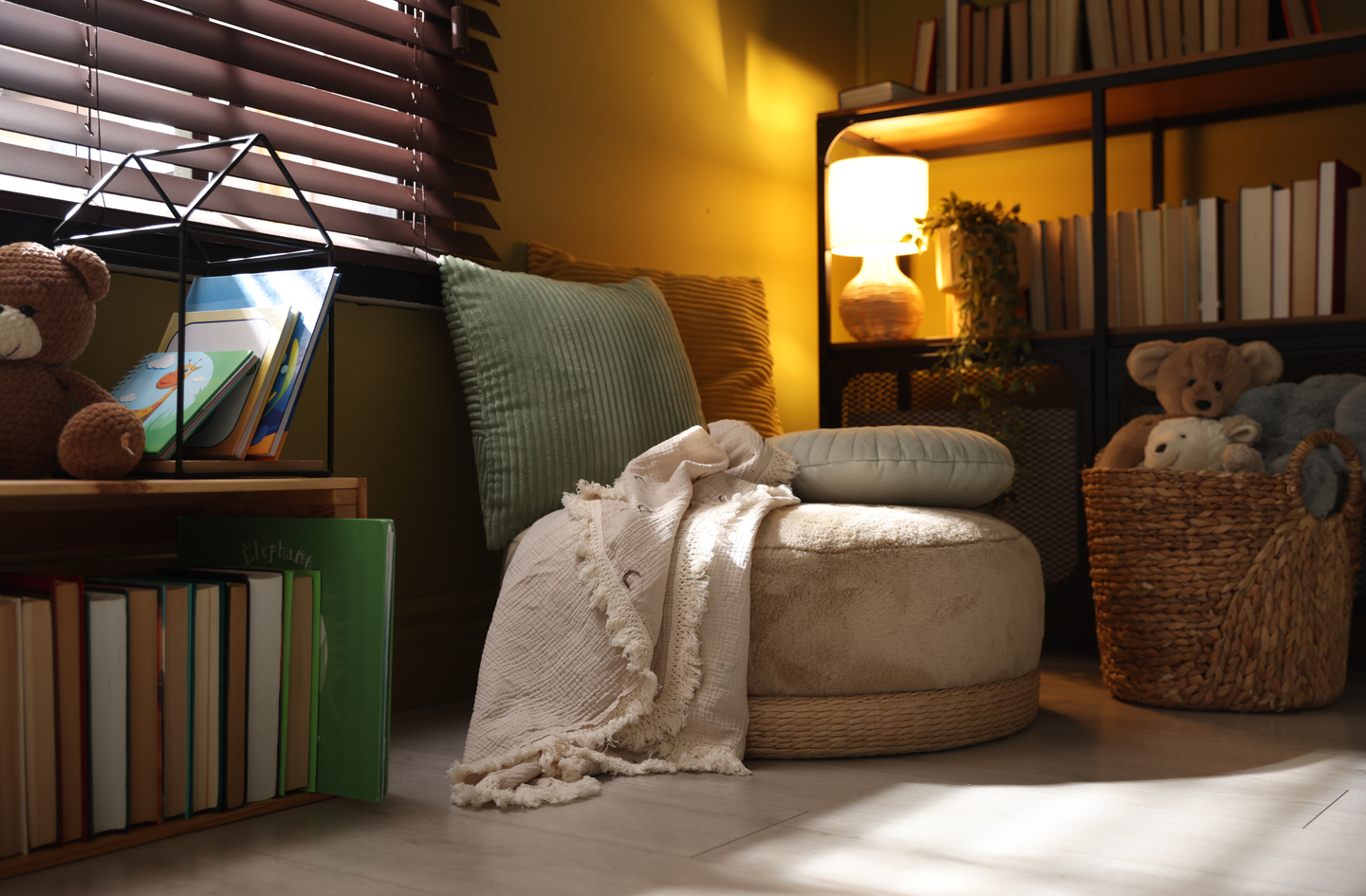
Choose a corner that sits outside the main bed-approach path, closet door swing, and room-to-door walkway. Add low-profile seating (8-16 inches off the floor, depending on the child’s age), a forward-facing shelf with 10-15 books within arm’s reach, and a dedicated task lamp that delivers at least 300 lux at the reading surface. Keep toy storage out of the zone entirely. In rooms under 120 square feet, a floor cushion plus a wall-mounted pocket shelf takes up as little as 24 inches by 24 inches.
Key Takeaways
- The share of U.S. 9-year-olds who read for fun almost every day fell from 53 percent to 39 percent between 2012 and 2022 (NAEP); a book-first bedroom corner reduces the friction that drives that decline at home.1
- Having as few as 20 books within a child’s reach has a measurable positive effect on educational outcomes, independent of household income (Evans et al., 2010).2
- Ambient bedroom lighting rarely reaches the 300-500 lux required for comfortable reading tasks (IESNA standard); a separate task lamp is not optional, it is the functional difference between a reading zone and a reading corner that goes unused.4
Before You Place the Nook, Walk the Room First
The most common planning error with a kids bedroom reading nook is treating it as a furniture purchase decision rather than a spatial one. Buy the cushion first, and it ends up in front of the closet, under the window that doesn’t open anymore, or in the path from the door to the bed. Research on classroom reading environments found that the physical arrangement of a space directly promotes or discourages voluntary time with books.7 The same principle applies to a bedroom. Walk the room before buying anything.
Map the three protected zones
Every children’s bedroom has three movement zones that must stay clear: the bed-approach path (typically the full length of one or both long sides of the bed), the closet door swing (most standard doors need 18-24 inches to open fully), and the primary walkway from the room entrance to the bed. Sketch these on a simple floor plan or tape them out on the floor. The space left over after protecting these three zones is where a reading nook belongs. In most 10-by-12-foot rooms, that leaves one or two viable corners, not four.
Identify corners where floor space is genuinely free
A viable nook corner has unobstructed floor space at least 24 inches wide and 24 inches deep. That is enough for a child to sit cross-legged on a cushion and reach a wall-mounted shelf in front of them. Larger is better, but 6 square feet is a functional minimum. Corners that are technically free but used as “overflow” space (piles of laundry, toys pushed aside) are not genuinely free. Clearing a corner and keeping it clear is a maintenance decision the whole nook depends on.
Note the natural light direction
A corner near a window is a bonus, not a requirement. Natural light helps during daytime reading, but the reading nook still needs a dedicated task lamp regardless, because most reading happens in the evening. More important than natural light: avoid placing the nook so the child faces a window directly. Glare on the page is harder for children to manage than for adults. Position the nook so light comes from the side or slightly behind the child’s shoulder. This works with or without a nearby window.
Step 1: Choose the Corner That Stays Clear of Traffic
Once the three protected zones are marked, pick the corner that sits deepest away from them. In most children’s rooms, this is the far corner from the door, or the corner between a window wall and the wall adjacent to the closet, as long as the closet door swings away from it. The goal is a spot where a child sitting and reading is never in the path of someone walking in or out of the room.
The dead-corner test
A “dead corner” is a spot the room’s occupant never needs to pass through during normal use. Stand at the door and walk to the bed, then to the closet, then to the desk or dresser. Watch which corners you never touch. That is your reading nook. In a typical 10-by-12-foot bedroom with a twin bed along one long wall and a dresser opposite, the far corner (away from the door) on the bed side is almost always dead space. It also happens to be quiet, which supports concentration.
Minimum floor footprint and what it fits
The minimum usable footprint for a bedroom reading nook is 24 inches wide by 24 inches deep (roughly 4 square feet). This fits a 20-inch floor cushion and leaves a child enough room to shift position. A 30-by-30-inch footprint accommodates a small bean bag and a forward-facing shelf within arm’s reach. A 36-by-36-inch zone (9 square feet) adds space for a low storage basket for two or three library books. If the corner allows 4 feet by 3 feet or more, you have room for a small bookcase and still feel contained.
What to do when the only viable corner has a radiator or baseboard heater
A radiator or baseboard unit in a viable corner is a common obstacle. The fix is not to abandon the corner but to work with the clearance requirement: most baseboard heaters need at least 6 inches of open space in front for airflow and heat distribution. A floor cushion placed 8-12 inches from the unit is typically safe, but confirm clearance with the unit’s documentation and, if the heating type is unfamiliar, with a licensed HVAC professional before placing anything against or near it. A wall-mounted shelf above the radiator (not over the heating element) keeps books accessible without blocking airflow.
Step 2: Select Seating at the Right Height for the Child’s Age
Low-profile seating is the single clearest signal that a zone is different from the rest of the room. A child who sits on a floor cushion to read is in a posture they do not use at their desk or in bed. That physical distinction matters because it trains the habit: this spot is for books. ANSI/BIFMA furniture standards define children’s chair sizes by seat height, with Size A (suited to around age 6, seat height under 13.9 inches) and Size B (suited to around age 12, seat height 13.9-16.7 inches).8 Reading nooks do not need formal chairs, but the height logic still applies.
| Age Group | Target Seat Height | Practical Nook Option |
|---|---|---|
| 2-4 years (toddler) | 8-10 in (20-25 cm) | Thick floor cushion (3-4 in), foam cube |
| 4-6 years (preschool) | 10-13 in (25-33 cm) | Floor cushion (4-5 in), small bean bag |
| 6-10 years (school-age) | 13-14 in (33-36 cm) | Firm floor pillow, low pouffe |
| 10-12 years (tween) | 14-17 in (36-43 cm) | Low chair (BIFMA Size B), floor seat with back support |
Why low seating signals “reading mode”
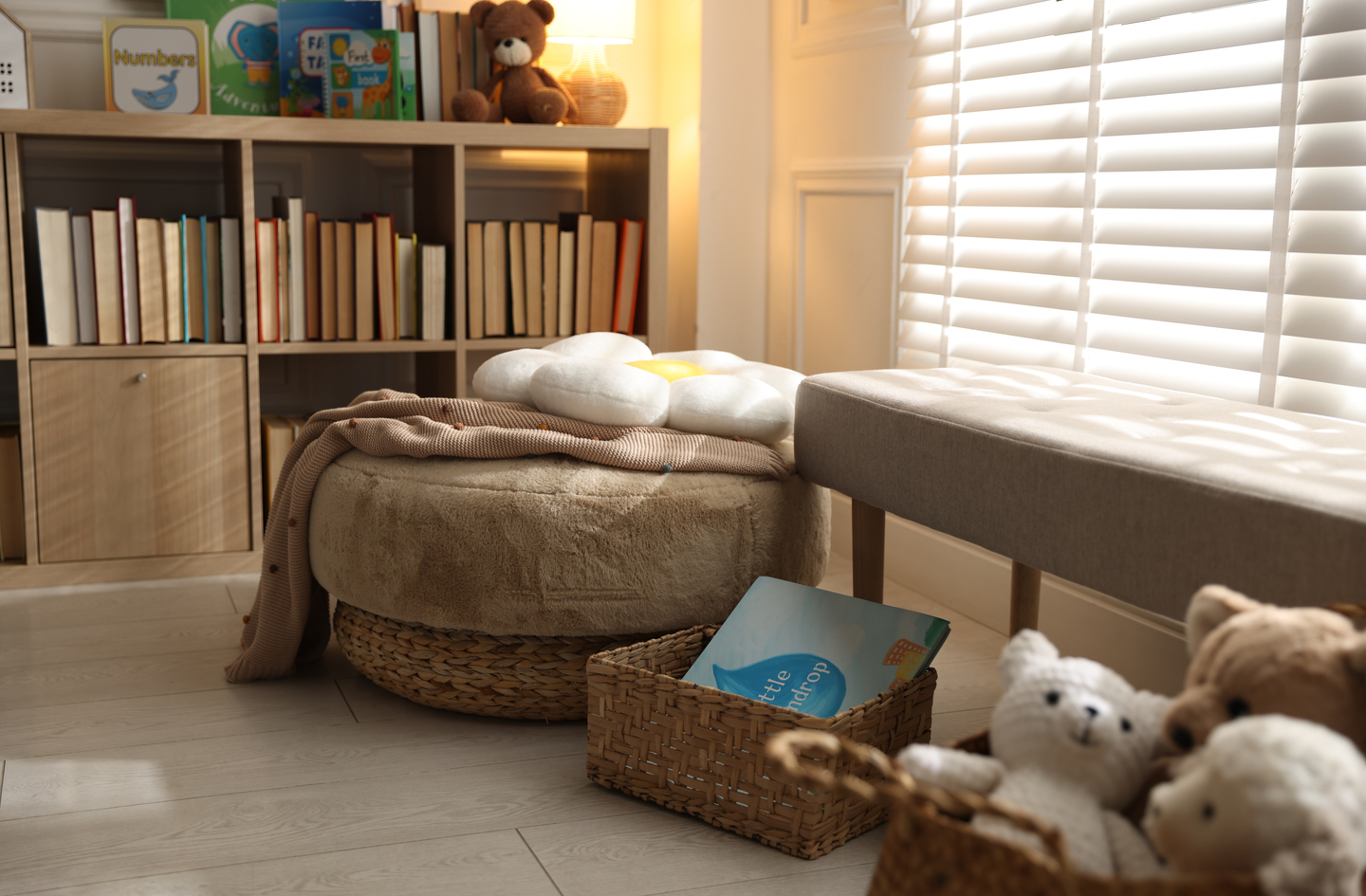
When a child moves from an upright desk chair to a floor cushion, the change in posture and eye level is enough to cue a different activity. This is not a decorative preference. Montessori-informed design uses the same principle: environment-level shifts in furniture height signal to a child what kind of engagement is expected in that space. A floor cushion in a corner with books says “settle in and read.” A standard chair at the same height as the desk chair says “this is an extension of school work.” The lower the seating, the stronger the cue.
What to look for in floor seating
The main practical requirements are firmness and stability. A bean bag with too much give makes it hard for a child to hold a book at reading height without slumping. A floor cushion between 3 and 6 inches thick provides enough lift while staying stable. Covers that wash easily matter more than material aesthetics, because reading cushions accumulate crumbs, sticky fingers, and spilled water cups. For children who tend to wriggle, a slightly angled wedge cushion (thicker at the back, thinner at the front) provides gentle pelvic tilt that keeps the back engaged during longer reading sessions. If in doubt about seating choices for a child with specific postural needs, a pediatric occupational therapist is the right resource.
Step 3: Put Books at Arm’s Reach and Face Them Forward
Research across 27 countries found that children with as few as 20 books at home attain significantly higher levels of education than children with none, independent of parental income or education level.2 The number matters, but so does access. A study of neighborhood book availability found that middle-income areas had roughly 13 age-appropriate books per child, while concentrated-poverty neighborhoods averaged 1 book for every 300 children.3 The implication for home design: the books in the bedroom nook need to be physically reachable, not stored behind other objects or on high shelves.
“Reading together with young children weaves joyful language and rich interactive moments into the fabric of daily life.”
Dr. Perri Klass, MD, FAAP, lead author of the American Academy of Pediatrics 2024 literacy policy statement6
Why forward-facing shelves outperform spine-out storage
A standard bookcase shows spines. A child has to already know what they want to select a book from a row of spines. Forward-facing shelves (covers visible, like the display at a library checkout) reduce that selection friction to zero: the child sees the image, feels drawn to the color or picture, and reaches for it. For a bedroom nook, forward-facing rail shelves mounted at the child’s seated eye level work better than a freestanding bookcase beside the nook. They hold fewer books, which is a feature: a contained, visible set is less overwhelming than a full shelf the child has to sort through.
How many books to keep in the nook, and where to store the rest
Ten to fifteen books forward-facing is a practical working set. More than that and the nook starts to feel like storage rather than a curated reading zone. Rotate the set every two to four weeks, swapping two or three titles at a time rather than refreshing the whole shelf at once. Books not currently in rotation belong in a closed bin or low cabinet outside the nook itself. This rotation approach keeps the nook feeling fresh without requiring the child to make choices from a large undifferentiated pile. The 20-book minimum from the Evans research applies to the home overall, not to the nook alone; the nook holds the active reading set.
Shelf height for the child’s seated eye level
The shelf holding the active reading set should sit at the seated child’s eye level. For a toddler sitting on a low cushion, that is typically 12-18 inches off the floor. For a school-age child on a firmer cushion, that is 18-24 inches. A wall-mounted rail shelf at this height keeps the shelf out of the floor footprint entirely, which is valuable in small bedrooms. A freestanding pocket shelf (the kind with angled wire or wood rails) works in rooms with more floor space. The test: a seated child should be able to reach and replace any book in the nook without standing up.
Step 4: Add Task Lighting That Works Independent of Room Ambient
Ambient bedroom lighting rarely reaches the illumination level needed for comfortable reading. The Illuminating Engineering Society of North America standard for reading and study tasks is 300-500 lux at the surface.4 A 2024 peer-reviewed study in PMC on optimal illumination for schoolchildren confirmed the same 300-500 lux range as the U.S. benchmark for reading tasks.5 Standard overhead bedroom fixtures deliver 50-150 lux at floor level. The gap is real and consistent: ambient light is not a substitute for task light in a reading nook.
Choosing the right lamp for the nook
Three lamp types work well in a bedroom reading nook. A clip-on LED lamp attached to the shelf above the reading seat is the lowest-footprint option: it takes no floor space and directs light onto the book rather than into the room. A small floor lamp placed beside the nook works for older children who read in different postures (including lying on their side). A wall-mounted swing-arm lamp is the most permanent option and keeps the floor completely clear, but it requires drilling into the wall and should be wired or outlet-mounted safely. For any lamp within a child’s reach, check that the cord is not a trip or pull hazard.
The separate-switch requirement
The reading lamp needs its own switch, separate from the room’s main overhead light. This is not an aesthetic preference. A child who falls asleep reading needs a parent to be able to turn off the reading light without turning on the ceiling fixture and waking them. A lamp plugged into a switched outlet, or a lamp with a rocker switch on the cord itself, solves this without any electrical work. Smart bulbs with app control work for older children who manage their own bedtime light. Whatever the solution, the reading lamp should never require the overhead fixture to be on.
Color temperature for evening reading
Lux (brightness) and color temperature (warmth) are separate variables. For evening reading in a child’s bedroom, warm white (2700-3000K) is preferable to cool or daylight-spectrum bulbs (4000-6500K). Cool light is energizing, which works against bedtime routines. Warm white light at 300 lux is sufficient for reading while supporting the transition to sleep. If a child reads before bed routinely, pair the task lamp with a warm-white LED bulb and avoid blue-rich bulbs in the nook entirely. A pediatric sleep specialist or your child’s pediatrician is the right resource for any specific questions about light and sleep for a particular child.
Step 5: Define the Zone Without Adding More Stuff
A bedroom reading nook works when a child instinctively understands “this corner is for reading.” That understanding comes from the physical environment, not from a sign on the wall. Two features do most of the work: a floor rug that defines the territory, and the deliberate absence of toy storage inside the zone. The nook does not need more furniture. It needs a clear signal that the zone belongs to books and the activity of reading them.
Use a rug to mark the floor territory
A small area rug (3 by 4 feet is enough for a toddler-preschool nook; 4 by 5 feet for a school-age or tween nook) does two things: it defines the nook’s floor boundary, and it adds acoustic softness that makes the corner feel quieter. Choose a rug that is visually distinct from any other rug in the room. If the rest of the floor is uncovered, even a simple round rug works. The child does not need to be told the rule. Sitting on the rug in the corner with the books in front of them says it without words. Remove the rug if the space is used for anything else; putting it back resets the signal.
Keep toy storage out of the nook entirely
Toy bins, baskets of building blocks, or even a single toy car visible from the reading seat dilutes the nook’s purpose. A child sitting in the reading corner who sees their toy basket nearby is not mentally “in” a reading zone; they are adjacent to the play zone. This is the most common functional mistake in bedroom reading nooks: the zone is physically defined but not functionally distinct. Toy storage belongs outside the rug boundary. If space is tight and the nook is very close to the storage area, a low curtain, a bookcase positioned as a divider, or a fabric canopy around the nook creates enough visual separation to work.
Small-Bedroom Reading Nook Adaptations
Secondary bedrooms in U.S. homes average around 120 square feet (10 by 12 feet). After a twin bed and a dresser, usable floor space is typically 60-70 square feet. A reading nook does not need much of that, but it does need deliberate placement. These four options work in rooms where a dedicated corner would normally feel like too much to give up.
The floor-only nook (6-8 sq ft)
The smallest viable reading nook is a thick floor cushion pushed into a corner, with a wall-mounted pocket rail at child seated eye level. This takes up 24 by 24 inches of floor space (4 square feet), plus the rug underneath it. The wall rail holds 8-12 books face-forward with no additional footprint. A clip-on LED lamp on the shelf completes the setup. This format works in rooms as small as 100 square feet because it adds essentially no furniture to the room and requires only wall mounting. The investment is under an hour of time and two wall anchors.
Under-loft or under-bunk alcove
If the bed is raised on a loft or bunk frame, the space underneath is a natural reading cave. The floor beneath a standard loft platform is roughly 30-40 inches high and 36-48 inches deep, which is enough for a floor cushion, a small shelf, and a clip-on lamp. Adding a curtain on a tension rod across the front of the alcove turns it into an enclosed nook with strong privacy signals. Children in the 5-10 age range often find enclosed spaces more inviting for independent reading than open corners. Check that the loft frame’s clearance, stability, and weight ratings are appropriate for the planned use before hanging anything from it.
The window seat option
A bedroom with a low window and a radiator cover or existing window ledge below it already has the structure for a window seat nook. A cushion cut to fit the ledge (or a custom foam pad), two wall-mounted shelves flanking the window at seated arm’s reach, and a clip-on lamp to the side creates a reading zone with natural daytime light at no cost to floor space. The main caveat: if the window seat is above a radiator, confirm safe clearance before adding foam cushioning, and avoid blocking the heating unit. A licensed HVAC professional can advise on clearances specific to the unit type.
The closet conversion
Removing the closet door and adding a low shelf inside converts a standard 24-by-60-inch closet into an enclosed reading nook with three walls already in place. The floor area (about 12 square feet) fits a floor cushion and a basket for extra books. A wall-mounted lamp inside the closet is the lighting solution. This is the most committed version: removing a closet door and replacing it with a curtain is reversible, but it does change the room’s storage. Relocate closet storage to under-bed drawers or a wardrobe before committing. The payoff is a fully enclosed reading space with no floor footprint outside the closet itself.
Common Mistakes That Undermine Reading Nooks
A bedroom reading nook that goes unused almost always fails for one of four reasons. These are not decorating mistakes. They are systems mistakes: the physical setup signals something other than “reading happens here.”
Relying on overhead ambient light only
The ceiling fixture in a typical bedroom delivers 50-150 lux at the floor. Reading tasks require at least 300 lux at the surface. A child who tries to read in dim light without a task lamp experiences eye strain and gives up. The nook looks inviting but does not function. Add a dedicated task lamp before assuming the nook is ready for use. This is the single most fixable issue in an underperforming reading corner.
Placing toy storage inside or directly adjacent to the nook
Toy bins within the nook’s visual boundary turn the reading zone into an extension of the play area. Children do not read in the nook; they sit in it briefly and then reach for a toy. The fix is to move all toy storage outside the rug boundary. If there is no other place in the room, a low curtain or a bookcase positioned between the nook and the toy area is enough to break the visual connection.
Choosing a corner that blocks the closet or bed approach
A nook placed in a path the family uses multiple times daily becomes an obstacle rather than a retreat. Children step around it or use it as a landing spot for bags and clothes rather than reading in it. Returning to the room-walk exercise from Step 1 almost always reveals a better corner. Relocating a cushion takes five minutes.
Seating too high for the child’s age
An adult-height chair, a school-desk chair, or a beanbag that compresses to seat height above 17 inches puts an elementary-age child’s eyes well above a forward-facing shelf mounted at child level. They end up looking down at the books, which is ergonomically awkward, or the shelf gets raised to adult height, which means the child cannot reach it independently. Match seat height to the child’s age using the ranges in the table above, and measure the shelf position from the child’s actual seated eye level, not from a generic “child height” estimate.
Frequently Asked Questions
How much space does a kids’ bedroom reading nook actually need?
The minimum functional footprint is 24 inches wide by 24 inches deep (roughly 4 square feet). That fits a floor cushion and allows a child to sit and reach a wall-mounted shelf in front of them. A 30-by-30-inch zone accommodates a small bean bag and a pocket shelf without feeling cramped. Larger is better, but this is not a space-intensive project: it is a corner with a cushion, a shelf, and a lamp.
What is the best lighting for a reading nook in a child’s bedroom?
Reading tasks require at least 300 lux at the reading surface, which is the IESNA standard for reading and study tasks.4 Overhead bedroom ambient lighting rarely reaches this level at floor height. A dedicated task lamp on its own switch is the right solution: a clip-on LED lamp on the shelf above the seat, or a small floor lamp beside the nook, with a warm-white bulb (2700-3000K) for evening reading.
How many books should a bedroom reading nook have?
Keep 10-15 books forward-facing in the active nook set, rotated every two to four weeks. Research found that having as few as 20 books accessible in the home has a measurable positive effect on children’s educational outcomes.2 The nook holds the active reading set; the rest stays in rotation storage outside the nook, in a bin or closed shelf nearby.
Should a bedroom reading nook be separate from the play area?
Yes. Mixing reading and toy storage in the same zone weakens the signal that the corner is for books. Physical arrangement research found that clearly designated book areas directly increase children’s voluntary reading time.7 In practice, that means keeping toy bins outside the reading rug’s boundary, even if the distance is only a foot or two.
Do bedroom reading nook ideas work in very small rooms?
Yes. A floor cushion plus two wall-mounted pocket rails takes as little as 4 square feet of floor space. Under-loft alcoves use floor space that is otherwise dead underneath the bed. A window seat with flanking shelves uses zero additional floor space. The key is treating the nook as a wall-and-floor problem rather than a furniture-addition problem.
Limitations and Edge Cases
- The seat height ranges in this article follow ANSI/BIFMA general guidance and ergonomic practice for typical development. A child with specific postural, sensory, or mobility needs requires evaluation by a pediatric occupational therapist before finalizing seating choices.
- Lighting recommendations are based on IESNA standards for reading tasks. Children with low vision or light sensitivity should be evaluated by an optometrist or ophthalmologist for specific lighting prescriptions.
- Any structural modification (loft conversion, wall-mounted lamp wiring, radiator-adjacent installation) specific to your home should be evaluated by a licensed contractor or the appropriate specialist before installation.
References
- National Center for Education Statistics – NAEP Long-Term Trend Assessment: Student Experiences, Age 9 and Age 13, 2022-2023.
- UCLA California Center for Population Research – Evans, M.D.R., Kelley, J., Sikora, J., and Treiman, D.J., “Family Scholarly Culture and Educational Success: Books and Schooling in 27 Nations,” Research in Social Stratification and Mobility, 2010.
- New York University – Neuman, S.B. and Moland, N., “Book Deserts: The Consequences of Income Segregation on Children’s Access to Print,” Urban Education, 2019.
- Archtoolbox – “Recommended Lighting Levels in Buildings,” citing IESNA Lighting Handbook; last updated March 2021.
- PMC / National Library of Medicine – Che Husin, N., et al., “Optimal Illumination Levels for Schoolchildren’s Visual Tasks,” 2024.
- American Academy of Pediatrics / HealthyChildren.org – Klass, P., “Beyond Literacy: Shared Reading Starting in Infancy Offers Lifelong Benefits,” 2024.
- Reading Rockets / WETA Public Broadcasting – “Literacy-Rich Environments,” citing Morrow, L.M. and Weinstein, C.S., “Encouraging Voluntary Reading: The Impact of a Literature Program on Children’s Use of Library Centers,” Reading Research Quarterly, 1986.
- BIFMA International – ANSI/BIFMA X5.1 Standard for General-Purpose Office Chairs and X10-1 Standard for Children’s Furniture Size Classifications, 2024.
Conclusion
A bedroom reading nook for kids is a spatial decision before it is a design one. Map the protected zones first (bed approach, closet door, main walkway), pick the corner that stays genuinely clear, and then add low-profile seating at the right height for the child’s age, 10-15 books within arm’s reach at seated eye level, and a task lamp delivering at least 300 lux on its own switch. Keep toy storage out of the zone. In a small bedroom, a floor cushion and two wall-mounted rails accomplish all of this in under 6 square feet.
For how this fits into broader nook planning across different room types, see Reading Nooks for Kids.