
A montessori style playroom is not a decorating project. It is a room built around how children actually learn: through independent exploration, orderly choices, and materials that do not compete for attention. For the broader context on the prepared-environment approach, see the Montessori Playroom Setup topic overview. A national randomized trial published in October 2025 found that kindergarteners who attended public Montessori preschool programs scored significantly higher in reading, short-term memory, and executive function than lottery-matched peers.5 The ten principles here translate that philosophy into practical home-playroom decisions, regardless of room size or budget.
What Is a Montessori Style Playroom?
What makes a playroom Montessori-style?
A Montessori-style playroom applies ten design principles: child-scale furniture, visual order, limited toy choices, natural materials, open floor space, low accessible storage, a calm visual hierarchy, defined activity zones, natural elements, and a rotation system that refreshes the prepared environment. Across 32 studies covering more than 132,000 data points, Montessori education produced consistent positive effects in language, math, executive function, and school experience.6
Key Takeaways
- Toddlers with 4 toys available played twice as long per toy and explored approximately 60% more interaction types than those with 16 toys.1
- Highly decorated classroom walls increase off-task behavior and reduce children’s learning gains compared to minimally decorated settings.2
- Electronic toys are associated with significantly fewer adult words, conversational turns, and child vocalizations than traditional wooden toys or books.3
- Open floor space is the most underused element in most home playrooms: children need room to move, not more furniture or zones.
- The room itself teaches independence when every item can be accessed, used, and returned by the child without adult help – what Montessori called the “Third Teacher.”
1. Child-Scale Furniture: Independence Starts at the Floor
The most foundational element in a Montessori-style playroom is not the toys. It is the furniture. When a child can sit down, reach their work, and return to standing without any adult involvement, the room is already doing its primary job.
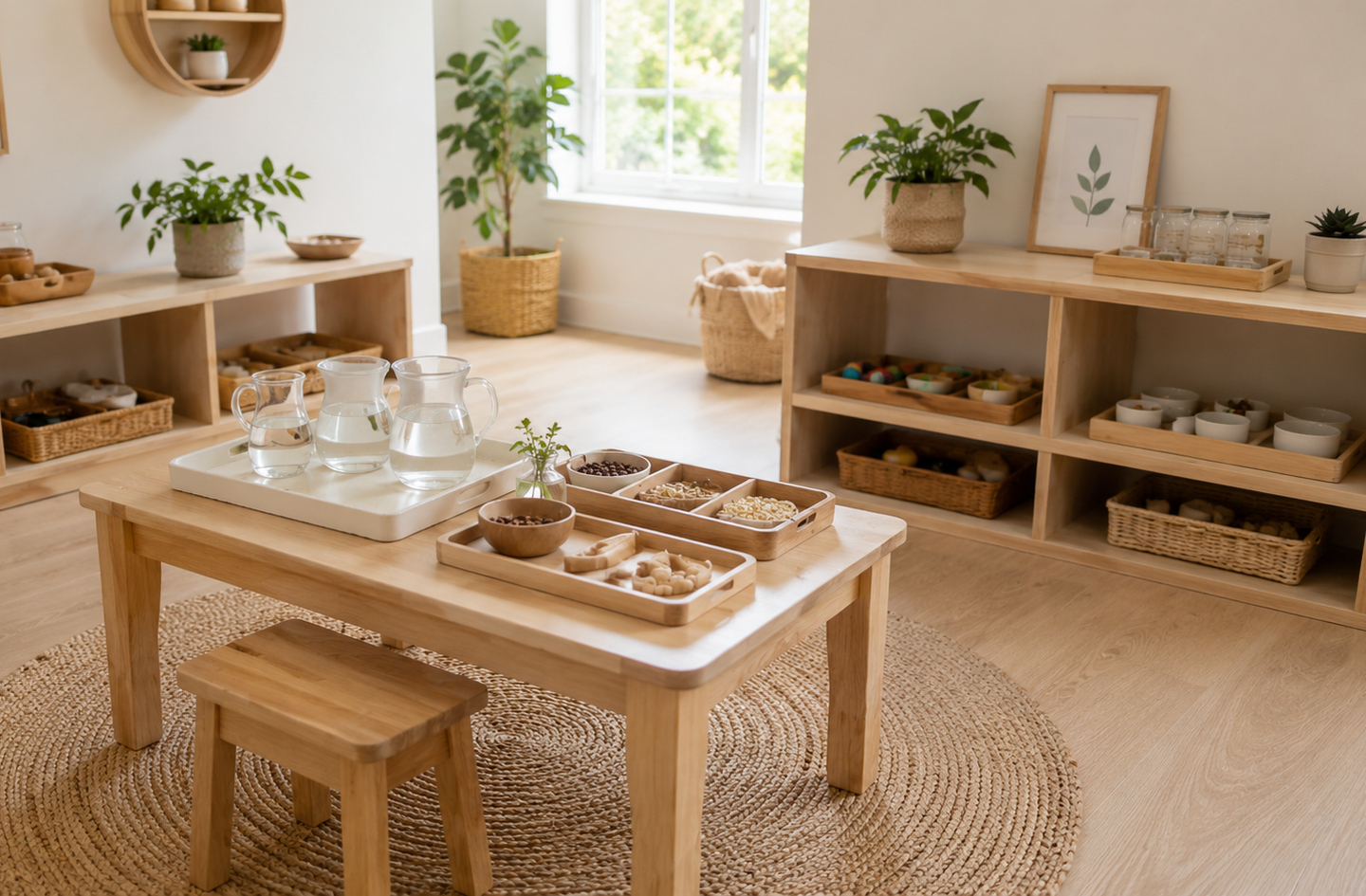
In practice, child-scale furniture means a table and chairs sized so the child’s feet rest flat on the floor when seated, not dangling. It means a shelf or bookshelf the child can reach without climbing or stretching. It means a floor cushion or low sofa the child can get onto independently. A full-length mirror at the child’s eye level – optional but effective – supports dressing routines and body-awareness activities without adult-directed setup.
The developmental logic is direct. When furniture fits the child’s body, the child can initiate activity, retrieve materials, and restore them to their place without waiting for an adult. That independence is not incidental to the Montessori approach; it is the room’s primary function. A three-year-old who has to ask an adult to get a puzzle down from a high shelf is not practicing independence. A three-year-old who walks to the shelf, takes the puzzle, works with it on a floor mat, and returns it is practicing it continuously.
If your room layout involves structural changes to support a floor bed or low furniture arrangement, consult a licensed contractor for the specific surface and configuration.
2. Visual Order: A Place for Everything the Child Can Read
Visual order means every item in the room has a fixed, visible home, and the child can read that home at a glance. This is not tidiness for aesthetic reasons. It is the information system through which the room communicates its logic to the child.
A child who can see where each item belongs can make decisions about what to use, where to use it, and how to return it without asking an adult. The room communicates its system through the arrangement. When the system is legible, the child self-directs. When it is not, the child either asks for guidance or, more commonly, leaves items wherever they land.
Visual order in practice means: each shelf position holds one item, not a stack of multiple items. Baskets and bins face open toward the child rather than stacked. Small trays group related items together: a sponge, a small pitcher, and a cloth belong on the same tray because they are used together, not scattered across three separate bins. Books face forward so the child sees the cover, not the spine – this reduces the decision cost of choosing a book significantly. Shelf positions stay consistent: the puzzle is always in the same spot when not in use, so the child can see immediately when it is out of place.
The parent’s role in establishing visual order is front-loaded. You observe the room, assign homes to every item, show the child the system once, and then let the room do the work. This is the “Third Teacher” concept from Montessori-influenced design: the environment teaches through its arrangement, not through adult instruction. If you can restore the room to its ready state in under two minutes, visual order is working. If it takes longer, there are friction points worth addressing before adding more storage or furniture.
3. Limit the Toy Count and Rotate the Shelf
This is the principle most parents resist, and it is the one backed by the clearest experimental evidence.
When toddlers had four toys available rather than sixteen, they played twice as long with each toy and explored each item in approximately 60% more distinct ways, according to a study published in Infant Behavior and Development by researchers at the University of Toledo.1 The researchers attributed the difference to reduced decision load: fewer options allow the child to settle into deeper engagement rather than cycling quickly from one toy to the next and fully engaging with none.
The practical Montessori implementation: the shelf holds between six and twelve items at one time, depending on the child’s age and the size of the items. Everything else is stored out of sight, either in a closed cupboard or in bins the child cannot see into from the play area. When the child’s engagement with the current shelf begins to drop – indicated by shorter play sessions, less variety in how items are used, or more frequent requests for something new – it is time to rotate.
Toy rotation is not complicated. Remove two or three items from the shelf. Replace them with two or three items from storage. Give the child space to discover the refreshed shelf on their own. The interval between rotations varies by age but often falls between two and six weeks for toddlers and somewhat longer for older children. The signal for rotation is always the child’s behavior, not the calendar.
4. Natural Materials Over Electronic Toys
The fourth principle concerns what goes on the shelf, not just how many items are there.
A Montessori-style playroom prioritizes materials that respond to the child’s handling: wood, metal, cotton, wool, glass where age-appropriate, and ceramic. These materials communicate texture, weight, temperature, and durability honestly. They do not add electronic stimulation; the child provides the stimulation through their own imagination and physical manipulation of the object.
The language-development case for natural materials is supported by direct research. A study published in JAMA Pediatrics found that when parent-infant pairs played with electronic toys, they produced fewer adult words, fewer conversational turns, fewer parental responses, and lower child vocalizations than the same pairs playing with traditional toys or books.3
“Across the board it was pretty consistent that when the babies were playing with electronic toys, all of the measures were lower.”
Dr. Anna Sosa, Northern Arizona University3
A 2022 replication study in Frontiers in Psychology found that children with typical development produced approximately 46% more utterances per minute during traditional toy play compared to electronic toy play: 7.74 utterances per minute versus 5.29.4 The researchers concluded that electronic toys “undermine play-based language learning opportunities” for children both with and without developmental differences.
A 2025 systematic review of 25 studies on open-ended, natural-material play with children ages 0-6 identified positive associations between such materials and children’s problem-solving, creativity, academic skills in reading and math, and both convergent and divergent thinking.9
The practical question for any item: does it require batteries to work, and does it add its own lights or sounds independent of the child’s actions? If the answer is yes to both, it is worth reconsidering whether it belongs on the shelf. The shelf should hold materials the child animates, not materials that animate themselves.
5. Open Floor Space: Movement Is Part of the System
The floor is the most valuable surface in a Montessori-style playroom, and it is the one most families underuse. Physical movement is not a break from the play environment; it is part of how children regulate themselves and consolidate what they are learning.
A room that is filled with furniture from wall to wall removes the floor as a usable play surface. Children end up constrained to seated activities or navigating around objects rather than using the full room. For toddlers and preschoolers especially, this is a significant functional loss.
A 2023 review published in the Journal of Pediatrics attributed a meaningful portion of the documented rise in childhood anxiety and depression to a multi-decade decline in opportunities for self-directed, independent physical activity and unstructured movement.8 A home playroom with clear floor space is one of the few domestic environments that still gives children room to move, build, and physically explore on their own terms.
In a Montessori-style layout, the open center of the room serves multiple functions. A floor mat or work rug defines a temporary individual workspace the child unrolls for a specific activity and rolls up when done. The mat signals that work is in progress – this is how a child in a Montessori classroom communicates to others that a space is occupied without a spoken rule. Large-format building layouts, train tracks, puzzle assembly, and gross motor movement all require floor space that furniture crowds out. Clear pathways between zones also reduce the chance of collisions and allow the child to navigate independently.
Start from an empty floor and return only what the child demonstrably uses. Many families find that what was in the center was never really engaged with; it was simply there because there was nowhere else for it.
6. Low, Accessible Storage: Access Determines Use
Access determines use. If a child cannot reach a storage area independently, that storage does not function as a Montessori environment; it functions as adult-managed storage that happens to sit in the child’s room.
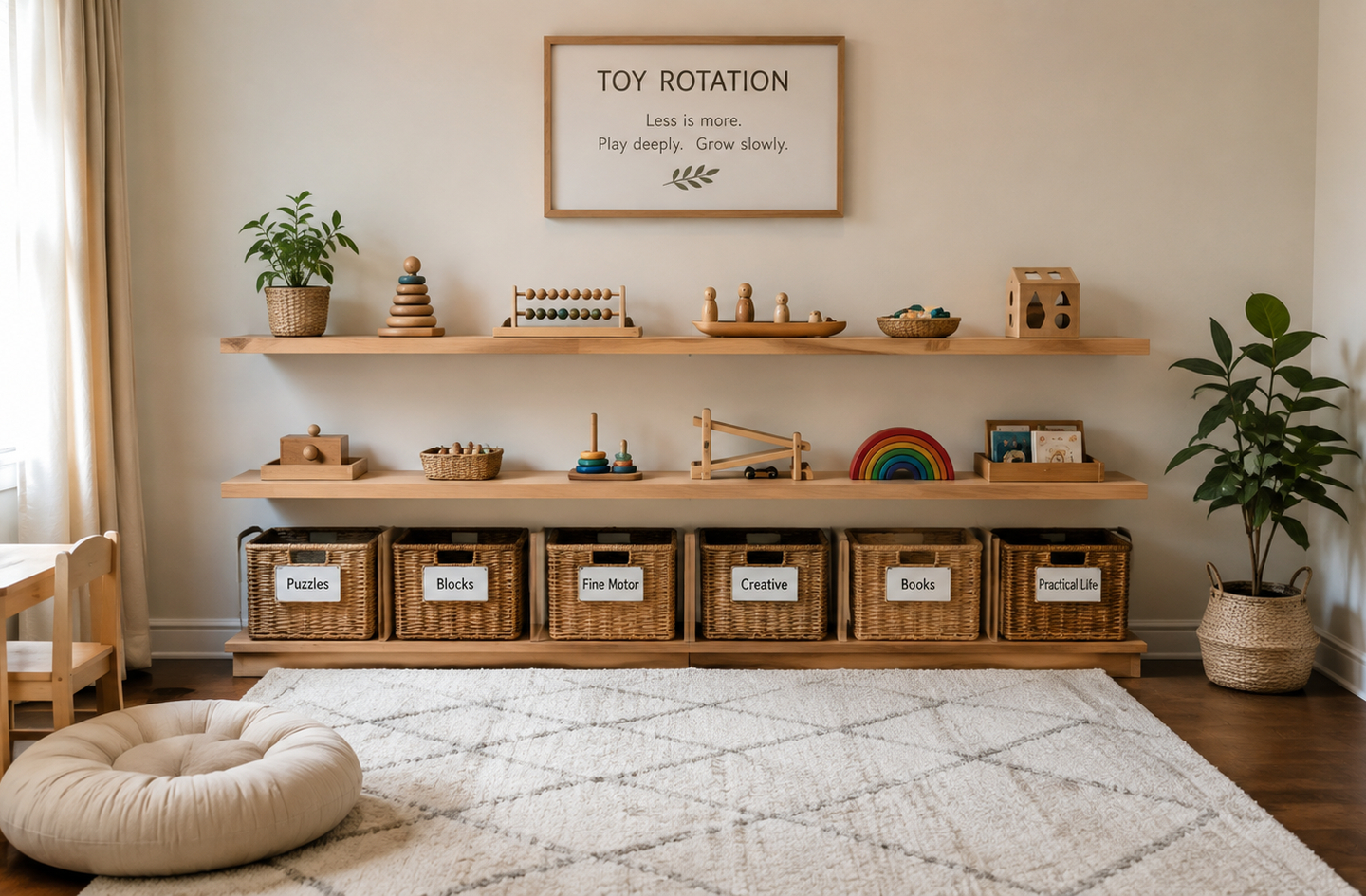
In a Montessori-style playroom, storage is at child height, open-fronted, and organized so the child can see what is inside without lifting the container. This applies to shelves, baskets, trays, and hooks.
The distinguishing features of accessible Montessori storage: the maximum height is no higher than the child can comfortably reach when standing flat-footed, without tiptoeing or climbing. Baskets, trays, and bins face forward or upward, not buried under lids. The organization follows a one-category-per-container rule, labeled with a picture if the child cannot yet read. Individual items and containers are light enough for the child to move safely without risk of dropping.
Lidded bins, opaque boxes, and deep toy chests all share the same functional problem: they hide what is inside. A child who cannot see what is in a container is less likely to engage with its contents and less able to restore items to their correct home after use. Clear or open containers are not just aesthetic choices; they are decisions about whether the room’s storage system is legible to the child who lives in it.
7. A Calm Visual Hierarchy: The Walls Are Part of the System
The visual environment of the room is not neutral. It is either helping the child focus or competing for the child’s attention. A Montessori-style playroom deliberately reduces visual noise to support self-directed engagement, not because minimalism is on trend, but because the evidence supports it.
Research published in Psychological Science placed kindergarteners in laboratory classroom settings with either highly decorated walls or minimal wall decoration. Children in the highly decorated setting were more distracted by the visual environment, spent more time off task, and showed smaller learning gains than children in the minimally decorated setting.2 The study authors attributed the effect to the cognitive cost of filtering out irrelevant visual stimulation: children who cannot easily filter it out spend mental resources on the environment rather than on the task.
In practice, a calm visual hierarchy means: wall color in muted, natural, or neutral tones – off-white, warm gray, sage green, or a natural wood panel. Decoration is minimal and purposeful: a single framed print, a child’s own artwork in rotation, or a simple nature element. Not a gallery wall of commercial characters. The shelves themselves are the visual interest in the room; the shelf unit should be plain wood or white, not brightly patterned. Rugs define space without commanding the eye: a simple pattern or solid color works better than a cartoon-themed rug that competes with the items on the shelf.
This does not mean the room must look blank. Natural wood tones, plants, and woven textures add warmth without visual competition. A room that is visually calm is a systems decision, not a style decision.
8. Defined Activity Zones Without Rigid Dividers
A Montessori-style playroom is typically organized into zones: a reading area, a practical-life or art area, a building and construction area, and sometimes a movement area. These zones do not require physical walls, room dividers, or purpose-built partitions. They require clear signals that even a young child can learn to read.
The signals a room can use without any physical separation: a rug defines the reading zone. When the child is on the rug with a book, they are in the reading area – the rug communicates the zone without a rule being spoken. A tray on a shelf or table defines the practical-life zone; everything needed for a specific activity is grouped on that tray. A low table and two chairs define the art or writing zone. A clear central floor space defines the movement and construction zone because the available floor communicates that large-format, physically active work belongs there.
Zone definition is about predictability, not separation. When a child knows which area is for which type of activity, they can self-direct without adult guidance about where to go next. Zones also make cleanup logical: the puzzle returns to the building area shelf, not the art table, because both child and parent share an understanding of the room’s organization. A meta-analysis of 39 studies found that guided, child-initiated play produces comparable or superior learning outcomes to direct instruction across multiple measured domains.7 Zone clarity is the environmental element that makes that play self-sustaining.
9. Bring Nature Inside
Nature does not require a large budget or a themed decor package to be present in a Montessori-style playroom. A single plant the child can water. A basket of smooth river stones. A collection of pine cones, dried seed pods, or pieces of bark. A small beeswax candle used only with adult presence. A bowl of sand for a simple sensory tray. These elements bring texture, living systems, and natural sensory input into a room that would otherwise be entirely manufactured.
The developmental logic is grounded in what natural materials ask of a child. A smooth stone is heavy, cool, and irregular. A piece of bark has texture the child did not produce. A living plant responds to water, light, and neglect in ways that a plastic toy does not. These materials invite careful, deliberate handling because they behave according to physics and biology rather than battery power. The child’s attention is drawn inward to the properties of the material, not outward to a flashing screen or electronic sound.
Open-ended, natural-material play is associated with development in problem-solving, creativity, and both convergent and divergent thinking across studies of children from infancy through early elementary age.9
A small basket with five interesting natural objects is enough to give the shelf a grounding quality that manufactured materials rarely match. Maintain what you introduce: if live plants are not practical, dried botanicals or a mineral collection serve the same purpose.
10. Design for the Reset: The Prepared Environment Refreshes
The prepared environment does not stay prepared on its own. The tenth principle is the one that keeps all nine preceding it working: the room must be easy to restore to its ready state.
Maria Montessori described the prepared environment as an active system, not a static arrangement. It requires continuous calibration: rotating the shelf when engagement drops, removing outgrown items, and introducing materials that match the child’s current developmental interests. The reset is the preparation that makes the next session possible.
A 2023 Campbell Systematic Review of 32 studies covering more than 132,000 data points found that children in Montessori-prepared environments showed consistent positive effects in language, math, executive function, and overall school experience compared to control groups.6 The national randomized trial published in PNAS in October 2025 reinforced those findings: kindergarteners who attended public Montessori preschool programs scored significantly higher on reading, short-term memory, executive function, and social understanding than lottery-matched peers.5 The prepared environment is not incidental to those outcomes; it is the mechanism through which the outcomes are produced.
“The argument is sometimes made that play, while beneficial, adds little to children’s education. In fact, although there are still some big questions about how we should use guided play in classrooms, there is promising evidence that it actively enhances learning and development.”
Prof. Paul Ramchandani, Professor of Play in Education, Development and Learning, University of Cambridge7
Design for the reset means that when you look at the room after a full play session, you can see exactly where every item belongs and restore it to that position quickly. If you can, the system is working. If the reset takes more than a few minutes, or if items regularly end up in locations where they obviously do not belong, the system has friction points worth addressing – usually a storage arrangement problem, not a child behavior problem.
“Design for the reset, not just the reveal” is the operating principle here. A room that photographs well on the day it is set up but cannot be maintained through ordinary use is not yet a system. It is a moment.
Design Principles at a Glance
| Principle | Core Goal | Primary Approach | Best Age Range | Primary Benefit |
|---|---|---|---|---|
| 1. Child-scale furniture | Independence | Low tables, floor-level items, child-height shelves | 1-8 yrs | Self-sufficient access to materials |
| 2. Visual order | Legibility | Fixed homes, open containers, consistent shelf positions | All ages | Faster reset, child-directed choice |
| 3. Limited toy count | Play depth | 6-12 items on shelf, rest in closed storage | 1-6 yrs | Longer, richer engagement per item |
| 4. Natural materials | Language and focus | Wood, metal, cotton, wool over battery-powered items | All ages | More parent-child language, deeper handling |
| 5. Open floor space | Movement | Clear central zone, floor mat for work | All ages | Physical regulation, large-format play |
| 6. Low storage | Access | Open shelves at child height, no lids | 1-8 yrs | Self-retrieval and self-return |
| 7. Calm visual hierarchy | Attention | Neutral walls, minimal decoration | All ages | Reduced off-task behavior |
| 8. Defined zones | Predictability | Rugs, trays, and table positions as zone signals | All ages | Self-directed focus by activity type |
| 9. Nature elements | Sensory grounding | Plants, stones, natural textures on the shelf | All ages | Deliberate interaction, sensory calm |
| 10. Reset system | Sustainability | Scheduled rotation, clear restoration path | All ages | Consistent prepared environment |
How These Principles Were Selected
These ten principles are drawn from three sources: Maria Montessori’s own writings on the prepared environment, peer-reviewed developmental and educational research on children’s play and learning environments, and the engineering-informed planning framework that Playroom Architect applies to all playroom content.
Every principle passed three filters before inclusion:
- Structural safety reasoning: does the principle reduce identifiable physical risk, or introduce new hazards? Principles affecting wall-mounted items or storage loading are flagged for professional consultation where the specific structural decision matters.
- Developmental fit: is the principle aligned with how children at the relevant age range actually learn, move, and engage? Where the research is direct and replicable, it is cited inline.
- Buildability in real homes: can this principle be applied without custom carpentry or high-cost furniture? Each principle works at a range of budget levels.
These principles are general guidance for designing a home playroom environment, not Montessori accreditation criteria. For decisions specific to your room’s structural elements or a specific child’s developmental needs, consult a licensed contractor or pediatric occupational therapist as appropriate.
Frequently Asked Questions
How many toys should I keep out in a Montessori-style playroom?
Between 6 and 12 items on the shelf at one time works well for most toddlers. Toddlers with only 4 toys available played twice as long per toy and found approximately 60% more ways to interact with each item than those with 16 toys.1 Rotate when engagement drops, not on a fixed calendar.
Does a Montessori-style playroom need specialized or expensive furniture?
No. A low open shelf at child height, a small table and chair set with feet flat on the floor, and a floor cushion cover the functional essentials. Many standard furniture lines offer appropriate options at a range of price points.
What wall colors work best for a Montessori-style playroom?
Muted, neutral tones: off-white, warm gray, sage green, or a natural wood finish. Highly decorated classroom walls increased off-task behavior and reduced learning gains in kindergarteners.2 Keep decoration minimal; the walls function as background, not a display surface.
Can a small room work as a Montessori-style playroom?
Yes. A single low shelf, one clear floor zone for movement, and a small table cover the core setup. Open floor space is the most space-efficient element in a Montessori layout because it requires removing furniture rather than adding it. A bedroom corner can support the system.
What is the “prepared environment” in Montessori design?
The prepared environment is Maria Montessori’s term for a physical space arranged to support the child’s natural drive to learn and explore independently. Every element – shelf height, item selection, zone definition, and visual calm – is chosen so the child can initiate, use, and restore the space without adult intervention. At home, it means the room is always ready for the child to begin without adult setup.
Limitations and Edge Cases
- In combined bedroom-playroom layouts, a low shelf unit used as a partial room divider can help define the play zone without requiring full separation.
- The toy count and rotation guidance applies most directly to the 1-6 age range. For school-age children with larger collections of building materials or craft supplies, a modified system with more stored rotation stock is more practical.
- These are engineering-informed planning principles, not criteria for Montessori accreditation. A home playroom following them is not a Montessori program.
References
- University of Toledo – Fewer Toys Lead to Richer Play Experiences, UT Researchers Find. December 2017. Corroborates Dauch, C., Imwalle, M., Ocasio, B., and Metz, A.E. (2018), “The influence of the number of toys in the environment on toddlers’ play,” Infant Behavior and Development, 50, 78-87.
- Psychological Science – Fisher, A.V., Godwin, K.E., and Seltman, H. (2014). “Visual Environment, Attention Allocation, and Learning in Young Children.” Psychological Science, 25(7), 1362-1370.
- Neuroscience News – Electronic Toys Suppress Parent-Child Interaction and Language Development. Corroborates Sosa, A.V. (2016). “Association of the type of toy used during play with the quantity and quality of parent-infant communication.” JAMA Pediatrics, 170(2), 132-137.
- Frontiers in Psychology – Venker, C.E. and Johnson, J.R. (2022). “Electronic toys reduce the quantity and lexical diversity of spoken language produced by children with ASD and age-matched children with TD.” Frontiers in Psychology, 13, 929589.
- Phys.org – National Montessori study shows early childhood outcomes sharply higher. October 2025. Corroborates Lillard, A.S. et al. (2025). National randomized controlled trial of public Montessori preschool programs. Proceedings of the National Academy of Sciences (PNAS). DOI: 10.1073/pnas.2506130122.
- Campbell Collaboration – Does Montessori Work? August 2023. Corroborates Randolph, J.J. et al. (2023). “Montessori education’s impact on academic and nonacademic outcomes: A systematic review.” Campbell Systematic Reviews, 19(3), e1330.
- ScienceDaily – Can Guided Play Enhance Learning? January 2022. Corroborates Skene, K. et al. (2022). “Can guidance during play enhance children’s learning and development in educational contexts?” Child Development, 93(4), e523-e541. DOI: 10.1111/cdev.13730.
- ScienceDaily – Rise in child mental health disorders linked to decline in independent play. March 2023. Corroborates Gray, P., Lancy, D.F., and Bjorklund, D.F. (2023). “Decline in independent activity as a cause of decline in children’s mental well-being.” The Journal of Pediatrics, 260, 113352.
- Journal of Intelligence – Systematic review of indoor loose parts play and cognitive development in children ages 0-6. 2025. Volume 13, Issue 5, Article 52. PubMed Central.
Conclusion
A Montessori-style playroom works because the room is a system: every design decision – furniture height, shelf count, material choice, wall color, floor space – either supports or undermines the child’s ability to play independently, engage deeply, and reset the room without adult direction. The ten principles here are not an aesthetic checklist. They are the structural logic of an environment that teaches through its arrangement.
Start with one or two principles that address your room’s most obvious friction points. Many families begin with the shelf count (Principle 3) or the furniture height (Principle 1) and find that the other principles follow naturally as the room starts to work. For the broader context on building out the full prepared environment, see the overview in Montessori Playroom Setup for how these principles fit the wider topic.