
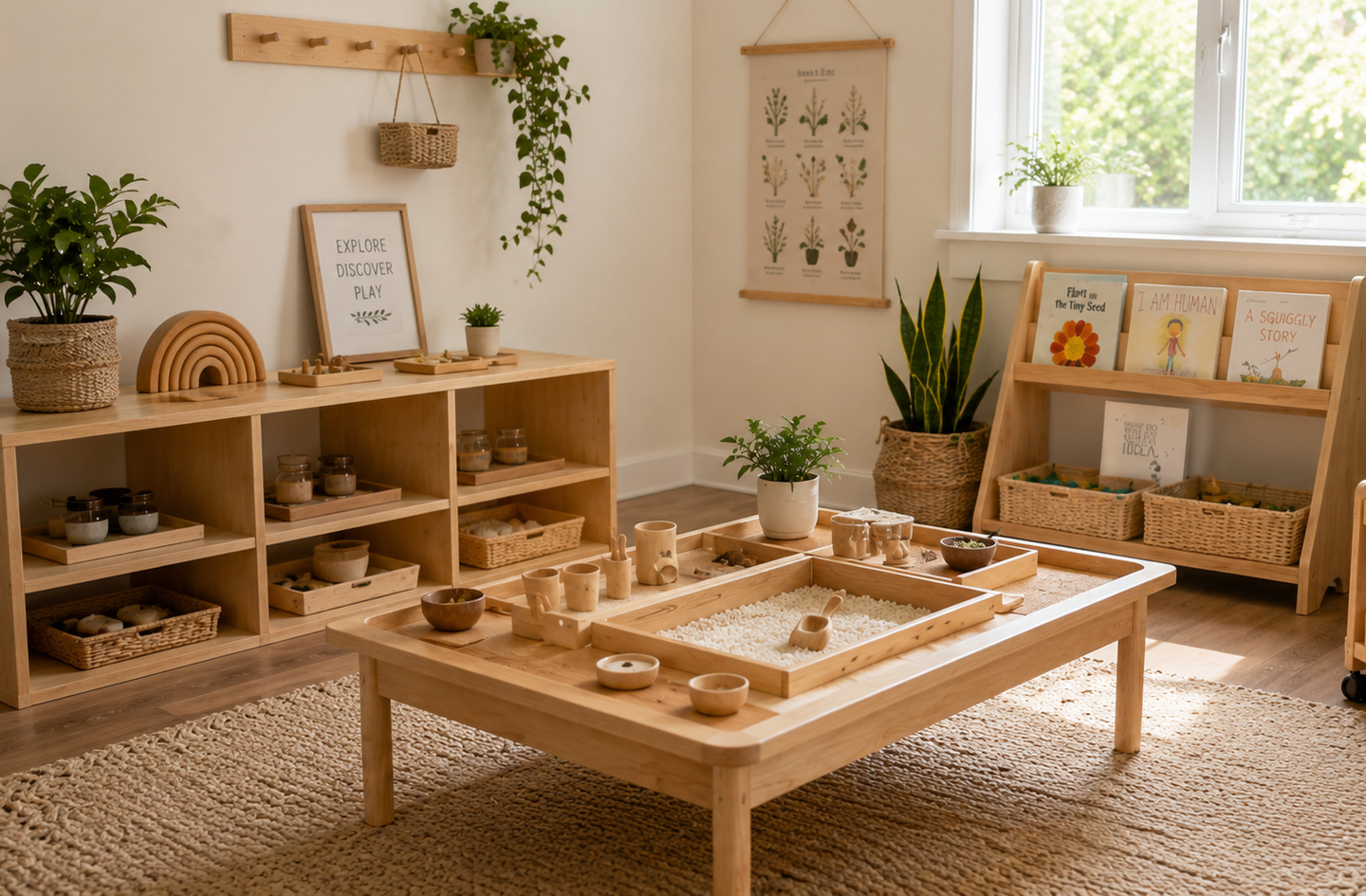
The montessori toy shelf is the operational core of a Montessori home environment. It is not a display unit or a storage solution. It is the system that determines whether a child can select an activity, carry it to a workspace, complete it fully, and return it without adult help. This spoke covers the specific setup questions that come up when building or placing a Montessori shelf at home: height by age, open versus closed shelving, spacing and presentation, how many activities to keep out, trays and baskets, toy rotation, wall anchoring, and reset design. For how the shelf connects to a full room system, see Montessori Playroom Setup, the overview of the prepared environment as a whole. A 2023 systematic review of 32 Montessori studies found a mean effect size of g = 0.36 for executive-function outcomes relative to traditional education2. The shelf’s role in that outcome is not coincidental.
Quick Answer
What height should a Montessori toy shelf be, and how many activities should it hold?
Montessori training guidelines recommend shelf tops at approximately 61 cm (24 in) for toddlers and 81-101 cm (32-40 in) for school-age children6. The governing rule: the top shelf should sit at or below the child’s eye level so every item is visible without adult help. Display 6 to 10 activities in single rows with 5-8 cm of clear space between each unit. Rotate activities every two to four weeks, or earlier when disengagement becomes visible.
Key Takeaways
- A Montessori toy shelf is a child-height, open-front unit where each activity is spaced visibly in a single row – not a toy chest or multi-cubby bin storage.
- Montessori training guidelines place the toddler shelf top at approximately 61 cm (24 in), keeping every item within a 2-year-old’s visual field and independent reach6.
- A 2018 peer-reviewed study found toddlers given 4 toys played longer and in more varied ways than those given 161; the shelf’s limited display count supports depth of engagement over breadth.
- Trays and baskets contain each activity so the reset is child-executable: one tray returns to one spot, with no adult sorting required.
- Wall-anchoring is a baseline structural precaution for any freestanding shelf; consult a licensed contractor if you are unsure about your wall type or construction.
What Makes a Shelf Montessori-Friendly
A Montessori toy shelf is defined less by its material, brand, or price point, and more by how it functions in relation to the child. Three properties make a shelf Montessori-compatible: the child can see every option without opening a door or digging through a bin; every displayed item is reachable without a step stool or adult lift; and returning an item to its exact spot is unambiguous, because each activity has one clearly designated location that does not change session to session.
These three properties rule out most conventional toy storage. A toy box fails all three: items are buried, there is no visible order, and there is no assigned location. A cubby unit with opaque bins fails the first property because the child cannot see what is inside until pulling the bin out. A wall-mounted shelf at adult height fails the second. What remains is a low, open-front unit where activities are arranged with space between them, facing the child at eye level.
Open shelf versus cubby storage
The open shelf places activities in full view, which is the mechanism that supports self-directed choice. The child can scan the shelf, identify what they want, and make a decision without adult mediation. A cubby unit can function in a Montessori-adjacent way if the bins are open-topped, each bin holds only one activity category, and the contents are visible from standing height. The problem with most cubby systems in practice is that they encourage over-filling: a parent adds more items because there is space, and the system collapses into unsorted toy storage. An open shelf makes over-filling immediately visible, which builds in a natural self-correction.
The U.S. Department of Agriculture’s Virtual Lab School training module for infant-toddler learning environments states:
“The best way to promote children’s ability to find and use materials independently is to store materials on low, open shelves, which lets children see the materials available, make a choice, and return the item with less adult support.”
Virtual Lab School, U.S. Department of Agriculture – Infant-Toddler Learning Environments5
| Feature | Open Shelf | Cubby with Opaque Bins |
|---|---|---|
| Child can see all options | Yes – full visual scan at a glance | No – bins must be pulled out first |
| Reset unambiguity | High – each tray returns to its visible spot | Medium – bins can mix if over-filled |
| Over-fill risk | Low – visible immediately | High – hidden inside bins |
| Visual calm | High when spaced correctly | Medium – depends on bin labels and color |
| Best for | Primary Montessori display | Supplemental category storage |
Why the prepared environment concept drives shelf design
Maria Montessori’s concept of the “prepared environment” holds that the room should support independence, focus, creativity, and self-correction without adult instruction at every step – what practitioners sometimes call “the Third Teacher.” The shelf’s design is a direct expression of that idea: every choice of height, spacing, display count, and tray placement either supports or undermines independent operation. A 2017 randomized longitudinal study found that 65% of Montessori preschool children chose a harder puzzle over an easier one, compared to 47% of peers in traditional programs (p = 0.03)3. The shelf is where that design principle starts.
Wood versus other materials
A Montessori toy shelf does not need to be wood. Solid wood and birch plywood are popular because they are durable, visually calm, and match the natural-materials aesthetic common in Montessori environments. A white laminate or painted MDF shelf at the correct height and depth functions equally well as a display system. Material affects aesthetics and long-term durability. It does not determine whether the shelf can operate as a Montessori tool. Height, stability, display count, and spacing matter more than material.
Montessori Toy Shelf Height by Age
Shelf height is the single most common setup error in a home Montessori environment. A shelf even 10 cm too tall forces a child to reach above their visual field, which eliminates independent access and gradually eliminates shelf use. Montessori teacher-training materials specify shelf heights by developmental stage, and CDC growth data for median standing heights provides the anthropometric basis for those guidelines67.
Height guidelines by age group
For infants under 12 months who are floor-based or just pulling to stand, materials are typically placed on a floor-level shelf no taller than 40 cm (16 in). For toddlers aged 12-36 months, the standard is a shelf top at approximately 61 cm (24 in). For preschool and early childhood ages 3-5, a top height of 61-81 cm (24-32 in) keeps activities visible and within reach. School-age children ages 6 and older can use shelves up to 81-101 cm (32-40 in), though lower always provides safer independent access. These dimensions reflect established Montessori training practice rather than a formally published measurement standard.
The underlying rule is practical: the shelf top should sit at or below the child’s shoulder height, so every item on the top shelf sits within their unobstructed sightline. When a child must look up at an angle to see what is on the shelf, they often cannot read it correctly and stop engaging with it consistently. The investment in a lower shelf pays for itself in independent use within days.
Shelf depth and side clearance
Shelf depth (front to back) directly affects whether a child can return an item without it falling or tipping. A depth of 20-30 cm (8-12 in) works for most standard Montessori activities, trays, and baskets. Deeper shelves accumulate items pushed to the back that the child cannot see or reach. Shallower shelves tip tall items or force trays to hang over the edge. Most commercially available low children’s shelves run 25-30 cm deep, which lands in the workable range.
Between each displayed activity, leave at least 5-8 cm of clear space on both sides. This visual gap signals “this is one separate thing.” Without that gap, the shelf reads as a continuous line of items, which raises the decision cost of choosing any single one. In a narrow space, reducing the displayed count is a better solution than crowding items together. Fewer well-spaced activities consistently produce more independent play than ten items touching.
Layout, Spacing, Trays, and Baskets
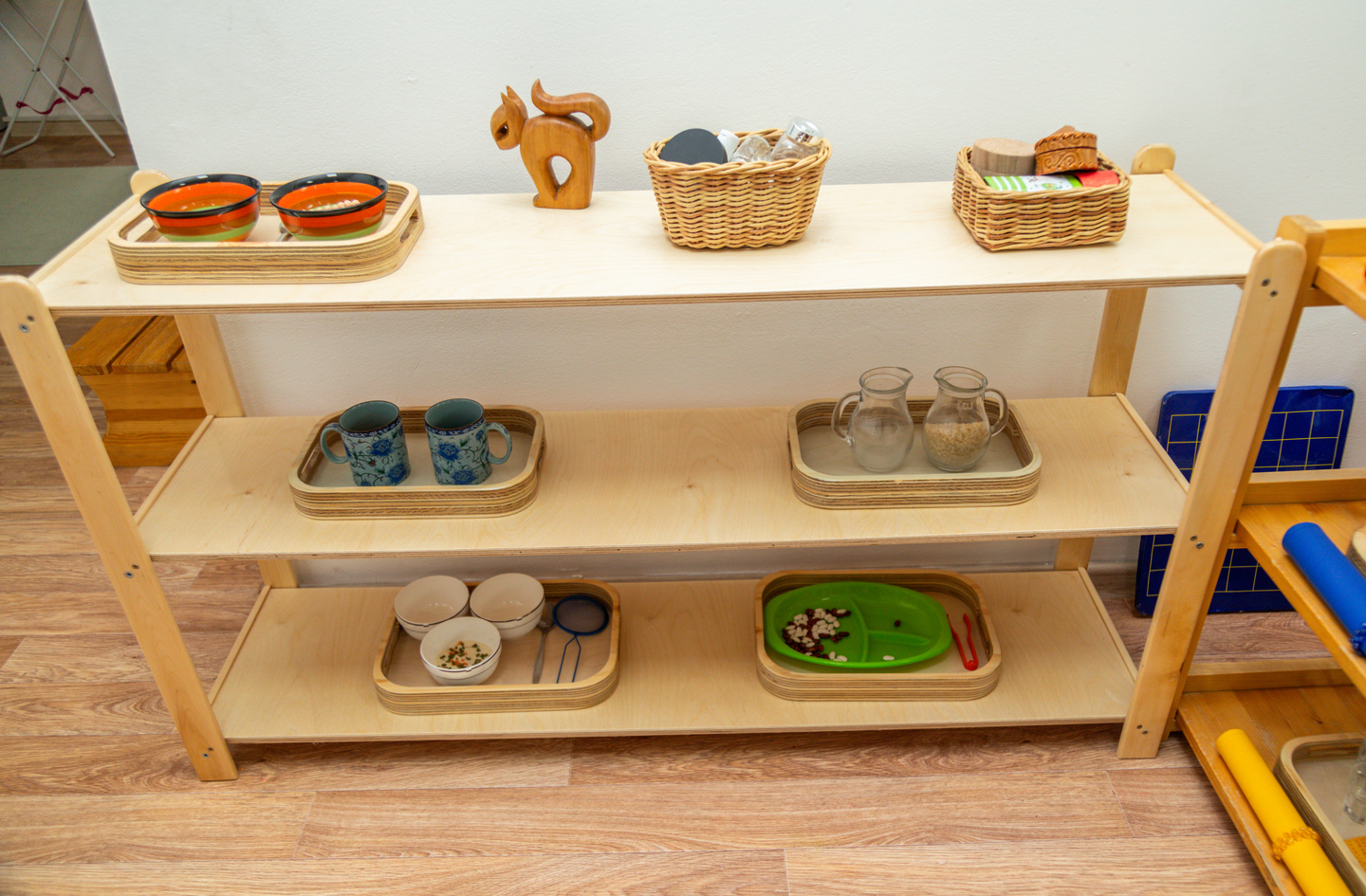
Once height and depth are correct, the layout of items on the shelf determines whether the child reads it as an invitation or as noise. The USDA Virtual Lab School guidance specifies “single rows on a shelf if possible” with “space between items so children can easily see each piece5.” That instruction describes the entire shelf layout principle in operational terms: one row, clear gaps, no stacking.
One activity, one assigned spot
Every item on a Montessori shelf has a fixed, assigned location. That means every activity occupies the same spot session to session, week to week, until a rotation event. The child learns the shelf map without being formally taught it: they know what is where because the layout does not shift arbitrarily between their visits. This fixed-location principle is what allows a child to return an item independently without scanning the whole shelf or asking a parent. When items are rearranged between uses, the reset becomes an adult task rather than a child task, and the system’s independence benefit disappears.
In practice: place activities from left to right in rough order of complexity, keep the most recently introduced activity in a consistent position, and never stack one tray on another. A moved tray is a system failure, not a styling choice.
Trays and baskets as reset containers
Trays and small baskets do the structural work that makes child-executed reset possible. Each tray holds all the components of exactly one activity: a pouring-work tray holds two small pitchers, a tray liner, and a cloth. A sensory sorting tray holds the sorting bowl, the items to be sorted, and any tools. When the work is complete, the child places everything back on the tray in the arrangement they found it, then carries the tray as a unit to its shelf spot. No components migrate, because the tray is the container.
Trays should be proportionate to the child’s grip and carry capacity. Wooden trays with shallow lips (2-3 cm) work for most Montessori activities. Wicker baskets with handles suit activities with loose parts that do not require a fixed arrangement. A tray with its contents neatly arranged signals to the child what “done” looks like, which reduces adult reset time during rotation.
Spacing as a design decision, not an afterthought
The space between activities on a shelf is not wasted shelf real estate. It is the visual separator that makes each activity readable as a discrete unit. Five to eight centimeters of clear space on each side of a tray, consistently maintained, communicates “this is one thing.” In spaces where that spacing is impossible to achieve across the full display count, the right response is to reduce the display count, not to compress the spacing. Compressed spacing turns the shelf back into visual clutter. The goal is a shelf face that a child can scan in two seconds and make a decision: that scan speed is a function of spacing, not of decoration.
How Many Activities to Display
This is the question that most directly determines whether the shelf functions as a Montessori tool or reverts to a prettier version of conventional toy storage. Too many items and the shelf creates the same choice-overload and clutter dynamic as a filled toy box. Too few and the child exhausts the options before the next rotation. The useful working range for most home setups is 6 to 10 activities for a single child, drawn from several developmental areas, with clear spacing between each.
The research case for a limited display count
A 2018 study published in Infant Behavior and Development compared toddlers aged 18-30 months in two free-play conditions: 4 toys available or 16 toys available. Children in the 4-toy condition showed longer durations of individual toy play and engaged with each toy in a greater variety of ways1. The researchers described “fewer incidences of toy play, longer durations of toy play, and played with toys in a greater variety of ways” in the smaller-set condition. The sample was small (n = 36), so these findings are directional rather than definitive, but the direction is consistent with the Montessori shelf philosophy: fewer displayed items supports depth of engagement.
A 2023 University of Minnesota study introduced a useful nuance: toddlers in that research preferred the side with more sticker options in approximately 70% of trials, suggesting children prefer having choices available8. Preference and engagement depth are not the same measure. A child may prefer to have more options visible, while also engaging more deeply when fewer are presented. The shelf manages both: the full toy collection exists in storage, so the child is not deprived of options; the active display is limited, so depth of engagement is supported.
Activity categories to represent on the shelf
A practical display of 6 to 10 activities typically draws from several categories. This is not a rigid curriculum; it is a rough distribution that keeps the shelf balanced across types of engagement:
- Fine motor and practical life (1-2 activities): pouring, spooning, transferring, lacing, threading, simple dressing frames
- Sensory and manipulation (1-2 activities): sorting, matching, stacking, simple knobbed puzzles
- Language and early literacy (1-2 activities): picture books, simple object-to-picture matching, sound-object activities
- Math and early logic (1 activity): counting objects, shape sorting, basic patterns
- Art and creative work (1 activity): one contained art tray with defined materials, not loose supplies scattered across the shelf
- Open-ended building (1 activity): unit blocks, simple loose parts, natural construction elements
Not every session needs every category represented. Adjust the distribution to match your child’s current developmental focus. The shelf is a planning tool, not a checklist. What matters is that each displayed item is complete (all components present), independent (usable without another activity), and achievable by the child without adult facilitation once introduced.
Introducing a new activity before it goes on the shelf
Before a new activity appears on the shelf, the parent introduces it briefly: showing where it lives and how each component works, at the child’s pace, with minimal narration. After introduction, the activity belongs to the child’s independent repertoire. New-to-rotation items are always introduced before they appear on the shelf as independent options.
Toy Rotation: When, What, and How Often
Toy rotation is the practice of keeping a portion of the total toy collection in active display while the rest is stored out of the child’s sight, then cycling stored items back to the shelf on a regular schedule. In a Montessori home environment, this is how a limited-display shelf stays engaging over months and years without the parent constantly adding new purchases. It also restructures tidying: there is a fixed home for everything that is out, and everything else has a designated place in storage rather than accumulating in the play space.
Rotation frequency
A two-to-four-week rotation cycle works for most toddler and preschool-age children. Some families use a shorter cycle (one to two weeks) for children who show rapid mastery of activities; others use longer cycles (four to six weeks) for children who return to the same activities repeatedly, which is a developmental sign worth supporting rather than interrupting. The most reliable signal for rotation is behavioral, not calendar-based: if a child has not engaged with a shelf item in roughly a week and shows no interest when the item is referenced, that activity is a candidate to cycle out.
A 2022 longitudinal study of 2,213 Australian children found that time in unstructured, child-directed play between ages 2-3 and 4-5 significantly predicted self-regulation two years later4. The proposed mechanism was “early opportunities for, and practice of, self-direction.” A well-designed rotation supports exactly this: a refreshed set of activities within a familiar system, self-directed choice within a constrained display, and independent work completion each session.
What to store and what to keep out
Not all activities rotate at the same rate. Some practical-life activities may stay on the shelf for most of a term because the child uses them daily and the underlying motor skill is still developing. A puzzle or matching activity rotates out after the child has mastered it and returns to it infrequently. Open-ended materials such as unit blocks, simple loose parts, and basic art trays often stay out continuously because their use evolves as the child develops: a 2-year-old uses unit blocks differently than a 4-year-old uses the same set.
Stored items live in labeled bins out of the child’s view but within the parent’s easy reach. A rotation is not a cleanup: outgoing items go to storage, incoming items are checked for completeness and briefly introduced if they have been stored long enough to feel new, then placed in their shelf spots. A rotation that takes more than 20 minutes has too many items in either direction.
Safety Anchoring and Child-Led Reset Design
A Montessori toy shelf is used by a child who may pull on its edges, lean against it, or attempt to stand on the lowest shelf. A freestanding shelf that is not secured to a wall carries a tip-over risk. This is not a decor choice or an optional refinement. It is a structural precaution that applies regardless of shelf type, height, material, or weight.
Wall anchoring
The Consumer Product Safety Commission’s furniture tip-over data show that unsecured freestanding furniture is a recurring source of child injury in residential settings. Most commercial children’s shelves ship with an anti-tip strap that requires one or two screws into a wall stud or an appropriately rated toggle anchor. If you are not confident about your wall type (drywall over wood stud, plaster over lath, concrete, masonry), consult a licensed contractor before anchoring. The shelf must be secured; the anchoring method depends on the specific wall construction, and that evaluation requires direct knowledge of the wall.
Any shelf a child can pull on, lean against, or use as a hand-hold when rising from the floor should be anchored. A licensed contractor evaluates the specific wall construction; this is engineering-informed guidance, not a wall-by-wall certification.
Designing for child-led reset
The Montessori prepared environment concept – sometimes called “the Third Teacher” because the room itself teaches through its organization – holds that the room should enable independence, focus, and self-correction without requiring adult instruction at every step. The shelf’s reset design is where that principle becomes concrete: a child who finishes an activity should be able to look at the shelf and know exactly where the tray returns, without asking. That clarity is the goal. When it exists, reset becomes a normal part of the activity rather than a separate chore that adults enforce.
Three structural conditions produce child-executable reset: fixed positions (each activity always returns to the same spot), clear spacing (the empty spot is visible even when the tray is gone), and proportionate containers (the tray fits its shelf location without ambiguity about which spot it belongs in). When all three are in place, the reset state of the shelf is as obvious as the initial display state. Design for the reset, not just the reveal. That single principle separates a Montessori shelf from an attractive display unit that adults constantly re-sort.
Shelf placement in the room
Place the shelf where the child can approach it from multiple angles, not pushed into a corner so tightly that only one path in exists. Position it away from high-traffic routes where siblings or adults might collide with a child carrying a tray. Natural light reaching the shelf face makes activities more visible and the display more readable at a glance. A child who can walk a relaxed arc to retrieve and return items will use the shelf more consistently than one who must squeeze or angle to reach it. Shelf placement and room circulation are connected design decisions, not independent choices.
Frequently Asked Questions
How tall should a Montessori toy shelf be?
For toddlers ages 1-3, Montessori training guidelines recommend a shelf top height of approximately 61 cm (24 in)6. For preschool-age children ages 3-5, 61-81 cm (24-32 in) is appropriate. School-age children ages 6 and older can use shelves up to 81-101 cm (32-40 in). The governing rule: the top shelf sits at or below the child’s eye level so every displayed activity is in their visual field and within independent reach.
How many toys should be on a Montessori shelf at once?
Most home Montessori environments display 6 to 10 activities at a time, drawn from multiple developmental areas such as fine motor, sensory, language, and open-ended building. A 2018 peer-reviewed study found toddlers with 4 toys played longer and in more varied ways than those with 161. The rest of the toy collection stays in rotation storage and cycles onto the shelf on a regular schedule.
How often should I rotate Montessori toys?
A two-to-four-week cycle is the most common guideline for toddlers and preschoolers. The behavioral cue matters more than the calendar: if a child has not engaged with a shelf item in roughly a week and shows no interest when it is mentioned, that activity is ready to rotate out. Activities a child returns to repeatedly can stay on the shelf longer without disrupting the system.
What is the difference between an open Montessori shelf and a cubby shelf?
An open Montessori shelf displays activities on flat, visible shelves with clear spacing between each tray. A cubby shelf organizes items into bins or compartments. Open shelves allow a full visual scan at a glance; a cubby with opaque bins requires the child to pull each bin out before seeing the contents. This adds steps to both selection and reset, which reduces independent use. Open-top cubbies with one activity per bin can approximate open-shelf function when the bin count is strictly controlled.
Does a Montessori toy shelf need to be made of wood?
No. A Montessori toy shelf does not need to be wood. Solid wood and birch plywood are common choices for durability and visual calm, but a stable white laminate or painted MDF unit at the correct height and depth functions equally well as a display system. Material affects aesthetics and durability. It does not determine whether the shelf can operate as a Montessori tool. Height, stability, display count, and spacing are the deciding factors.
Limitations and Edge Cases
- Shelf height guidelines reflect Montessori training convention for typically developing children near median height. For children with different mobility profiles, stature, or physical development, a pediatric occupational therapist can advise on the appropriate display height for a specific child – do not rely on general guidelines for that evaluation.
- The Dauch 2018 toy-quantity study used a small sample (n = 36) of toddlers aged 18-30 months. The directional finding (fewer toys, deeper engagement) is consistent with broader Montessori practice, but the study should not be over-cited as definitive evidence for a specific toy count.
- Rotation frequency guidance is a general framework for a single-child setup. Households with multiple children at different ages and stages, or children with significantly different engagement patterns, will need a modified approach. The broader Montessori room system context is where multi-age shelf strategy is addressed.
References
- PubMed / Infant Behavior and Development – Dauch, C., Imwalle, M., Ocasio, B., and Metz, A. “The influence of the number of toys in the environment on toddlers’ play.” Infant Behavior and Development, Vol. 50, pp. 78-87. 2018.
- PMC / Campbell Systematic Reviews – Randolph, J.J., Bryson, A., Menon, L., et al. “Montessori education’s impact on academic and nonacademic outcomes: A systematic review.” Campbell Systematic Reviews, Vol. 19, No. 3, e1330. 2023.
- Frontiers in Psychology – Lillard, A.S., Heise, M.J., Richey, E.M., Tong, X., Hart, A., and Bray, P.M. “Montessori Preschool Elevates and Equalizes Child Outcomes: A Longitudinal Study.” Frontiers in Psychology, 8, 1783. 2017.
- ScienceDirect / Early Childhood Research Quarterly – Colliver, Y., Brown, J.E., Harrison, L.J., and Humburg, P. “Free play predicts self-regulation years later: longitudinal evidence from a large Australian sample of toddlers and preschoolers.” Early Childhood Research Quarterly, Vol. 59, pp. 148-161. 2022.
- Virtual Lab School, U.S. Department of Agriculture – “The Indoor Environment: Designing and Organizing.” Infant-Toddler Learning Environments module. USDA-funded ongoing resource.
- NAMC – North American Montessori Center – “Prepared Environment Tips: Montessori Furniture for Infants and Toddlers.” Montessori Teacher Training Blog. 2013.
- CDC / National Center for Health Statistics – “Clinical Growth Charts: Stature-for-age percentiles, 2 to 20 years.” Centers for Disease Control and Prevention.
- Frontiers in Developmental Psychology – Castelo, R.J., Kim, S., and Carlson, S.M. “More is more: toddlers do not show choice overload.” Frontiers in Developmental Psychology. 2023.
Conclusion
A Montessori toy shelf works when three conditions are met: the height places every displayed activity within the child’s unobstructed visual field, the display count is low enough to support depth of engagement, and the layout is designed so the child’s reset is as unambiguous as the initial display. These are structural and systems questions. A white laminate shelf at 61 cm, wall-anchored, holding eight activities in single rows with clear spacing and contained in proportionate trays, will outperform an expensive natural-wood unit at adult height holding thirty items in stacked rows. The material and aesthetic are secondary to the system.
For how the shelf fits into a full Montessori-inspired room – including zone planning, circulation, and the broader prepared environment – see Montessori Playroom Setup for the room-level overview.