
Indoor active-play zones are planned parts of a home, classroom, or childcare room set aside for climbing, jumping, crawling, balancing, and ball play. They turn a loose pile of mats and toys into a layout with clear edges, soft landings, and a reset plan. The World Health Organization advises at least 180 minutes of physical activity a day for children aged 1 to 41. On cold or wet days, much of it happens indoors. This guide is for parents, teachers, and childcare staff, and it maps the whole topic before pointing to deeper guides by age and setting.
Quick Answer
What is an indoor active-play zone?
An indoor active-play zone is a bounded floor area where children can run, jump, climb, crawl, and throw without crossing walkways, furniture edges, or quiet corners. A working zone pairs open floor with soft landing surfaces, age-fit equipment, clear sightlines, and storage that resets fast. US guidelines ask adults to encourage at least 3 hours of active play per day for children ages 3 through 52.
Why it matters:
Children move whether or not a room plans for it. A defined zone sends that energy toward soft floor and open space instead of toward bookcases, doorways, and the sofa arm.
Key Takeaways
- Preschoolers need at least 3 hours of active play spread across the day, so an indoor zone does daily work, not occasional work2.
- Location comes first: a zone placed on a walkway or beside tall furniture fails no matter what equipment fills it.
- Furniture and TV tip-overs sent an average of 18,673 US children to emergency rooms each year, so anchoring and distance from storage are part of zone planning3.
- Equipment should match the youngest regular user, because a set-up built for a 6-year-old asks too much of a toddler.
- The most common mistake is planning for the reveal instead of the reset; a zone that takes a long time to tidy stops being used.
Indoor Active-Play Zones in 30 Seconds
| If you are… | Do this |
|---|---|
| Planning for a toddler aged 1 to 2 at home | Keep everything low: a crawl tunnel, a push toy, a wedge, and full mat coverage within arm’s reach of an adult. |
| Working with a small apartment room | Use one wall as the zone edge, fold-away mats, and a single bin that holds the whole kit. |
| Finishing a basement for mixed ages | Split the floor into a low toddler pad and a higher-energy area, with storage on the far wall. |
| Running a classroom or childcare room | Set a head-count limit, mark start points on the floor, and keep every station in one adult’s line of sight. |
| Planning for school-age kids aged 5 to 12 | Divide by intensity: agility and ball games on one side, balance and strength on the other. |
| Working with no budget | Build stations from cushions, painter’s tape, and laundry baskets, and pack them away after each session. |
What Is an Indoor Active-Play Zone?
An indoor active-play zone is a defined area inside a building where children practice large-muscle movement such as running, climbing, rolling, jumping, and throwing. It sits inside a larger room but has its own boundary, surface, equipment, and storage.
Gross motor skills are the whole-body movements that use the large muscles of the arms, legs, and trunk, including crawling, walking, balancing, and catching. An active-play zone is where those skills get daily practice when outdoor play is not possible, whether because of weather, daylight, or a busy schedule.
The scope includes soft play areas, foam ball pits, tumbling mats, obstacle courses, and movement stations in homes, classrooms, and childcare rooms. It excludes permanent climbing walls, wall-mounted gym hardware, and home trampolines, which call for a structural engineer or licensed installer.
The American Academy of Pediatrics describes play as anything but frivolous, stating that it enhances brain structure and function and promotes executive function4. An active-play zone treats the room as a system that makes that play easier to start, safer-feeling to repeat, and quick to tidy away.
Why Indoor Active-Play Zones Matter
Indoor active-play zones matter because the daily movement targets for young children are large, and weather limits outdoor time for much of the year. WHO guidance for children aged 3 to 4 sets at least 180 minutes of activity a day, of which at least 60 minutes should be moderate to vigorous1. The same guidance says young children should not be restrained for more than 1 hour at a time1.
WHO Director-General Dr Tedros Adhanom Ghebreyesus framed the reason for those targets plainly when the guidelines were released:
Achieving health for all means doing what is best for health right from the beginning of people’s lives.
Without a planned zone, that movement still happens, just in the wrong places. Three gaps recur:
- Energy goes toward sofas, bookcases, and doorways because nothing else in the room invites it.
- Equipment is bought before the floor is measured, so it crowds walkways or sits too close to hard edges.
- The zone looks good on day one but has no storage plan, so it fills with clutter within a week.
Furniture risk is the clearest reason to plan the space with care. A 30-year study of US emergency data found that children younger than 6 accounted for 69.9% of furniture and TV tip-over injuries. Almost half of all such injuries, 47.0%, were to the head or neck3. Keeping climbing and jumping away from tall, anchored storage removes a common cause of those injuries from the movement area.
The Six-Layer Active-Play Zone Framework
The Six-Layer Active-Play Zone Framework was grouped from the friction points parents and teachers raise most. Those were then reduced to the smallest set that still covers every planning decision: location, landing, age fit, activities, supervision, and reset. Each layer depends on the one before it, so the order matters.
Layer 1: Location and Boundaries
A circulation path is the route people use to cross a room, such as the line from a doorway to a window or to another door. An active-play zone should never sit on one. The best spot is a corner or wall run away from doors, tall furniture, radiators, and glass. A rug, a mat border, or the back of a low shelf marks the edge. That edge tells a child where fast movement is allowed and tells adults where not to walk with a hot drink.
If only one decision gets made with care, it should be this one, because no mat or equipment choice can rescue a zone placed on a walkway.
Deeper read: planning an indoor active-play zone at home.
Deeper read: indoor active-play zone layout and setup ideas.
Deeper read: a safe layout for a soft play area at home.
Deeper read: active playroom zones for movement and energy.
Layer 2: Surfaces and Clearances
A fall zone is the clear, cushioned area around any equipment a child can climb, jump from, or roll off. It needs a soft surface and nothing hard inside it: no table corners, toy bins, or radiator edges. Room size, ceiling height, and landing space decide what a zone can hold. A low ceiling rules out bouncing and overhead swings, and a narrow room rules out running games. Foam ball pits and play mat sets add their own footprint, plus space to climb in and out and room for the balls that escape.
The floor plan sets the limit on what fits, not the product listing, so landing space gets measured before any equipment gets chosen.
Deeper read: how to plan the zone for indoor gross motor activities.
Deeper read: a foam ball pit and play mat zone layout.
Deeper read: setting up the Verdes foam ball pit set in an active-play zone.
Layer 3: Age and Stage Fit
Developmental fit means matching height, challenge, and speed to the youngest child who uses the zone often. Toddlers aged 1 to 2 need low climbing, crawl paths, push toys, and things to carry, with an adult within arm’s reach. Preschoolers aged 3 to 5 add jumping, balance beams, and throwing at targets. School-age children want agility, strength, and group challenges, which need more floor and clearer rules. US guidelines pair the preschool target of 3 hours a day with at least 60 minutes of moderate-to-vigorous activity daily for youth ages 6 through 172. Questions about a specific child’s motor development belong with a pediatric occupational therapist.
Mixed-age homes do better with two heights than with one compromise, because a middle setting is too high for the toddler and too dull for the older child.
Deeper read: an indoor gross motor zone for 1-year-olds.
Deeper read: indoor gross motor zone planning for young toddlers.
Deeper read: an indoor gross motor zone for toddlers.
Deeper read: a movement zone for age two.
Deeper read: an at-home gross motor zone for 2-year-olds.
Deeper read: a free indoor gross motor zone for 2-year-olds.
Deeper read: an indoor gross motor zone for 3-year-olds.
Deeper read: an at-home active-play zone for ages 3 to 5.
Deeper read: planning indoor gross motor activities for preschoolers.
Deeper read: preschool active play kept off hard edges.
Deeper read: a step-by-step zone guide for age four.
Deeper read: an indoor gross motor zone for kindergarten.
Deeper read: an indoor active-play zone for ages 5 to 12.
Layer 4: Stations and Games
A movement station is one small, self-contained activity, such as a tunnel, a tape-line balance path, or a beanbag toss, with a clear start point and end point. Stations let a zone change from week to week without new equipment. Games are chosen by footprint, ceiling height, impact level, number of players, and reset time. Household items can build most stations at no cost, provided each one is stable and has open space around it. The American Academy of Pediatrics strongly discourages home trampoline use and notes that most trampoline injuries occur with several users on the mat at once5.
A game should be judged by how it ends, since one with no finish line turns into chasing through the rest of the room.
Deeper read: preschool gross motor game zone setup.
Deeper read: free preschool gross motor zone ideas.
Deeper read: space and zone planning for indoor gross motor games.
Layer 5: Supervision and Shared Settings
Supervision is a layout decision as much as a staffing one. Every station should be visible from the adult’s usual seat or standing spot, with no furniture blocking the view. Childcare rooms and schools add capacity limits, turn-taking rules, cleaning routines, and marked movement routes for groups. A gym or multipurpose room can hold whole-class games, while a classroom corner suits two to four children at a time.
A head-count limit belongs in the plan before any equipment does, because crowding turns a well-spaced layout into a collision course.
Deeper read: a toddler gross motor zone for childcare settings.
Deeper read: indoor active-play zones for students at school.
Layer 6: Storage, Reset, and Rotation
A reset is the routine that returns the zone to its starting state after play. A zone that resets quickly gets used, and one that needs a long clean-up gets closed. Equipment works best stored beside the zone in open, labeled bins at child height, with heavy items low and tall shelves anchored to the wall. Seasonal rotation keeps interest up: winter calls for more stations in less space, while spring is a good time to lighten the kit and recheck mats and anchors.
Design for the reset, not just the reveal: the storage plan decides whether the zone still works in its third month.
Deeper read: winter gross motor zone ideas for preschoolers.
Deeper read: a spring indoor active-play zone refresh.
How to Choose the Right Indoor Active-Play Zone Setup
Free floor space is the single most important criterion when planning an indoor active-play zone, measured after walkways, door swings, and furniture clearances are taken out. Everything else, from equipment to games, follows from that number. The steps follow observation before shopping: understand the room first, then fill it.
- Walk the room. Watch where children already run, where toys pile up, and which routes adults use. Those patterns point to the zone’s location, as the planning steps for an active-play zone at home set out.
- Measure floor and ceiling. Record the clear floor area and the ceiling height above it. Both limit what equipment and games can fit.
- Name the youngest regular user. Set heights and challenge for that child, then add harder options that older children can use.
- Choose surface and containment. Decide on mats, rug edges, or a ball-pit wall based on what the activities need.
- Plan storage before buying. Every item needs a home beside the zone, reachable by the child who uses it.
- Check the adult’s view. Stand where the supervising adult sits and confirm every station is visible.
| Criterion | What to check | Red flag |
|---|---|---|
| Location | Corner or wall run off the main walkway | Zone sits between a door and the kitchen |
| Floor | Clear area after furniture clearances | Mats butt against table legs or radiators |
| Ceiling | Height above the highest jump or climb | Bouncing planned under a low basement beam |
| Surface | Soft, non-slip mats under every climb and landing | Thin rug over tile below a step or wedge |
| Age fit | Equipment height matched to the youngest user | One tall structure shared by a 2-year-old and a 7-year-old |
| Storage | Low, labeled bins beside the zone; tall units anchored | Unanchored bookcase at the zone edge |
Two red flags override the rest. Climbing hardware fixed to a wall or ceiling needs a structural engineer or licensed installer. Jumping placed next to tall storage needs a new location.
Compare All Indoor Active-Play Zone Settings
| Criteria | Small-room corner | Dedicated playroom | Basement zone | Classroom or childcare | Free DIY stations |
|---|---|---|---|---|---|
| Typical footprint | A rug-sized area along one wall | Half the room or more | A large open section of the floor | A marked corner, gym, or multipurpose room | Whatever floor is clear that day |
| Best ages | 1 to 5 | 1 to 12 | 3 to 12 | 1 to 12, grouped by age | 2 to 6 |
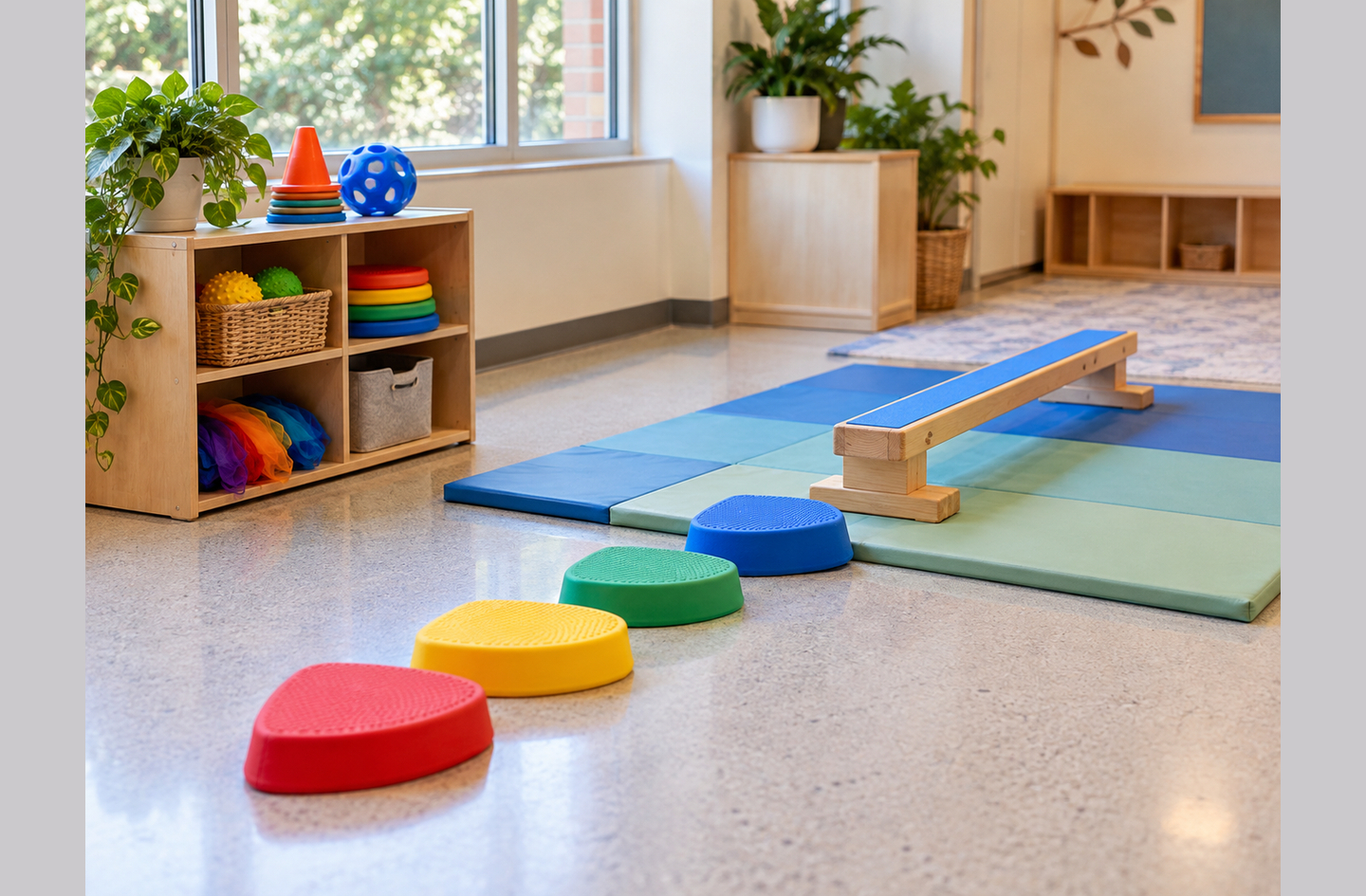
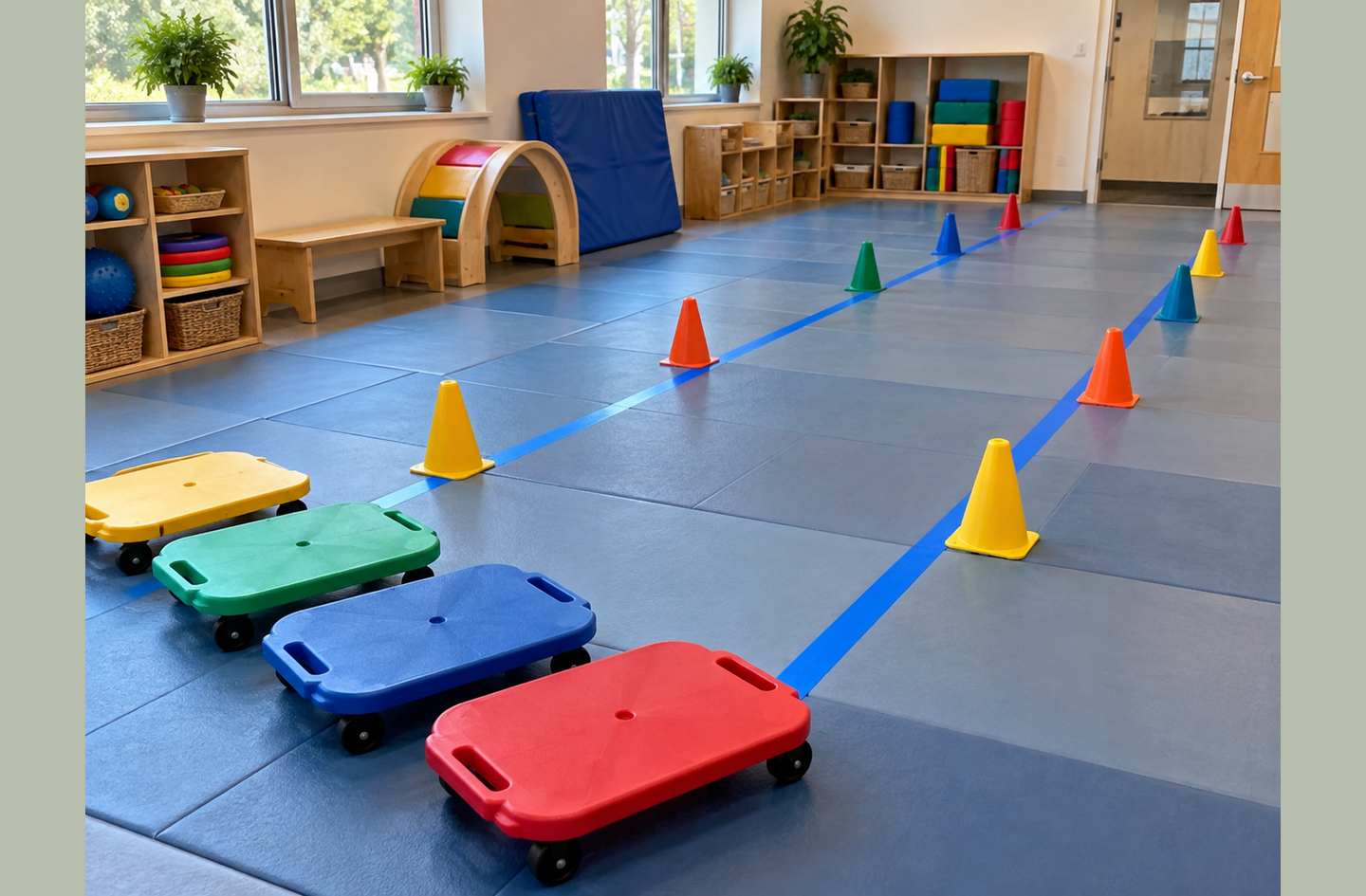
| Core equipment | Fold-away mat, tunnel, soft blocks | Mats, low climber, balance beam, ball pit | Mats, obstacle course, ball games | Floor markers, cones, mats, scooter boards | Cushions, tape lines, laundry baskets |
| Reset effort | Low: one bin | Medium: shelves and bins | Medium to high | High: shared kit, cleaning | Low: pack away after use |
| Main constraint | Space and walkways | Mixed ages | Ceiling height and flooring | Head count and sightlines | Stability of household items |
| Cost range | Low | Medium to high | Medium to high | Program budget | None |
Choose a small-room corner if: the home has no spare room and the zone must disappear at night.
Choose a dedicated playroom if: siblings of different ages need separate heights in one space.
Choose a basement zone if: there is ceiling clearance and room for running games away from storage.
Choose a classroom or childcare layout if: several children use the zone at once and adults rotate supervision.
Choose free DIY stations if: the goal is to test what children enjoy before spending anything.
Deeper read: indoor active-play zone layouts for small and large rooms.
Common Mistakes
Mistake 1: Placing the Zone on a Walkway
Why it is a mistake: Adults and siblings cross the zone mid-game, and children run into people carrying things.
What to do instead: Move the zone to a corner or wall run and keep a clear path around it, not through it.
Read more: planning an indoor active-play zone at home.
Mistake 2: Buying Equipment Before Measuring
Why it is a mistake: A climber or ball pit that fills the floor leaves no landing space, and a low ceiling can rule out whole categories of play.
What to do instead: Measure clear floor and ceiling height first, then shortlist only equipment that leaves soft space on every side.
Read more: how to plan the zone for indoor gross motor activities.
Mistake 3: One Set-Up for Every Age
Why it is a mistake: Toddlers and school-age children need different heights, speeds, and rules, so a shared set-up is too hard for one and too easy for the other.
What to do instead: Create a low pad for the youngest and a separate area or time slot for higher-energy play.
Read more: an indoor gross motor zone for toddlers.
Mistake 4: Active Play Beside Tall, Unanchored Furniture
Why it is a mistake: Climbing and pulling on furniture are part of how young children move. US emergency rooms treated an average of 18,673 children a year for furniture and TV tip-over injuries between 1990 and 20193.
What to do instead: Anchor tall units to the wall, keep heavy items on low shelves, and leave clear floor between storage and any climbing or jumping area.
Read more: preschool active play kept off hard edges.
Best Indoor Active-Play Zone by Use Case
Best for Toddlers at Home
A toddler zone works best as a low, fully matted pad within sight of the kitchen or living area. Crawl tunnels, a wedge, and a push toy cover most needs, and everything packs into one bin so the zone resets in a single trip.
Deeper read: an at-home gross motor zone for 2-year-olds.
Best for Preschool Classrooms
Preschool groups need marked start points, short movement paths, and simple rules that children can repeat without an adult explaining each turn. Floor markers and color-coded stations keep a group of four moving in one direction.
Deeper read: preschool gross motor game zone setup.
Best for School-Age Kids
Children aged 5 to 12 do best when the zone is split by intensity. Agility and ball games get the open side of the room, while balance and strength stations sit along the wall where they are easier to watch.
Deeper read: an indoor active-play zone for ages 5 to 12.
Best for Zero Budget
Cushions, painter’s tape, and laundry baskets can build a full set of stations at no cost. The rule is the same as for bought equipment: every station stays stable, has open floor around it, and packs away fast.
Deeper read: a free indoor gross motor zone for 2-year-olds.
Frequently Asked Questions
How much space does an indoor active-play zone need?
An indoor active-play zone needs enough clear floor for the planned activity plus soft landing space on every side of anything a child can climb or jump from. A toddler crawl-and-push area fits along one wall of a small room. Running games and obstacle courses need a larger open section, such as half a playroom or part of a basement. Measure after walkways, door swings, and furniture clearances are removed, then choose activities that fit that footprint rather than the other way round.
How much active play do toddlers and preschoolers need each day?
The World Health Organization recommends at least 180 minutes of physical activity a day for children aged 1 to 4. For ages 3 to 4, at least 60 minutes of it should be moderate to vigorous1. US guidelines ask adults to encourage at least 3 hours of active play a day for ages 3 through 52. That time is spread across the day, so an indoor zone supports several short sessions rather than one long one.
Should a home active-play zone include a trampoline?
The American Academy of Pediatrics strongly discourages home trampoline use in its 2012 policy statement on trampoline safety. The statement notes that most trampoline injuries occur when several users are on the mat at once. It adds that safety measures such as nets and padding have not clearly reduced risk5. Lower-impact options such as mats, foam blocks, balance beams, and tape-line hopping games give children jumping practice without the same rebound forces.
What flooring works best under an indoor active-play zone?
Interlocking foam mats or folding gym mats on top of carpet or a non-slip rug pad work for most home and classroom zones. The surface needs to stay put when children land, cover the whole fall zone around any climb or step, and wipe clean. Thin rugs over tile or concrete give little cushioning. For a basement or a permanent installation, flooring choice is worth discussing with a licensed contractor who can check moisture and subfloor conditions.
How can a small apartment fit an active-play zone?
A small apartment can fit an active-play zone by using one wall as the boundary and choosing equipment that folds, stacks, or rolls away. A single storage bin that holds the whole kit keeps the reset fast, so the zone appears for play and disappears for dinner. Low-impact stations, such as tunnels, cushion paths, and tape-line balance games, also keep noise down for neighbors below and suit the shorter sessions that small spaces allow.
How This Guide Was Built
The methodology behind this guide combines public health guidance, peer-reviewed injury research, and Playroom Architect’s observation-first planning sequence. Figures come from the World Health Organization, the US Office of Disease Prevention and Health Promotion, and American Academy of Pediatrics journals. Each links to the page that carries it. The six layers were derived by ordering the planning decisions so that each one limits the next. Oded Feigin, founder and lead author, holds editorial responsibility for the guide, which is revised when cited guidance changes.
What This Hub Does Not Cover
- Indoor climbing walls, monkey bars, swings, and other hardware fixed to a wall or ceiling. These need a structural engineer or licensed installer to evaluate the specific room.
- Concerns about a specific child’s balance, coordination, or motor development. A pediatric occupational therapist is the right professional for those questions.
- Outdoor playgrounds and public play equipment, which follow separate surfacing and equipment standards.
- Product certification. This hub explains planning logic and does not certify any product, room, or installation as safe.
References
- World Health Organization – To grow up healthy, children need to sit less and play more (guidelines release, April 2019)
- US Office of Disease Prevention and Health Promotion – Top 10 things to know about the Physical Activity Guidelines for Americans
- Lu et al., Injury Epidemiology (2021) – Furniture and television tip-over injuries to children treated in United States emergency departments
- American Academy of Pediatrics, Pediatrics (2018) – The Power of Play: A Pediatric Role in Enhancing Development in Young Children
- American Academy of Pediatrics, Pediatrics (2012) – Trampoline safety in childhood and adolescence
Next Read
An indoor active-play zone works when location, landing space, age fit, activities, supervision, and reset are planned in that order. Structural reasoning first, decor inspiration second.