
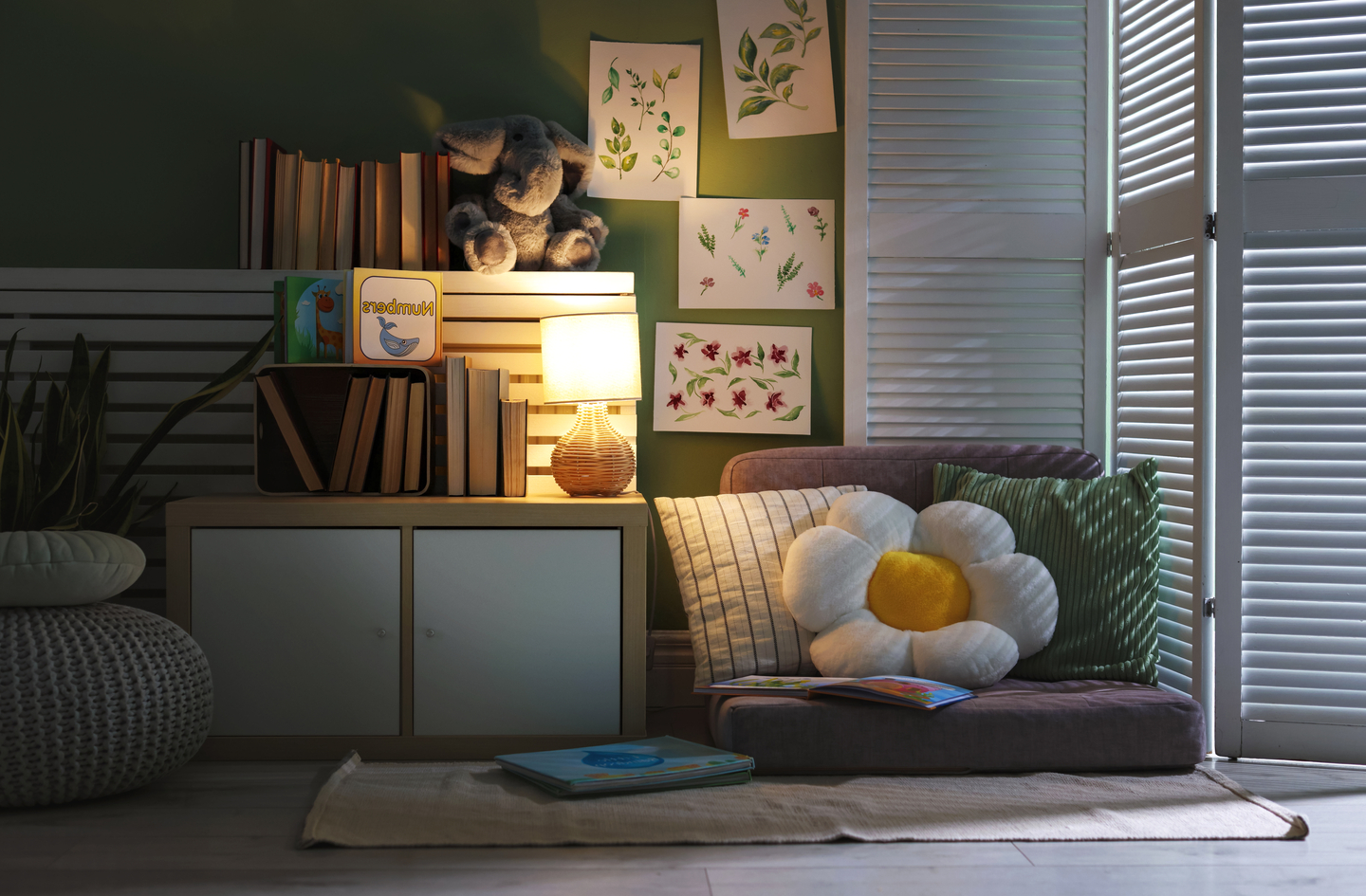
Children who own a book read daily at three times the rate of children without one, 23.1% versus 7.0%, according to the National Literacy Trust’s 2024 survey of over 76,000 children1. A reading corner makes book access physical and immediate. This guide covers the six steps to build a Montessori reading corner inside your playroom: quiet placement, a front-facing display at child height, floor seating, a dedicated lamp, a limited book selection, and a return and rotation system. For context on the full prepared environment, see Montessori Playroom Setup.
Quick Answer
What goes into a Montessori reading corner?
Choose a quiet spot away from active play. Install a front-facing book display with the top row no higher than 30 inches for a 5-year-old. Add floor seating within arm’s reach of the books. Position a dedicated lamp for 300-500 lux on the reading surface5. Put out 8-12 books at a time, and give each book a clear return slot. The setup fits in roughly 4-6 square feet and takes about two hours.
Key Takeaways
- Children with a book of their own enjoy reading at nearly four times the rate of children without one (38.7% versus 10.1%), making physical book access the most direct lever in the setup1.
- A front-facing display lets pre-readers self-select by cover art: the core reason Montessori book shelves face outward rather than spine-out.
- Limiting the display to 8-12 books keeps choice manageable for young children and makes the return system simple enough to use independently.
What You Need Before You Start
A quick inventory before moving shelves and cushions avoids a mid-setup pause.
What to gather:
- A corner or wall section with 4-6 square feet of clear floor space
- A front-facing book display (a low rail shelf, forward-facing picture-book rack, or wall pockets)
- Floor seating: a firm cushion, small foam mat, or low child-size floor chair
- A table lamp or adjustable floor lamp
- 8-12 books appropriate for your child’s current age and interests
- Storage for back-stock books (a closed cabinet shelf or a bin out of visual reach of the corner)
Time to set up: 1-2 hours for a basic configuration.
Difficulty: Beginner. No tools required for most setups.
Age range: 1-5 years. Specific adjustments by age are noted in each step.
Step 1: Choose a Quiet, Low-Traffic Location
A corner with quiet and low visual distraction becomes the foundation of the whole reading setup. Location determines whether your child uses the corner at all.
The prepared environment is the Montessori term for a space arranged to support a child’s independent exploration and self-directed activity. Inside a Montessori playroom, the prepared environment organizes into distinct zones: active movement, creative work, and quiet focus. A reading corner belongs in the quiet focus zone, placed well away from the energy of blocks, gross motor play, or anything with bright audio or motion.
What to look for in a location:
- At least 3 feet from any active play area or movement furniture
- No direct sightlines to a TV screen, large toy shelf, or busy activity zone
- Close to a window for natural light, but not in direct morning glare
- A wall outlet within reach for a lamp
A corner where two walls meet is ideal. Two walls create natural enclosure without needing furniture barriers on three sides. A rug or mat defines the floor area, the bookshelf anchors one side, and the wall closes the other. A child sitting inside feels spatially contained without feeling confined.
If the playroom is small, the reading corner does not need much room. A 4 x 4-foot square with the bookshelf against one wall and floor seating directly in front of it is enough. What matters is the quiet and the visual simplicity, not the square footage.
The most common placement error in playroom setups: putting the reading area in the liveliest corner of the room because the lighting is good there, or because it looks balanced in the layout. A child seated in a reading corner and looking directly at an active play zone is going to notice those things. Face the seating toward a wall or corner, not toward the room.
Structural reasoning first: choose the location where the child’s attention stays on the books, not the one where the corner photographs best from across the room.
Step 2: Install a Front-Facing Book Display at Child Height
The books face outward at child height. This is the most functionally important element in the entire reading corner setup.
A front-facing book display is a shelf where books stand face-out so the child sees the cover rather than the spine. Pre-readers identify books by cover art, not by title text on a spine. A spine-out shelf requires the child to already know what they are looking for. A face-out shelf invites browsing. The cover does the work of invitation.
Research on book access consistently links physical visibility to engagement. A 2026 randomized controlled trial across 60 high-poverty U.S. schools found significant literacy gains from giving children access to books over five years, with effect sizes roughly doubling in the full five-year cohort compared to partial exposure6. Making books easy to see and reach is part of that mechanism.
Shelf height by age
For a toddler (18-36 months), the top row of displayed books should sit at or below 18 inches from the floor. For a preschooler (3-5 years), the top row should stay at or below 30 inches. A child who needs to stand on tiptoe to reach the top shelf is no longer using the shelf independently.
| Age | Top Row Maximum | Rows | Book Format |
|---|---|---|---|
| 12-24 months | 14-18 inches | 1-2 | Board books, cloth books |
| 2-3 years | 18-24 inches | 2 | Board books, simple picture books |
| 3-5 years | 24-30 inches | 2-3 | Picture books, early concept books |
Shelf types suited to front-facing display:
- Forward-facing picture-book rails (purpose-built; the front lip keeps books upright and visible)
- Low open shelves with enough depth to prop books face-out (5-6 inches minimum for standard picture books)
- Mounted wall pockets (a good option for very small spaces or for displaying board books)
For full shelf sizing, spacing, and stability guidance for Montessori-style storage, see the Montessori Toy Shelf guide.
Avoid standard bookcases where books stand spine-out. If a spine-out bookcase is all you have, use bookends or a shallow tray on the shelf to prop a row of books face-out. The function is what matters, not the fixture.
Depth matters for stability: most forward-facing rails are 5-6 inches deep. Pockets shallower than 4 inches tip books repeatedly during the session and break the reset logic.
A front-facing display is the one element of this setup with no workable substitute. Every other decision in this list is adjustable. The display method is not.
Step 3: Set Up Floor Seating
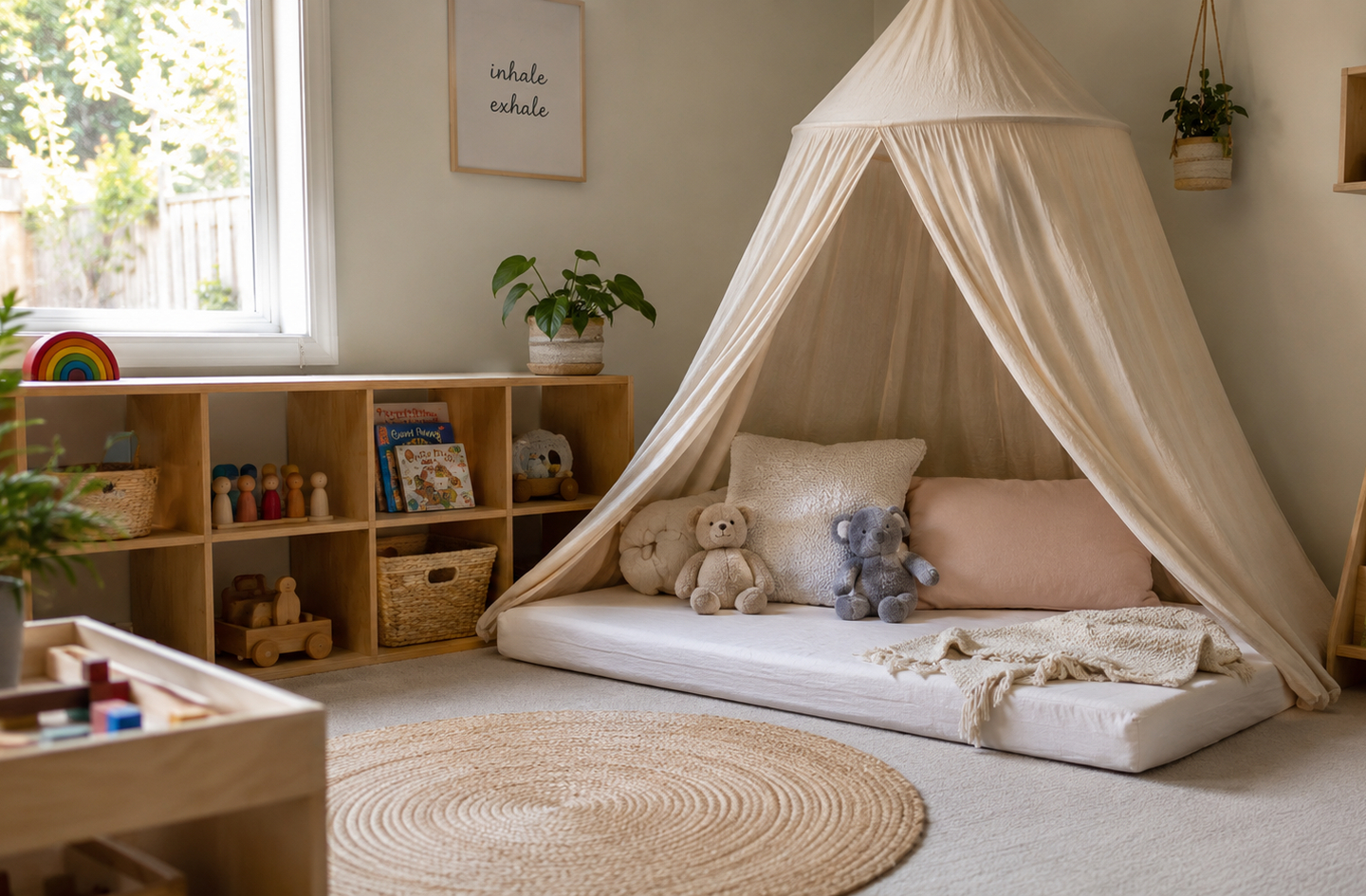
The seating sits at floor level, within arm’s reach of the books. Montessori reading areas use floor-level seating rather than raised chairs for three reasons: it puts the child at the same level as a low book display, makes entering and exiting fully self-managed, and creates a physical cue that this is a reading zone.
A child who needs to climb into elevated seating adds a barrier between impulse and action. The corner depends on low-friction access. Floor level removes the barrier.
| Seating Type | Best Starting Age | Seat Height | Independence Rating |
|---|---|---|---|
| Floor cushion or pillow | 12 months+ | Floor level | Full (get in/out alone) |
| Small foam mat (2 inch) | 12-24 months | Floor level | Full |
| Low toddler floor chair | 2.5 years+ | 8-10 inches | Full |
| Bean bag | 3 years+ | Variable | Moderate (harder exit) |
For toddlers under 24 months, a firm 20-24 inch floor cushion or a small foam mat is the simplest option. Washable covers are practical. Avoid cushions so soft the child sinks and loses comfortable posture for looking at a book.
For children 2.5 and up, a scaled child-size floor chair with an 8-10 inch seat height gives back support while keeping the seat low enough for self-managed entry. The child’s feet should rest comfortably on the floor, not dangle.
Bean bags work well for children aged 3 and up but require more effort to exit, which reduces the spontaneous “pick up a book and sit for two minutes” dynamic the corner depends on.
Keep seating within 12-18 inches of the books. A child should reach the nearest book without standing up. If the seating and display are more than 18 inches apart, the zone is too spread out and loses its functional cohesion.
Seating height and proximity to the display are the two dimensions most often off in setups reviewed online. Low and close is the answer for this age group, regardless of what looks proportionate to an adult.
Step 4: Add a Dedicated Reading Lamp
A dedicated lamp at the reading surface delivers 300-500 lux. Ambient playroom lighting typically sits at 100-200 lux under general ceiling fixtures. Comfortable reading requires more.
International standards for children’s reading and writing tasks, including IESNA guidelines and the updated European standard EN12464-1, specify 300-500 lux as the recommended illuminance range for children’s reading tasks, with 500 lux as the current minimum for writing5. A ceiling light aimed at the whole room rarely delivers 300 lux at the specific surface where a child holds a book. A lamp aimed at the reading area does.
Lamp positioning:
- Position the light source over the child’s shoulder or to the side, not directly in front of them, which creates glare on the page
- Aim the lamp at the reading surface, not at the wall or ceiling
- For a floor lamp, a height of 40-50 inches with an adjustable head works well for children seated at floor level
Bulb choice:
- Warm white (2700-3000K) is less fatiguing for relaxed reading than cool white or daylight bulbs
- A dimmable bulb lets you adjust for early-morning use or for younger children building reading stamina
Natural light from a window supplements the lamp during the day. Position the seating so the window is to the side of the child: behind creates backlighting, in front creates glare. A standard 60-75W equivalent LED in an adjustable floor lamp or a table lamp on a low side table delivers 300-500 lux. No specialized fixture is needed.
For the broader visual environment of a Montessori playroom, including color choice and decor, see Montessori Playroom Decor.
The lamp also functions as a ritual anchor. When the child turns the lamp on, the reading zone activates. Small environmental cues carry more weight in child behavior than most setup guides account for.
Step 5: Limit the Display to 8-12 Books
Eight to twelve books go on the display, selected for the child’s current age and interests. Book ownership drives reading engagement at every age measured. Children with a book of their own are nearly four times more likely to enjoy reading than children without one (38.7% versus 10.1%), and three times more likely to read daily (23.1% versus 7.0%)1.
A young child’s ability to choose degrades as the number of visible options increases. Eight to twelve books is a range where a toddler or preschooler looks at each cover and makes a real decision, rather than scanning, feeling overwhelmed, and walking away.
The 8-12 range also makes the return system work. Each book has an obvious face-out slot, and the child sees at a glance whether the shelf is in order. Fewer visible books means faster cleanup, which is the variable most parents do not anticipate mattering as much as it does.
Book selection for the corner display:
- 2-3 books the child currently returns to on their own
- 5-8 titles new enough to hold interest through a 2-4 week rotation window
- Age-appropriate format: board books for 12-24 months, simple picture books for 2-3 years, longer picture books and early concept books for 4-5 years
- A mix of themed titles (current interest: animals, vehicles, a favorite character) and open-ended storytelling
- At most 1-2 adult-curated titles the child has not yet shown interest in; the corner should be led by the child’s current pulls, not adult aspirations
“Five years after books were initially distributed, students attending treatment schools scored significantly higher on reading assessments than those in control schools.”
Geoffrey D. Borman, University of Wisconsin-Madison, Proceedings of the National Academy of Sciences, 20266
The American Academy of Pediatrics recommends shared reading from birth through kindergarten, noting the association with broader vocabulary, stronger language skills at school entry, and fewer behavioral difficulties4. Physical book access in the home is what makes shared and independent reading happen regularly rather than occasionally.
For guidance on separating what stays on display from what goes into adult-managed back-stock, see Montessori Playroom Storage.
Eight books on a well-maintained display beats thirty books in a bin. The bin creates a hunting problem. The display creates an invitation.
Step 6: Set Up a Return System and Rotation Schedule
Every book gets a clear return slot, and a rotation schedule prevents stagnation. A reading corner without a return system becomes a floor pile within a week. The return system is not complicated: each book has a visible, specific slot, and the child sees at a glance whether the shelf is in order.
Book rotation is the practice of keeping a small number of books on display at any time and periodically exchanging them with titles from a stored collection to sustain a child’s interest. The principle is the same as toy rotation on activity shelves: novelty within a stable structure.
Practical return system elements:
- Front-facing display slots where each book sits face-out (an empty slot is visible immediately, showing where to return the book)
- A small basket or low tray near the seating where the child deposits finished books during the session rather than refiling each one immediately
- Adequate spacing between books so replacing a title requires no force or rearranging
The basket acts as a staging area during reading time. A child who drops finished books into the basket keeps the floor clear without stopping to refile mid-session. Restock the shelf together at cleanup.
Rotation frequency by age:
- 12-24 months: rotate every 3-4 weeks, or when the child stops picking up current titles for several days in a row
- 2-3 years: rotate every 2-3 weeks, or when a title sits untouched for more than a week
- 4-5 years: rotate every 2-4 weeks, or theme-based (all ocean books for a few weeks, then all construction books) tied to what the child is currently interested in
Store back-stock on a closed shelf or bin outside the corner’s visual field. If back-stock books sit in sight of the corner, the child requests them constantly and the display limit loses its purpose.
For the broader rotation and storage system, see Montessori Playroom Storage.
Design for the reset, not just the reveal. A corner built around a beautiful display but with no return system in place is a one-day setup. A corner built around an easy return becomes a permanent feature of the room.
Common Mistakes to Avoid
Several patterns come up repeatedly and are worth naming directly before you finalize the setup.
Placing the corner inside or next to the active play zone
This is the most common placement error. A child seated with a book while another child runs nearby, or while a sibling plays blocks two feet away, will put the book down. Reading and active play need spatial separation, not just a rug border. Noise and visible movement pull attention away at this age faster than almost any other distraction. Move the reading corner to the quietest part of the playroom, even if that sacrifices a more balanced floor plan. For the underlying design principles of quiet zones, see Montessori Playroom Principles.
Putting too many books on the shelf
More books on display do not produce more reading at this age. A shelf with 25 visible books presents a decision problem, not an invitation. The child scans, feels no clear pull, and walks away. Start with 8 books and add only when the child works through the current selection.
No dedicated lamp
Relying on overhead lighting shortchanges the corner. A 2015 multi-school classroom design study ranked natural light and electric lighting among the three physical factors with the largest measured effect on young children’s learning outcomes2. That research covers institutional classrooms rather than home corners, but the underlying principle holds: the lamp signals “this is the reading area” in the same way a defined mat signals “this is the work area.” Without a lamp, the corner is visually undifferentiated from the rest of the room. It also lacks the light level the activity needs for comfortable sustained reading.
Spine-out display on a standard bookcase
A child looking at spines sees colors and widths but no actionable information. A pre-reader sees nothing to engage with. Move to front-facing display on whatever shelf you have. Prop books face-out using bookends, small easels, or a shallow tray along the shelf lip. The function is front-facing covers at child height. The fixture is secondary.
No clear book return system
If returning a book to its slot requires more effort than dropping it on the floor, the book lands on the floor. The return system deserves as much thought as the display setup. Each book needs a visual home, and the child needs to find it without adult guidance every time.
What a Working Reading Corner Looks Like
A well-set reading corner shows reliable patterns. Your child goes to the corner without being prompted. They pick a book based on the cover and sit with it for 5-15 minutes, longer at 4-5 years. They attempt to return books to the shelf, sometimes imperfectly at first. The corner stays roughly intact between room resets.
A global 2019 study of over 100,000 children aged 36-59 months across 35 countries found a child’s odds of being on track for literacy and numeracy nearly doubled when at least one book was available at home, with a relative risk of 1.89 (95% CI 1.75-2.03)3. Despite this, only 51.8% of children in those 35 countries had even one book at home3. A reading corner converts “book available somewhere in the house” into “book visible, accessible, and appealing right now.”
Self-directed reading at this age is brief, mixed with movement, and includes flipping pages as much as reading them. A reading corner does not create a reading child. It removes the friction between a willing child and a book.
Frequently Asked Questions
How many books should I put in a Montessori reading corner?
Eight to twelve books at a time. This range keeps the display manageable for children 1-5 years and makes the return system simple enough for a child to maintain independently. Fewer than six books can feel sparse and may not offer enough variety for a longer reading session. More than twelve begins to produce choice overload in toddlers and preschoolers, where the child scans without settling. Store the remaining back-stock out of visual reach and rotate every 2-4 weeks based on the child’s current interests.
Does a Montessori reading corner need its own dedicated shelf, or can books share an activity shelf?
A dedicated display works better than a shared shelf for the same reason a dedicated floor mat works better than a shared floor space: it makes the zone legible to the child. A book display mixed with puzzle pieces or art supplies blurs the signal. That said, if space is genuinely limited, a single row of face-out books on an otherwise clear shelf section can function, provided the books are visually distinct from surrounding materials. The minimum is a front-facing row at child height with nothing stacked on top of the books.
What if my child ignores the reading corner entirely?
Check three common causes before changing the setup. First: is seating too far from the display? Move it to within arm’s reach of the bottom display row. Second: is the corner placed in or near an active play zone? Visible movement and noise pull attention away from a quiet activity at this age. Third: do the books match the child’s current interests? A corner stocked with ocean books for a child currently fascinated by dinosaurs will sit unused. Swap the selection and observe for a week.
Can I use a wall pocket organizer instead of a shelf for the book display?
Yes, wall pockets work for board books and slim picture books in spaces where a floor-standing shelf is not practical. The key requirements remain the same: each pocket holds one book face-out, the top pocket is within the child’s reach without tiptoe, and the number of pockets visible at once stays in the 8-12 range. Standard fabric wall pockets (6-pocket organizers) fall short of this on their own. Two 6-pocket organizers mounted side-by-side, or a single 12-pocket unit with the bottom row at floor level, cover the range. Avoid deep pockets that hide the cover art behind the pocket lip.
At what age can a child start using a reading corner independently?
A child as young as 12 months can pull a board book from a low face-out display and handle it on a floor cushion. True independent maintenance, where the child pulls a book, reads it, and returns it to the correct slot without prompting, typically appears between 2.5 and 3.5 years. Before that age, shared reading in the corner alongside the child is the primary use pattern and the activity the corner is most built for.
Limitations and Edge Cases
This guide covers the core setup for ages 1-5 in a home playroom. Several conditions fall outside that scope.
Very small spaces. The 4-6 square foot floor area assumes a corner or wall section large enough for a display and a cushion side by side. A setup smaller than that is possible using wall pockets for the display and a single small seat cushion, but the arrangement becomes a tighter decision about which element to prioritize when both won’t fit at full size. In that case, prioritize the display. A child can read on the floor without a cushion; they cannot use the corner without books at child height.
Multiple children at different developmental stages. A corner calibrated for a 4-year-old sits too high for a 15-month-old. Stage the display: place a second, lower row of board books at floor level for the younger child, and keep the older child’s books on the 24-30 inch top row. The two zones share one shelf if the shelf is wide enough.
Rental and temporary housing constraints. Wall-mounted shelves may not be an option. Floor-standing display racks, leaning ladder shelves, or wall pockets on tension rods all deliver front-facing display without anchoring. Check that any freestanding fixture is stable before leaving a child near it unsupervised.
Children with visual processing differences. Front-facing display and limited selection are both rooted in visual-channel engagement. For a child who navigates primarily by touch or who finds a visually dense display overwhelming, the same principles apply in reduced form: fewer books (4-6 rather than 8-12), consistent physical placement of each title, and textured spines or covers as tactile identifiers. Consult your occupational therapist if the child has a sensory profile that affects their response to visual displays.
References
- National Literacy Trust. (2024). Children’s and Young People’s Reading in 2024. London: National Literacy Trust. [Survey of 76,106 children on book ownership, reading frequency, and reading enjoyment.]
- Barrett, P., Zhang, Y., Davies, F., & Barrett, L. (2015). Clever Classrooms: Summary Report of the HEAD Project. University of Salford, Manchester. [Multi-school study of physical classroom design factors; lighting ranked among the three strongest measured predictors of learning outcomes for primary-age children.]
- UNICEF Multiple Indicator Cluster Surveys (MICS). (2019). Global analysis of early childhood home learning environments. [Analysis of 100,000+ children aged 36-59 months across 35 countries: relative risk of being on track for literacy and numeracy was 1.89 (95% CI 1.75-2.03) when at least one book was available in the home; 51.8% of children had at least one book.]
- American Academy of Pediatrics. (2014, reaffirmed 2021). Literacy Promotion: An Essential Component of Primary Care Pediatric Practice. Pediatrics, 134(2), 404-409. [Clinical guidance recommending shared reading from birth through kindergarten, citing associations with vocabulary development, language skills at school entry, and reduced behavioral difficulties.]
- Illuminating Engineering Society (IES). (2020). IES Lighting Handbook, 10th Edition. New York: Illuminating Engineering Society. European standard EN12464-1:2021 also cited for 300-500 lux maintained illuminance for children’s reading tasks. [Recommended illuminance range for reading surfaces in residential and educational settings: 300-500 lux.]
- Borman, G. D., & Yang, R. (2026). Long-term effects of children’s book distributions on reading achievement: A five-year randomized controlled trial. Proceedings of the National Academy of Sciences. [RCT across 60 high-poverty U.S. schools; students in treatment schools scored significantly higher on reading assessments five years after initial book distribution, with larger effect sizes for the full-cohort group.]
Set Up the Corner, Then Step Back
A reading corner built to these specifications takes two hours to put together. What it creates is a zone in your playroom that does one thing: make books immediately accessible to your child at their level, in a quiet location, with seating and light already in place.
The six elements in this guide, a quiet location, a face-out display at child height, floor seating within arm’s reach, a dedicated lamp, 8-12 books at a time, and a clear return and rotation system, are each chosen because they reduce the friction between a willing child and a book. Remove any one of them and that friction increases.
Once the corner is up, your role shifts. You stock it, rotate the books, and read there with your child. The corner runs the invitation; you run the reading. For the broader framework that this corner sits inside, see the full Montessori Playroom Setup guide.