
An art table fits your child and the room, or becomes daily friction. In a 2019 federal survey of K-5 households, 75% of children had done arts and crafts with a parent in the prior week,3 making the workspace itself worth planning correctly. The decisions come down to six variables: footprint, height fit, cleanability, built-in storage, paper-roll setup, and clearance. The planning overview in Art & Craft Stations: A Practical Guide to Planning the Space covers the broader zone context. This article works through each variable and explains when a plain activity table outperforms a purpose-built kids art table.
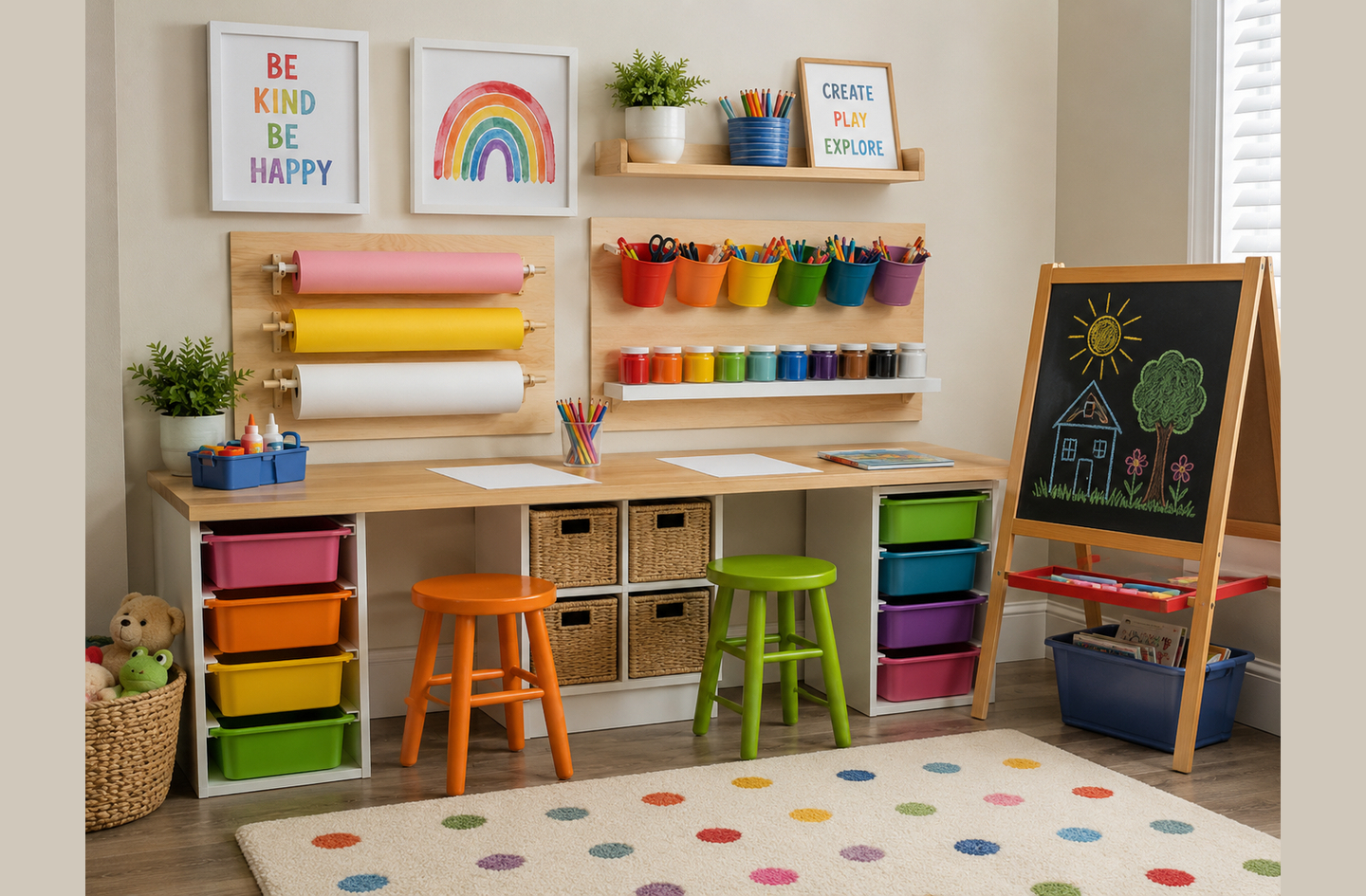
Quick Answer
What are the key dimensions for a kids art table that actually works?
Match the table height to the child’s seated elbow height: roughly 18 in for ages 3-5 and 20 in for ages 6-8.1 Choose a surface at least 24 in deep with rounded edges and a wipeable finish. Keep 24-30 in of clear floor on each open side. Built-in storage adds footprint; a plain activity table with a nearby shelf often covers the same functions in less floor space.
Key Takeaways
- Recommended table height for a child age 3-5 is 18 in; the gap between the tabletop and the chair seat should be 7-8 in.1
- A surface at least 24 in deep keeps supplies reachable without the child leaning out of the chair and losing back support.
- Rounded or rolled edges reduce injury risk at corners; raised edge lips trap paint spills and are harder to wipe than a flat surface.
- Built-in storage bins typically add 4-8 in of footprint on each side of the table, which matters in rooms under 10 ft wide.
- A mounted paper roll needs roughly 24 in of clear floor behind the table for a child to tear a sheet without bumping a wall.
How Kids Art Tables Compare to Plain Activity Tables
A specialized kids art table is a child-sized work surface designed specifically for drawing, painting, and art projects, with features such as a built-in paper-roll rail, storage bins, or a recessed tray. A plain activity table is a general-purpose child-height table with no craft-specific features built in. The two differ most in footprint, storage, and price, not in surface quality or ergonomic fit.
| Category | Specialized Kids Art Table | Plain Activity Table |
|---|---|---|
| Best For | Dedicated, permanent craft zone | Flexible or multi-purpose room use |
| Typical Surface Width | 28-36 in | 24-30 in |
| Surface Depth | 20-24 in | 18-20 in (shallower average) |
| Height Options | Usually fixed; matched to age group | Same; some models adjustable |
| Surface Cleanability | Wipeable laminate or lacquer standard | Varies by brand; not always wipeable |
| Built-in Storage | Bins, rails, or cubbies standard | None; depends on adjacent shelving |
| Paper Roll | Integrated holder common | Not included |
| Multi-Child Seating | Often designed for 2 seats | Depends on length; add chairs freely |
| Price Range | $80-$400+ | $40-$150 |
| Verdict | Better when the craft zone is permanent and isolated | Better when space is shared or multi-purpose |
What Footprint Does a Kids Art Table Actually Need?
Child desks and activity tables typically measure 24-30 in wide and 18-20 in deep.6 Specialized kids art tables tend toward the wider end of that range, with many dual-seat models reaching 32-36 in wide. The deeper question is not the table’s own footprint but the total floor area the complete station needs: the table plus storage on each side plus the chair-pull zone behind it.
Table footprint refers to the floor area the table occupies, including any overhanging storage bins or rails that extend beyond the table’s edge. A table with side-mounted bins adds 4-8 in to each end. In a room under 10 ft wide, that matters.
For a single-child setup, a surface 24-28 in wide gives enough working width for drawing paper or a standard watercolor set without extra room being wasted. Dual-child setups need at least 32 in of surface width so two children work side by side without crossing into each other’s space. A narrow table forces a child to rotate their paper sideways, which makes fine motor work harder.
Surface depth controls something separate from width: reach. A depth of 18 in keeps every supply within the child’s reach from the seated position. A depth over 24 in means the back row of supplies sits beyond the comfortable reach of a 4-year-old with average arm span, which leads to leaning forward and losing back support. The 18-20 in depth standard is not arbitrary; it matches the seated reach of school-age children in the 4-10 age range.
For most single-child home stations, a table in the 24-28 in wide range serves better than a wide dual-seat table, because it leaves more of the room’s perimeter free for the shelf and drying zone the workflow actually needs.
How Should Table Height and Seating Fit Your Child?
The correct table height puts the work surface 2-3 in above the child’s bent elbow when seated with relaxed shoulders.2 This keeps the wrist above the paper plane, which reduces strain and supports fine motor precision. The gap between the tabletop and the chair seat should measure 7-8 in.1 For ages 3-5 that means a table around 18 in tall; for ages 6-8, closer to 20 in.
Table height fit refers to the match between a child’s seated elbow height and the work surface, measured as the gap between the chair seat and the tabletop. A table too tall pushes the child’s shoulders up. A table too low rounds the back and drops the wrist below the work surface.
“One size does NOT fit all. The desk surface should be at about 2-3 inches above their elbow (measure when elbow is bent down along the side of their body) and their shoulders should be relaxed.”
Sari Ockner, OTR/L, Pediatric Occupational Therapist2
Research confirms the stakes. A 2004 study in the American Journal of Occupational Therapy tested 6- and 7-year-olds in properly fitted furniture versus standard oversized classroom furniture. Children in the fitted setup performed significantly better on in-hand object manipulation tasks (t = -2.77).5 Art table work involves the same in-hand precision.
Seating options: chairs versus stools
Chairs with a backrest support posture during long sessions. Stools work for short sessions and for standing-to-sitting transitions, which younger children do frequently. A stool with no footrest leaves a child’s feet dangling when the table is at the correct height, which shifts weight onto the thighs and creates fatigue faster. If you use stools, choose a height where the child’s feet reach the floor or a dedicated footrest.
Fixed versus adjustable height
Most kids art tables ship at a fixed height. An 18 in table works well for ages 3-5 and starts to feel cramped around age 7-8. Adjustable-height models add mechanical complexity and usually cost more, but a child grows 2-3 in per year in the preschool range, so a fixed table at 18 in has roughly a 3-year useful window before the fit degrades. That is a meaningful planning constraint for families who want the table to last through early primary school.
Height fit is the single most common overlooked specification when buying a kids art table. A table too tall by 3 in turns every drawing session into a shoulder workout for the child.
Which Surface and Edge Details Make Cleanup Realistic?
The surface finish determines whether a spill is a 10-second wipe or a permanent stain. Most purpose-built kids art tables use a laminate or a lacquered MDF top. Both wipe clean with a damp cloth for watercolor and most washable markers. Acrylic paint and permanent marker resist wiping on both, so the surface finish matters less than the art supply discipline you set. What matters more is the edge profile and whether the surface has a lip.
Edge profile refers to the shape of the table’s perimeter edge, which affects both safety and cleanup. A rounded or bullnose edge reduces the risk of a corner impact if a child falls against the table. A sharp square edge at hip and head height creates a harder contact point. No published standard mandates rounded edges on general children’s activity tables, but rounded edges are standard on purpose-built art tables and represent better design practice for children’s furniture.
Raised edge lips: the tradeoff
Some art tables include a raised perimeter lip designed to keep supplies from rolling off the edge. The lip does its job on pencils and markers. On paint and water, it creates a secondary cleanup problem: spills pool in the corners where the lip meets the surface, and the corner joints collect dried paint over time. A flat surface with rounded edges is faster to wipe end-to-end. If the table has a lip, check whether the corners are sealed or open joints before buying.
Surface materials compared
Laminate tops clean up fast and resist most washable media, but they chip at edges over time if the substrate is MDF. Solid wood with a urethane finish costs more and needs more care: some paints etch the finish after repeated exposure. Powder-coated metal tops are found on some adjustable and workhorse-style tables; they wipe clean but are cold to the touch and heavier to move. For most home art stations, a laminate top on a wood frame gives the best balance of cleanability and durability at the price points available.
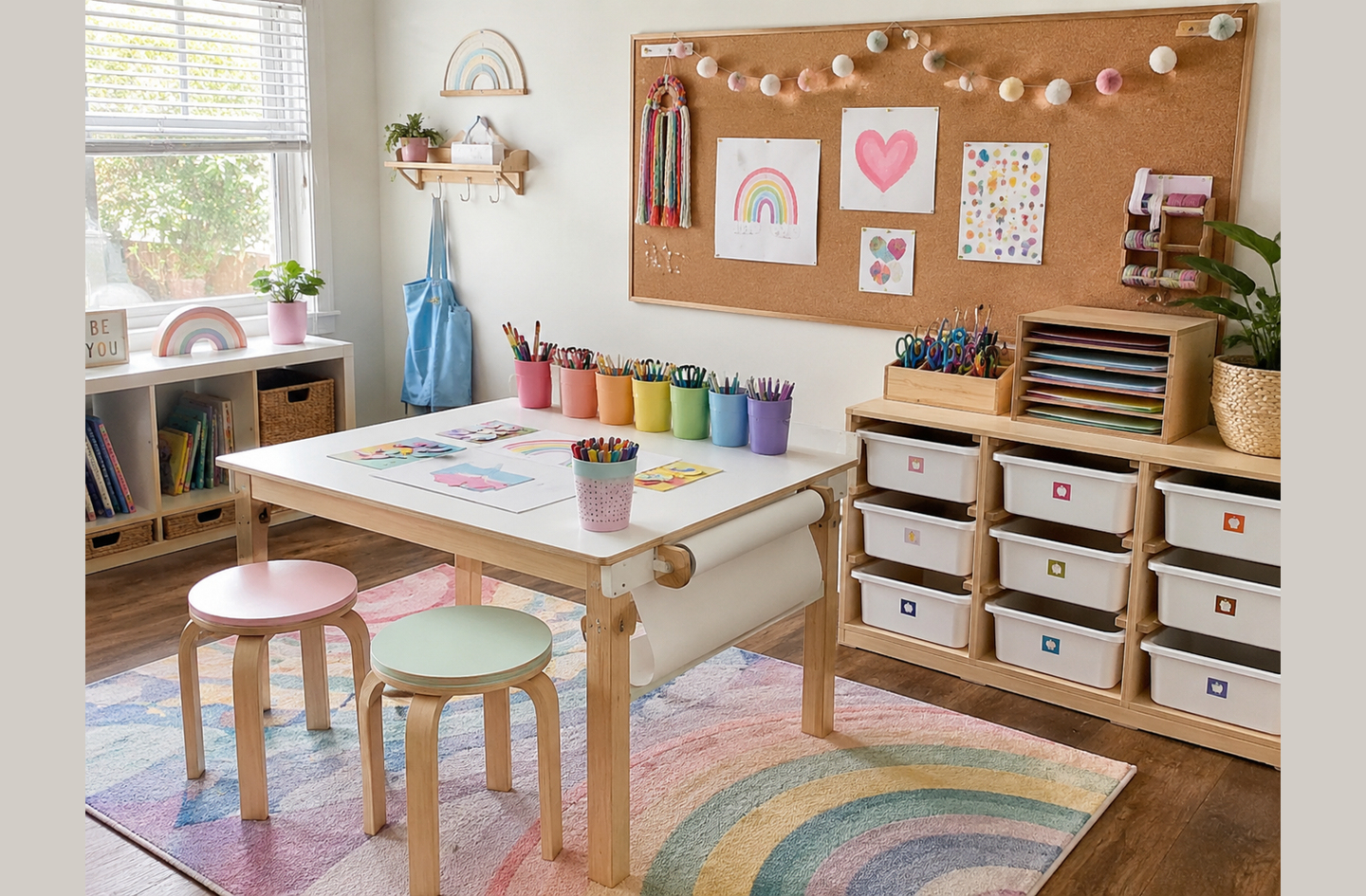
A flat, laminate surface with rounded edges and no raised lip is the fastest to clean because a single wipe clears the entire work surface. Lips and joints are small details worth checking before buying, especially for wet media use.
When Is Built-in Storage Worth the Extra Footprint?
Built-in storage refers to bins, cubbies, or rails built into the table’s structure itself, as opposed to shelving or organizers placed next to the table. The value of built-in storage depends on where your supplies live and how often the table resets between sessions.
Purpose-built art tables with side bins typically hold 4-8 bins of roughly 4-6 in width each. The bins sit within arm’s reach of the seated child, which supports independent supply access during a session. The tradeoff is physical: those bins add 6-10 in to each end of the table’s floor footprint. A 28 in table with side bins on both ends occupies the same floor width as a 44-48 in table without bins.
When built-in bins work well
Built-in bins make the most sense when the table has a fixed location and enough clearance on each end. They also work well when the bins are the only storage in the zone, because they consolidate supplies onto the table structure itself. A child who uses the same set of supplies every session benefits from bins that do not need to be carried over and set up. For independent self-serve access, bins at child height are better than a shelf above or behind the table.
When a separate shelf works better
A separate low shelf 12-18 in from the table gives more capacity, lets you rotate supplies in and out, and does not expand the table’s own footprint. It also separates storage from the work surface, which keeps the table clear between sessions rather than inviting supplies to migrate onto the tabletop. For rooms where the art table sits against a wall, a wall-mounted shelf at child reach is often a more space-efficient solution than side bins. See how to store kids artwork for a system that connects the work zone to in-progress and finished-piece storage.
Built-in bins are not a reason to choose an art table over a plain activity table if the table’s total floor footprint no longer fits the room. An adjacent shelf at the right height serves the same supply-access function without consuming the table’s footprint.
What Does a Paper-Roll Feature Actually Require?
A mounted paper roll is a genuinely useful feature for kids who draw frequently on large sheets. Most replacement rolls for art tables and easels come in a standard 17-18 in width, with a 75 ft roll length common across multiple product lines. The roll feeds from the back or end of the table; the child tears a sheet at the front edge. The convenience is real. So is the spatial requirement.
Clearance behind the table
A roll-fed table needs clear floor behind it so the paper pulls forward without catching on a wall or shelf. The minimum clearance depends on the roll mount and tear mechanism, but roughly 20-24 in of clear space behind the table is a practical working minimum. In rooms where the table sits against a wall with only 12-18 in behind it, the roll feature either goes unused or requires moving the table out from the wall for each session. Neither is ideal. Before choosing a table with a built-in roll feature, measure the actual clear distance between the table’s back edge and the wall.
Roll holder types
End-mounted roll holders attach to one side of the table; the roll sits horizontally. Rail-mounted holders use a bar across the back or bottom edge; the roll feeds upward or forward over the work surface. Rail-mounted systems are more common on dedicated art tables because the paper lies flat on the surface when unrolled. End-mounted holders appear more often on easel conversions and adjustable tables. Both use the same 17-18 in standard roll width, so replacement rolls are interchangeable across most models.
If the paper roll will not have 20-24 in of clear space behind the table, a roll holder is a feature you pay for but do not use. A ream of drawing paper stored in a nearby bin serves the same function without the clearance requirement.
How Much Clearance Does a Working Craft Zone Need Around the Table?
A kids art table needs clear floor on three sides: behind the chairs for the chair-pull zone, beside the table for a child to exit the seat, and in front or to the side for a parent to supervise without blocking the child’s movement. Accessible seating configurations under ADA guidelines require at least 30 in x 48 in of clear floor space per seated position,7 which serves as a useful engineering reference for minimum clearance planning, even in a private home.
Chair-pull zone
Children pull their chairs back farther than adults do when exiting, often pushing the chair completely clear of the table before standing. A minimum of 20-24 in of clear floor behind the table’s back edge is a practical working figure. If the table backs against a wall, that zone disappears. A table pushed flush to a wall becomes harder to exit, which means children climb out sideways and risk catching the table edge. A small gap of 6-12 in between the table back and a wall significantly reduces that problem, though it does not substitute for the full 20-24 in pull zone when the chair is in active use.
Side clearance for circulation
Each open side of the table needs enough clearance for the child seated there to exit without being blocked by a shelf or wall. A minimum passage width of 24 in on each open side keeps movement comfortable. For rooms where the art zone sits in a corner, plan only one side seat rather than two, because the wall-side child has no exit path without the other child moving first. That single constraint eliminates a common source of conflict at shared craft tables.
Parent access and supervision sightlines
A parent supervising the zone needs a clear sightline from the room’s main circulation path without having to enter the art zone itself. This means the table should not sit behind a large shelving unit relative to the room entrance. For wet media and paints, a parent within reach for the first few minutes of a session is a practical safety consideration, which affects placement relative to where the adult will be in the room. The layout spoke on placing an art area in a playroom covers sightline and placement decisions in more detail.
The total floor area a working craft zone needs is typically 2-3 times the table’s own footprint: the table itself, the chair zone behind it, and the circulation path on at least one side. Measure this total before choosing a table, not after.
Art Table or Plain Activity Table: A Decision Framework
Properly fitted children’s furniture supports the fine motor work that art activities require. A 2023 randomized study of 57 children found art activities combined with motor accuracy training produced significantly better manual dexterity outcomes than accuracy training alone, with p < 0.001 for both dexterity and motor accuracy measures.4 The workspace fit shapes how well those benefits transfer. The choice between a specialized art table and a plain activity table comes down to four factors: room permanence, room size, the child’s age and activity range, and whether the craft zone functions independently or as part of a multi-purpose table.
Choose a specialized kids art table when
The craft zone is permanent. If the table will stay in one spot and serve primarily as the art and supply zone, the built-in storage and paper roll features pay off in daily convenience. Choose a dedicated art table when the child uses the space for longer, multi-session projects and when the room’s floor plan gives the table enough clearance on three sides. A dedicated art table also makes more sense when you have two children working simultaneously, because the dual-seat models are designed for that layout in a way a short activity table is not.
Choose a plain activity table when
The room is small, shared, or multi-purpose. A plain activity table at the same height costs less, takes less floor space, and leaves the storage logic to you. A low shelf adjacent to the table and a supply caddy that moves on and off the surface give you most of the functionality of built-in bins without the fixed footprint. A plain table also works better when the child is still young enough to outgrow the furniture quickly, because replacing a $60 activity table is easier than replacing a $200 art table. For rooms where the table doubles as a puzzle surface, a building-toy table, or a spot for homework, a plain table without art-specific features gives you more flexibility across those uses.
Neither option fits
In rooms under 8 ft wide where even a 24 in table leaves tight clearance, a wall-mounted fold-down table with a nearby caddy often works better than any freestanding option. This is the small-space art station approach covered in more depth in the wider cluster.
| Situation | Better Choice | Reason |
|---|---|---|
| Permanent craft zone, room > 10 ft wide | Specialized art table | Built-in bins and paper roll justify the footprint |
| Shared or multi-purpose room | Plain activity table | Lower cost, smaller footprint, more flexible use |
| Child ages 3-5, one child | Either | An 18 in table works for both; choose by room size |
| Two children working simultaneously | Specialized art table (dual-seat) | Designed for that layout; 32-36 in surface width needed |
| Room under 9 ft wide | Plain activity table | Narrower footprint; storage moves to a separate shelf |
| Child cycles through multiple activities at same table | Plain activity table | Non-craft features stay out of the way when unused |
Frequently Asked Questions
What height art table is right for a 4-year-old?
For a 4-year-old, a table height of 18-19 in is correct. The tabletop should sit 2-3 in above the child’s bent elbow when seated with relaxed shoulders,2 and the gap between the chair seat and the tabletop should measure 7-8 in.1 Most purpose-built preschool art tables ship at 18 in, which fits well until around age 6-7.
What table surface size do two kids need to work side by side without conflict?
Two children working simultaneously need at least 32 in of total table width, which gives each child roughly 14-16 in of personal working space. Narrower than that, and elbow contact becomes regular. A 36 in surface with a supply zone at each end reduces reach-across conflicts further.
Are built-in paper roll holders on kids art tables worth it?
Yes, if the table has at least 20-24 in of clear floor behind it. Most replacement rolls are 17-18 in wide, widely available, and inexpensive. The paper roll feature saves setup time and keeps large-format drawing accessible. If the table backs against a wall with less than 20 in clearance, the feature goes unused most of the time.
How do I clean dried paint off a kids art table surface?
For washable tempera and watercolor, a damp cloth works on laminate or lacquered surfaces if cleaned before the paint fully cures. Dried acrylic paint on laminate often needs a plastic scraper before wiping. Permanent marker on most laminate surfaces comes off with rubbing alcohol on a cloth. Avoid abrasive pads on lacquered surfaces, which scratch and lose their wipe-clean properties over time.
How much floor space does a complete kids art station take up?
Plan for 2-3 times the table’s own footprint for the full working zone. A 28 in x 20 in table needs roughly 28 in x 60-72 in of total clear floor to include the chair-pull zone behind it and a side passage. That is approximately 14-16 sq ft, which fits comfortably in a 10 x 10 ft room alongside other activity areas.
Limitations and Edge Cases
- Height recommendations here are ergonomic conventions, not mandatory regulatory standards. No U.S. federal code requires a specific table height for general children’s activity tables sold for home use.
- Clearance figures assume a Western-standard room layout with chairs that pull straight back. In smaller spaces where children exit sideways, clearance requirements differ.
- The paper-roll clearance estimate (20-24 in) applies to rail-mounted and back-fed roll holders. End-mounted side holders reduce the required clearance behind the table because the roll feeds laterally rather than from behind.
References
Methodology: every figure below comes from an independent published source and links to the page that carries it; sources were reviewed for accuracy and relevance to home playroom planning contexts.
- Westshore Furniture – Kid’s Table and Chair Height Guide, sizing reference for children’s furniture, current edition.
- KidzOccupationalTherapy.com – “The Ergonomics of a Child’s Work Space,” Sari Ockner OTR/L, September 2011.
- National Endowment for the Arts – “Household or Community Dynamics Affecting Children’s Engagement with Art,” NEA analysis of NCES Parent and Family Involvement Survey data, 2023.
- PubMed Central – Frikha, M. & Alharbi, R.S. “Optimizing Fine Motor Coordination, Selective Attention and Reaction Time in Children: Effect of Combined Accuracy Exercises and Visual Art Activities.” Children (Basel), 10(5):786, April 2023. DOI: 10.3390/children10050786.
- American Journal of Occupational Therapy – Smith-Zuzovsky, N. & Exner, C.E. “The Effect of Seated Positioning Quality on Typical 6- and 7-Year-Old Children’s Object Manipulation Skills.” AJOT, 58(4):380-388, 2004.
- Dimensions.com – “Classroom Layout Desk & Table Sizes,” continuously maintained reference database.
- U.S. Access Board – “ADA Accessibility Guidelines, Chapter 3: Clear Floor or Ground Space and Turning Space,” continuously maintained federal guidance.
Conclusion
The six variables covered here, footprint, height fit, surface and edge details, storage, paper roll, and clearance, interact in ways a table’s product listing rarely makes visible. Height fit shapes whether art activities support fine motor development or create postural strain. Footprint determines whether the zone stays usable as the child grows. Clearance decides whether the table becomes a fixed obstacle or a working part of the room.
For the broader planning picture, see the overview in Art & Craft Stations: A Practical Guide to Planning the Space. For a system connecting the art zone to displayed and stored finished work, see kids artwork display ideas.