
A kids art table either supports a working craft zone or quietly fights it, and the difference is rarely the feature list. Our Art & Craft Stations guide is the overview of planning a home art station. This article goes deeper on one decision: the table itself. Fit comes first. In a study of 108 Spanish primary pupils, 97.2% worked at desks that did not match their body size2. The sections that follow compare a specialized art table with a simple activity table on size, seating, edges, cleanability and storage.
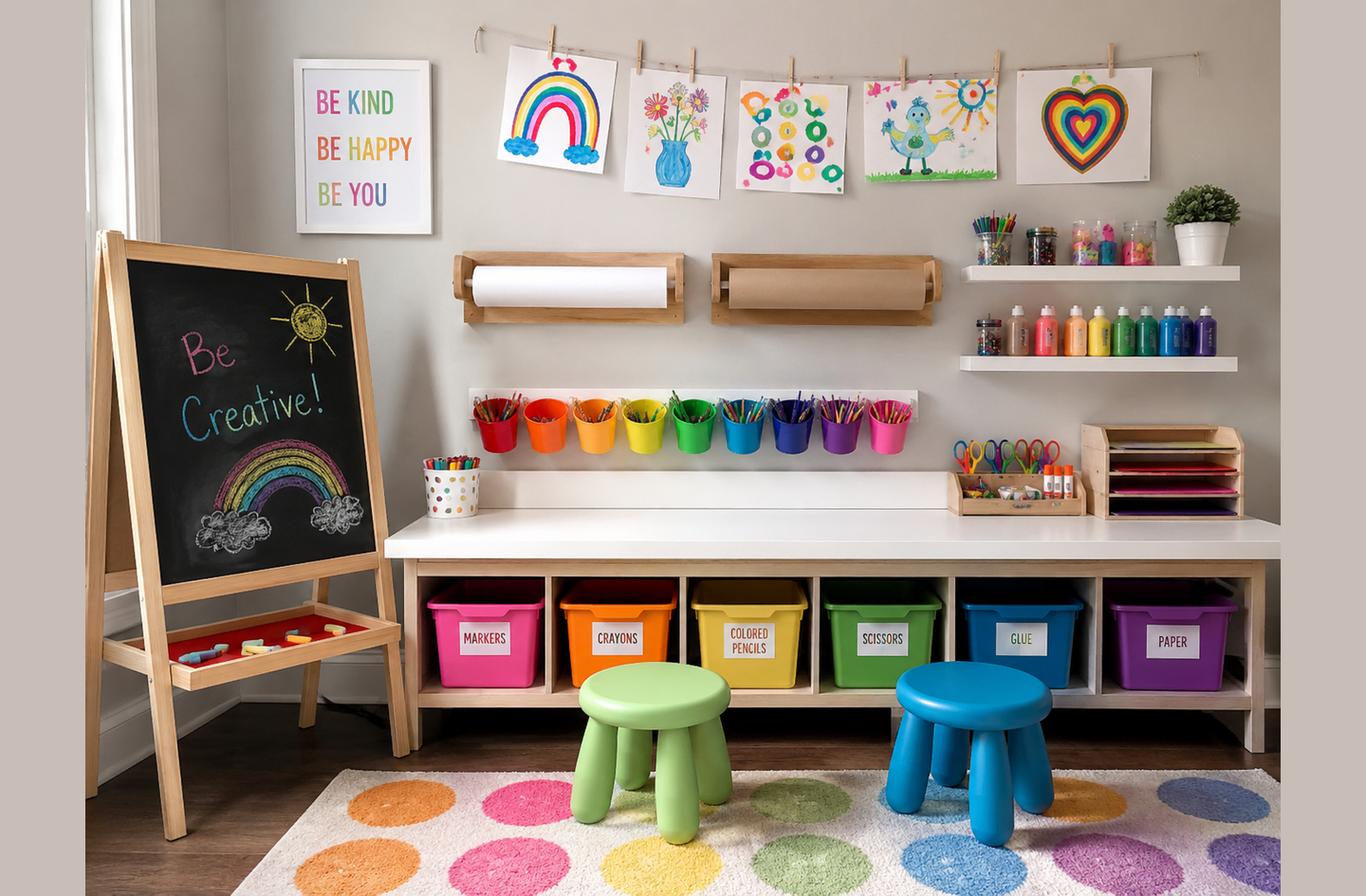
Quick Answer
Should you buy a specialized kids art table or use a simple activity table?
Choose by fit and floor space first, features second. A plain activity table at the right height, with a wipeable top and storage beside it, serves most families well. Federal accessibility standards set children’s table tops at 26 to 30 inches1. A specialized art table earns its cost when daily craft sessions need a paper roll and supplies built into the frame.
Key Takeaways
- Height fit beats features: a Spanish study found 91.7% of pupils sat on chairs that did not match their body size2.
- The table is only part of the footprint. Chairs need room to slide back, and a walking route needs 36 inches of clear width in accessible design1.
- Children grow fast. WHO median height for boys rises from 116.0 cm at age six to 149.1 cm at age twelve4, so adjustable legs extend a table’s useful life.
- Cleanability is a surface decision, not a product category: sealed, wipeable tops handle glue, paint and markers best.
- A common misconception: built-in storage always helps. Bins fixed to the table can crowd knees and block chairs, so a separate low shelf often works better.
Kids Art Table vs Simple Activity Table: Quick Comparison
A specialized kids art table and a simple activity table do the same core job. The better choice depends on fit, floor space and how often children make art. A specialized art table is a children’s table built for craft work, with a paper-roll holder, supply cups or bins fixed to the frame. An activity table is a plain child-height table with no built-in craft features, used for drawing, puzzles, play dough, snacks and homework.
Structural reasoning first, decor inspiration second: this comparison rates each option on what it does in a real room, not on how it photographs.
| Category | Specialized art table | Simple activity table |
|---|---|---|
| Best for | Daily drawing and craft sessions in a dedicated zone | Mixed use: art, puzzles, snacks, homework |
| Footprint | Larger: roll holders and side bins add width | Smaller and easier to place |
| Height fit | Usually fixed; some models offer adjustable legs | Adjustable-leg models are common |
| Seating | Often sold as a set with matching stools | Pairs with any chair, stool or bench |
| Edges | Varies; roll cutter bars add a sharp edge | Varies; rounded corners widely available |
| Cleanability | Depends on the top finish, not the category | Depends on the top finish, not the category |
| Storage | Supplies within arm’s reach | Needs a nearby shelf or cart |
| Paper roll | Built in | Add-on roll holder or none |
| Reset speed | Fast if every bin has a clear home | Fast if the shelf sits beside the table |
| Verdict | Wins for daily, art-heavy use | Wins for mixed use and small rooms |
The specialized table wins on convenience and the activity table on flexibility. The deciding question is how many days a week the table holds art and nothing else.
Footprint and Clearance: Which Table Fits the Room?
A simple activity table wins on footprint, because it fits more rooms and leaves more floor for play. The table top is only part of the space a craft zone uses. Chairs slide back when children stand, and a walking route around the table needs room too. Federal accessibility standards set the clear width of walking surfaces at 36 inches minimum1, a useful reference for a path beside a pushed-out chair.
A clearance zone is the floor area a table needs once its chairs, the space to stand up and the walking route beside it are counted. Planning the clearance zone prevents a common mistake: a table that fits the wall but blocks the door, the shelf or the path to the toy bins.
| Table size (depth x length) | Table top area | With chairs on both long sides (24 in pull-back each) | Plus a 36 in walking path on one side | Floor used vs table top |
|---|---|---|---|---|
| 24 x 36 in (small activity table) | 6 sq ft | 18 sq ft | 27 sq ft | 4.5x |
| 30 x 48 in (art table, four seats) | 10 sq ft | 26 sq ft | 38 sq ft | 3.8x |
| 36 x 60 in (large family craft table) | 15 sq ft | 35 sq ft | 50 sq ft | 3.3x |
The pattern holds across sizes: the table top accounts for roughly a fifth to a third of the floor the zone really uses. A specialized art table adds to that budget, because a paper roll mounted at one end or bins hung on the sides widen the frame. Measure the room with the chairs pulled out before choosing a size.
Where a small room changes the answer
In a small room, a wall-side activity table with seats on one long side cuts the zone sharply. A round table suits a corner, and a folding table that stores flat frees the floor for movement.
Plan the route, not only the rectangle
Walk the room with the table outline marked in painter’s tape for a few days. If children step over chairs to reach the shelf, or the door clips a chair back, the table is too large or in the wrong place.
Choose the largest table the clearance zone allows, not the largest table the wall allows, because a cramped zone turns every art session into a traffic problem.
Child Fit: Which Kids Craft Table Height Works?
A kids craft table with adjustable legs wins on child fit, because children grow faster than furniture is replaced. Federal accessibility standards set the tops of children’s tables and counters at 26 to 30 inches above the floor1. Those standards cover public buildings, so treat them as a reference range rather than a rule for a toddler at home.
Anthropometric mismatch means a gap between a child’s body measurements and their furniture. A table can sit too high for the elbows, or a seat too tall for the feet to reach the floor. It is common even in schools. In the Spanish study, 91.7% of pupils used chairs and 97.2% used desks that did not fit, and most furniture was larger than they needed2.
“There is a high mismatch level between school furniture and students’ anthropometric characteristics.”
Prieto-Lage et al., Universidade de Vigo, Archivos Argentinos de Pediatria2
Choosing the right height is harder than it looks, even for the children themselves. In a Korean study, about three quarters of children could be matched to the right furniture by following the official guidelines. Only a quarter of 36 children picked matching desk and seat heights on their own3. Korean primary schools use seven different height levels for desks and chairs3, which shows how much a single fixed height leaves out.
Growth data shows why a fixed height falls behind. WHO median height for boys climbs from 116.0 cm at age six to 149.1 cm at age twelve, a rise of about 13.0 inches4. The published children’s table-top range, written for wheelchair access in public buildings, stays fixed at 26 to 30 inches1.
Check the fit at home
Seat the child and check three things. Feet rest flat on the floor or a footrest, the seat supports the thighs, and forearms rest on the top without raised shoulders.
Buy for now, adjust for later
Buying a table to grow into is the mistake the Spanish data describes: furniture too large for the child using it today. An adjustable-leg table bought at the right height now, then raised a notch each year, matches growth without a mismatch phase. For a specific child’s posture or motor needs, consult a pediatric occupational therapist.
Height fit changes how long a child stays at the table, so an adjustable activity table beats a fixed art table with every craft feature.
Seating: Chairs, Stools or Benches at a Children’s Art Table?
Separate chairs win on seating at a children’s art table, because each seat can match one child’s height. Matching stools sold with a specialized art table look tidy, but they usually come in one height, so they fit one age band at a time. A simple activity table pairs with any seat, which makes mixed ages easier.
Federal guidance already sizes one children’s seat by age. The Access Board’s advisory toilet seat heights run from 11 to 12 inches at ages three and four to 15 to 17 inches at ages nine through twelve1. No federal rule sets chair heights for a home art table, but that spread shows why one stool height cannot serve a preschooler and a ten-year-old.
“The chair height is appropriate when the entire sole of the foot can rest on the floor with the back of the knee slightly higher than the seat of the chair.”
U.S. Occupational Safety and Health Administration, Computer Workstations eTool5
OSHA wrote that test for adult workstations, but the logic carries over to a craft table. A seat that is too high leaves feet dangling, and OSHA notes it can push a person forward in the chair until the back is unsupported5. A child perched on the front edge of a tall stool may be showing the same pattern.
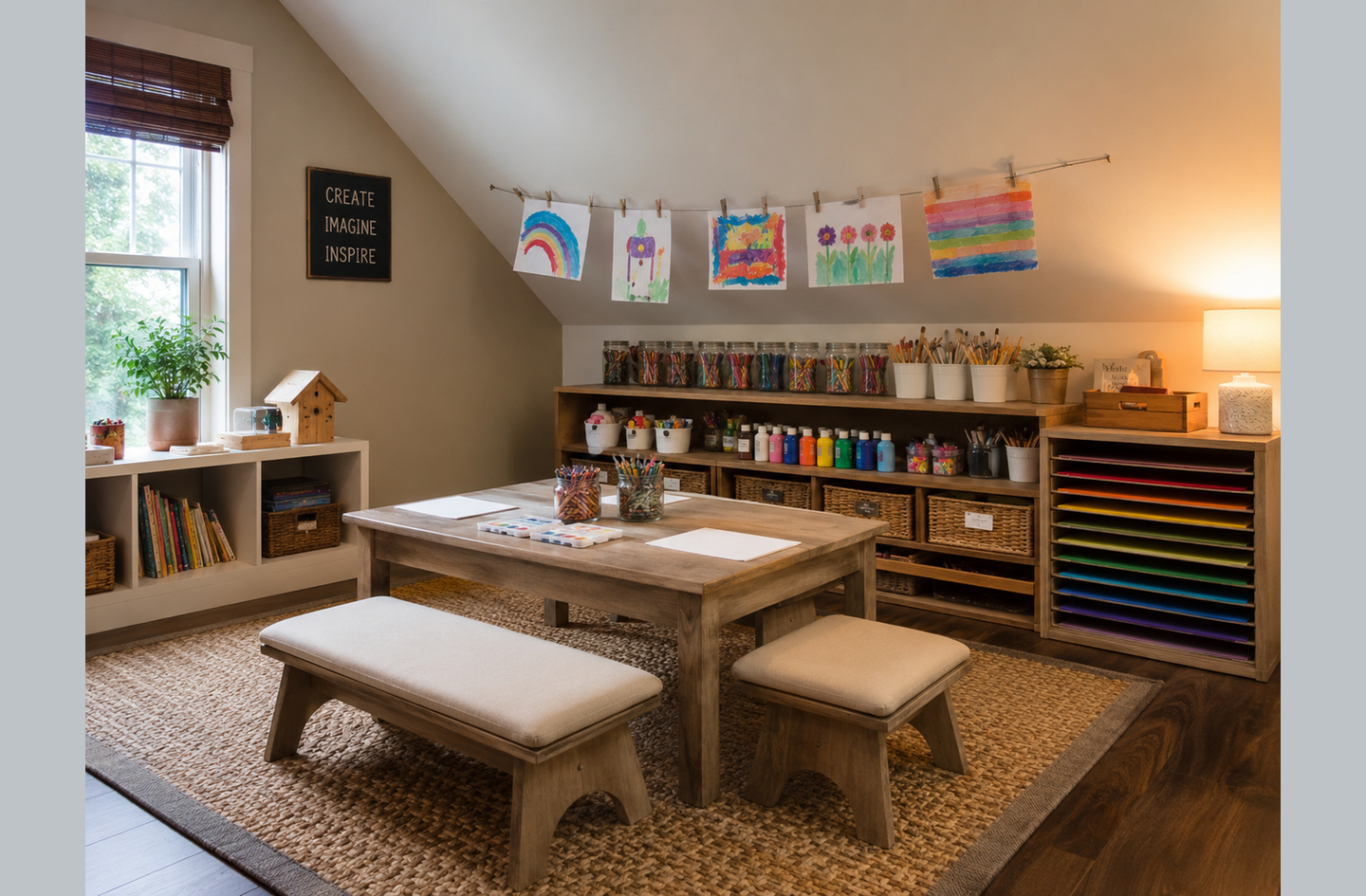
Benches: space-efficient, harder to fit
A bench seats more children and tucks under the table, which saves floor. It also forces every child to one seat height, so benches suit siblings close in age.
Stools and chairs: pick by stability and back support
Backless stools let children hop on and off, which suits short sessions. For longer drawing work, a chair with a low back supports the posture the OSHA test describes. Choose wide-based seats that sit flat without rocking, and avoid seats tall enough to need climbing.
Buy the table and the seats as separate decisions, because the seat is the part that has to change as each child grows.
Edge Details: Which Corners and Rims Suit Young Children?
Neither table type wins on edges by default: the deciding detail is the corner shape and any cutter bar, not the category. Collisions, tip-overs and falls are common ways furniture injuries involve children’s heads and faces. A national emergency-department study estimated 41,914 craniofacial furniture injuries in children from 2013 to 2022, and toddlers aged one to three made up 53.3% of them6.
That study counted all furniture, including television tip-overs and storage units, so it does not single out tables. It does show where the exposure sits: 76.5% of those injuries happened at home6, and a low table edge sits near a toddler’s height.
Rounded corners and eased edges
Choose a top with rounded corners and edges that are softened rather than square. A round or oval activity table removes corners entirely, which helps in a room where younger siblings walk past the table.
Rims and lips: useful, with a height trade-off
A raised lip around the top keeps crayons and beads from rolling off. It also adds height at the edge where forearms rest. For accessible play tables, the federal standards cap the tops of rims and other obstructions at 31 inches1. At home, a low lip works better than a tall one.
Paper-roll cutter bars
Many specialized art tables mount a serrated cutter bar to tear paper from the roll. A serrated edge is designed to cut, so check that it is guarded and sits away from a young child’s face height when standing.
For a home with a toddler, a round activity table with no cutter bar reduces avoidable risk at the edge.
Cleanability: Which Table Surface Survives Glue, Paint and Markers?
Cleanability is a tie between the two table types, because it depends on the top finish rather than the label on the box. A sealed, non-porous top wipes clean, while raw wood and fabric absorb paint, glue and water. The CPSC Art and Craft Safety Guide tells adults to clean up spills immediately, even small spills7. That only works on a surface that releases them.
| Top finish | Markers and crayon | Glue and paint | Water | Long-term wear |
|---|---|---|---|---|
| Laminate or melamine | Wipes off | Wipes off when fresh | Resists; seal any exposed edges | Chips at corners if struck |
| Sealed hardwood | Wipes off | Wipes off when fresh | Resists while the finish holds | Can be sanded and refinished |
| Molded plastic | Wipes off; some marker stains | Wipes off | Resists | Scratches hold pigment |
| Raw or oiled wood | Stains | Absorbs | Swells and marks | Needs a cover or sealing |
TSCA Title VI is the federal emission rule for composite wood products such as particleboard and medium-density fiberboard, which sit under many laminate tops. The EPA states that, after March 22, 2019, composite wood products must be labeled as TSCA Title VI compliant8. Look for that label on a new pressed-wood table.
Shared tables: art and meals
An activity table that also hosts snacks needs a clear switch-over routine. The CPSC guide tells adults to keep food and drinks out of the art area7. Put all art materials away before food comes out, then wipe the top. For paint-heavy sessions, the painting station plan covers water, splashes and drying in detail.
Judge every table by its top finish and its exposed edges, because a beautiful raw-wood art table will spend its life under a plastic cover.
Art Table With Storage for Kids: Built-In or Beside the Table?
Storage beside the table wins for most rooms, while an art table with storage for kids wins only when its bins leave knee room clear. Built-in bins put supplies within arm’s reach, which shortens setup. The cost is space under and around the top, where knees, feet and chair legs need to go.
Knee clearance is the open space under a table where a seated child’s knees and thighs fit. For accessible play tables, federal standards call for knee clearance at least 24 inches high, 17 inches deep and 30 inches wide1. Bins slung under the top or between the legs eat into exactly that space, so measure under the table before buying.
Keep supplies inside the reach band
Wherever the storage sits, everyday supplies belong where children can reach them without climbing. Federal guidance lists children’s reach as 20 to 36 inches at ages three and four, and 16 to 44 inches at ages nine through twelve1. A low shelf or rolling cart beside an activity table can hold the full supply set inside that band.
Fewer supplies out, faster reset
The CPSC guide advises giving children only small amounts of art materials to minimize spills and mishaps7. The same idea works for storage: keep a small working set at the table and the backup stock on a higher shelf the adult controls. The guide also says to avoid using food containers for storage7, so label supply bins clearly.
Plan where finished work goes
Table storage handles supplies, not finished pieces. Without a plan, drawings pile up on the table itself. Our guide to storing kids artwork covers trays, portfolios and archives, and the rotating art gallery article compares display options that stay connected to the station.
Design for the reset, not just the reveal: storage helps only when every supply has one obvious home a child can return it to.
Paper-Roll Features: When Are They Worth It?
A built-in paper roll is the clearest win for a specialized art table, but only for children who draw large and often. A roll gives a fresh sheet in seconds and invites big, sprawling drawings that standard sheets cannot hold. For a child who draws a few times a week on letter-size paper, a roll adds width, a cutter bar and a refill routine without much benefit.
Roll position changes the footprint
A roll mounted across the top lets children pull paper over the work surface, which keeps the table length unchanged. A roll mounted at one end adds width to the clearance zone and the walking route. Wall-mounted roll holders free the table, but they need anchors suited to the wall. Ask a licensed installer if the wall is plaster, brick or unknown.
A low-cost alternative
A floor roll stand, or paper taped across an activity table, gives most of the same experience and moves aside when the table is needed.
Pay for a built-in roll when the roll will be used every week; otherwise, a removable roll keeps the table flexible.
Cost, Lifespan and Hidden Costs
A simple adjustable activity table usually wins on lifespan, because it can follow a child from preschool to homework age. The hidden cost of any fixed-height table is replacement once the child outgrows it. WHO median height for girls rises from 115.1 cm at age six to 151.2 cm at age twelve4. A table that fits in kindergarten sits low by the end of primary school.
A specialized art table also carries running costs: paper refills, replacement cups and bins, and the floor it occupies. Those costs make sense when the table is used daily.
Second life after the art years
An activity table with adjustable legs can become a homework desk or a game table later. A table built around a paper roll and fixed bins has fewer second uses.
Count the cost per year of use, not the price on the tag, because the cheaper table is the one that keeps fitting.
Who Should Choose Which Table?
If children make art most days in a dedicated zone, choose a specialized art table. If the table must also serve meals, puzzles or homework, or the room is small, choose a simple activity table with storage beside it. These four profiles cover most homes.
- One preschooler, small room: a round activity table with adjustable legs and a low shelf beside it. Rounded edges and a small clearance zone matter more than built-in features.
- Two or three school-age children who draw daily: a specialized art table with a roll across the top, plus separate chairs at each child’s height.
- Siblings far apart in age: an activity table set for the older child, with a footrest or taller chair for the younger one.
- Shared living or dining space: a folding or wall-side activity table, with a rolling cart that stores the supplies out of sight after each session.
When neither fits, such as a child who prefers to stand and paint, an easel can serve better than any table.
The room as a system decides this, not the catalog: the right table is the one that fits the room’s routes and the child’s body together.
Verdict: Category Winners
A simple activity table wins most categories for most families, and a specialized art table wins where daily, art-heavy use makes its built-in features pay off.
| Category | Winner |
|---|---|
| Footprint and clearance | Simple activity table |
| Child fit | Adjustable activity table |
| Seating | Separate seats (either table) |
| Edges | Tie: depends on corners and cutter bar |
| Cleanability | Tie: depends on the top finish |
| Storage | Storage beside the table, unless built-in bins leave knee room |
| Paper roll | Specialized art table |
| Cost and lifespan | Simple activity table |
| Overall | Activity table for mixed use; art table for a dedicated daily craft zone |
Start with an adjustable activity table and a good shelf, then upgrade to a specialized art table only once the craft habit has proven itself.
Frequently Asked Questions
What size should a kids art table be?
Size the table to the floor it will really use, not only its top. Chairs need room to slide back, and accessible design sets walking routes at 36 inches of clear width1. In our floor-budget estimate, the top covers roughly a fifth to a third of the zone, so measure with chairs pulled out.
How tall should a kids art table be?
Federal accessibility standards set children’s table tops at 26 to 30 inches above the floor1, in public buildings, a rule written for wheelchair access. Treat it as a reference point, not a home sizing rule. The best check is the child: feet flat, thighs supported and forearms resting on the top without raised shoulders. Adjustable legs keep that fit as the child grows.
Is an art table with storage for kids worth it?
It is worth it when the bins leave knee room clear. Federal standards for accessible play tables call for knee clearance at least 24 inches high and 17 inches deep1. Bins under the top can crowd that space, so a low shelf beside the table often works better.
What chair height works at a kids craft table?
A chair fits when the child’s whole foot rests on the floor and the back of the knee sits slightly above the seat. OSHA uses that test for adult workstations5. Seat height changes fast with age, so separate chairs or a footrest beat one fixed set of stools.
When does a simple activity table work better than an art table?
A simple activity table works better for mixed use, small rooms and growing children. WHO median height for boys rises about 13 inches between ages six and twelve4, and an adjustable activity table follows that growth. A specialized art table pays off mainly for daily, art-heavy sessions.
Limitations and Edge Cases
- The heights and clearances cited here come from accessibility standards for public buildings and describe groups of children, not one child. Watch your own child at the table and adjust. For a specific child’s posture, motor or sensory needs, consult a pediatric occupational therapist.
- The mismatch studies measured school furniture in Spain and Korea, where 97.2% of pupils in one study used desks that did not fit2. Home results can differ, but the fit check is the same.
- Wall-mounted roll holders, fold-down tables and shelves fixed to the wall are outside a planning article. Before installation, evaluate the wall and hardware with a licensed installer or contractor.
References
Methodology: every cited figure comes from a published source listed here, each checked live on October 5, 2026. The floor-budget table, the verdict table and the growth chart are Playroom Architect planning syntheses, not product tests.
- U.S. Access Board – Guide to the ADA Accessibility Standards (2010 ADA Standards), sections 403.5.1, 902.4 and 1008.4.3, Advisory 308.1 and the advisory on water closets serving children.
- PubMed – Prieto-Lage I, Ayan C, Alonso-Fernandez D, et al. Degree of mismatch between anthropometric characteristics and school furniture in a sample of Spanish students aged 6-12 years old: a pilot study. Archivos Argentinos de Pediatria, December 2021.
- PubMed – Lee Y, Yun MH. Evaluation of the guidelines and children’s ability to select the anthropometrically recommendable height of school furniture: a case study of Korean primary school children. Work, 2019.
- World Health Organization – Growth reference data for 5-19 years: height-for-age, simplified field tables for boys and girls (percentiles), WHO 2007 reference.
- Occupational Safety and Health Administration – Computer Workstations eTool: Chairs.
- PubMed – Gursky AK, Reese AD, Kenny A, Neimanis S. Exploring trends in pediatric craniofacial furniture accidents: implications for prevention, safety counseling, and future advocacy initiatives. Injury, July 2025.
- U.S. Consumer Product Safety Commission – Art and Craft Safety Guide, Publication No. 5015.
- U.S. Environmental Protection Agency – Formaldehyde Emission Standards for Composite Wood Products.
Conclusion
A kids art table works when it fits the child and the room before it fits a feature list. Start with height and clearance, choose separate seats, and pick rounded corners and a sealed top. For most families, an adjustable activity table with a shelf beside it does the job.
To see how the table fits the wider craft space, return to the art station planning overview, the summary of planning a home art station.