
A Montessori playroom is a room that works before it photographs; it earns calm through structure. This guide gathers fifteen Montessori playroom ideas that address what most rooms get wrong. Each idea sits under our Montessori playroom setup guide, the overview of the prepared environment for the whole topic. Research on toy count shows toddlers played twice as long with four toys on display than with sixteen2. So the count of activities on the shelf is one of the highest-leverage decisions in the room. Every idea passes structural safety reasoning, developmental fit, and buildability in a real home. You can adapt them to a shared corner or a whole basement.
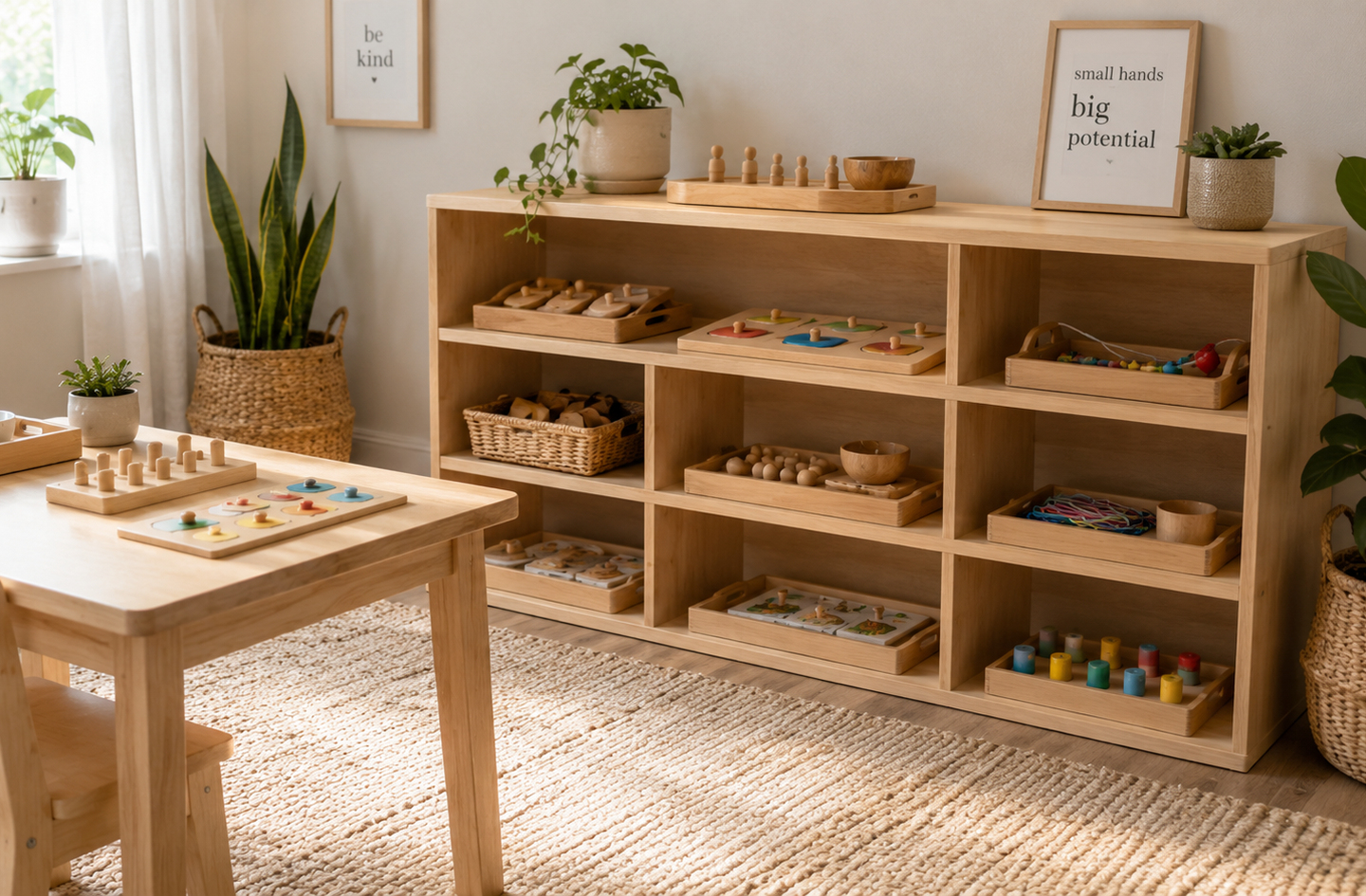
Quick Answer
What is a Montessori playroom, and how do you set one up?
A Montessori playroom is a room set up so a child can move, choose, and reset without adult help. That looks like low anchored shelves and a small rotating set of activities: four to eight for a toddler5. Add open floor for movement and quiet zones for reading, art, and rest. Every choice starts with observation of how the child uses the space.
Key Takeaways
- Fewer accessible activities support longer, deeper play: research shows four toys on display doubled toddlers’ play time compared with sixteen2.
- Anchor every piece of furniture over 30 inches tall into wall studs; CPSC tip-over data makes this a floor rule, not a preference3.
- Design for the reset, not just the reveal: every item needs a labeled home a two-year-old can find without asking.
- Sightlines and circulation come before decor; walk the room before you shop.
Layout Ideas (1 to 5)
A Montessori playroom starts with layout, not decor: the paths, sightlines, and zones a child moves through daily set the room’s ceiling. These five ideas map the observations that should shape a floor plan before any purchase.
The reader’s decision here is which two friction points to observe first, because circulation and sightlines usually pay back faster than shelf or decor decisions.
1. Walk the room before you shape it
Observation is watching where the child moves, stops, and abandons play, without steering them. That data beats any Pinterest layout, because it tells you where the friction points already sit. Spend three separate half-hour blocks watching, not tidying. Note where feet travel, where toys pile up by the end of the session, and where the child looks up to check on you. Those three patterns anchor every zone the room will hold.
Sketch the room on a single sheet of paper. Draw arrows for the paths you saw. Mark the pile spots with an X and the check-on-you sightlines with a dashed line. Only then decide where the shelf, the rug, and the reading corner belong. This is what we mean by the room as a system: layout follows behavior, not the other way around.
2. Anchor low shelves under 32 inches, into wall studs
Child-scale storage means shelves low enough that a toddler can retrieve and return items without adult help, usually 24 to 32 inches high at the top edge. Every piece of furniture over 30 inches tall gets tip-over hardware into wall studs, not drywall alone. The Consumer Product Safety Commission reports that on average one child dies about every two weeks from a tip-over incident3. About 11,300 emergency-department visits each year involve furniture or television tip-overs3.
That is why a low shelf on a hard floor is still a load-bearing safety decision, not only a design one. Use the hardware the shelf ships with, add a stud-finder check, and treat wall-anchor questions on brick, plaster, or uneven walls as a licensed-installer job. For a deeper read on shelf construction and height, see our toy shelf height guide.
3. Reserve open floor space of at least 4 by 6 feet
A prepared environment needs a clear zone big enough for gross motor work, floor puzzles, block building, and a rug that defines the boundary of a single work. In a real home that usually means keeping a 4 by 6 foot rectangle free of furniture, wires, and low tables. That is the smallest area that fits an adult crouched next to a toddler rolling out a mat.
Open floor space also matters for circulation. An adult with a laundry basket needs a 24 to 30 inch clear path across the room. A child abandoning a work needs somewhere to walk that is not the middle of an activity. If the room is small, protect the floor by moving storage up (higher wall shelves for the adult back stock) rather than by shrinking the play zone.
4. Keep the caregiver in the sightline
A child who can see you plays longer alone. Position at least one line of sight between the primary play zone and the room’s most-used adult seat: a sofa, a desk chair, or the kitchen doorway. That single sightline reduces the check-ins that break concentration.
The rule matters most in the 12 to 30 month band, when secure-base behavior is at its strongest. It also matters in shared rooms, where an older sibling can quietly hold the sightline for a younger one. Avoid tall storage between the child and the adult; use lower shelves along that axis and put taller cabinets on the perpendicular wall. If the reading corner sits behind a bookcase, that is the corner you can afford to hide, because a child in a reading nook usually is not seeking connection.
5. Neutral walls, low visual noise, and the Third Teacher
The Third Teacher refers to the idea that the room itself, along with adults and other children, guides a child’s focus and independence. Walls, color, and pattern belong to that teacher. Choose muted paint (warm off-whites, soft naturals, quiet greens) and hang two or three pieces of child-height art rather than a saturated feature wall.
Visual quiet is not a taste preference; it lets the shelf display be the loudest signal in the room, which is what carries the day’s choice architecture. Save saturated color for the works themselves: a red set of pegs, a blue sorting tray, a woven yellow basket. For the palette and material choices that support this, see our sibling on Montessori decor guidance. Structural reasoning first, decor inspiration second.
Shelf and Storage Ideas (6 to 10)
The shelf is where a Montessori room either supports independent play or fights it. These five ideas cover how many activities to show, how to present them, and how to make cleanup possible without an adult.
The reader’s decision here is how much to show at once, and the rule from the toy-count research is that fewer visible activities produce longer, deeper play2.
6. Show 6 to 10 activities at a time, not 30
A Montessori shelf earns its calm by limiting choice. Dauch and colleagues found that when the accessible toy count dropped from 16 to 4, toddlers played roughly twice as long with each toy2. They also moved through fewer distinct items in a session. Extend the finding across age bands and pair it with AMI’s prepared-environment guidance6. Under two years, show 4 to 6 activities. From two to three, show 6 to 8. From three to six, show 8 to 12.
The rest live in adult-managed back stock: a labeled bin in a closet, a top shelf out of sight, or a garage tote. Rotate weekly. Watch the shelf on the third day; the activities a child ignores for a week come out, and a new tray goes in.
7. One tray per activity, one activity per tray
A tray is a shallow container that defines the boundary of a single work: the tray is the mat’s edge in miniature. Wooden trays, cane baskets, and small tin dishes all work. What matters is that the tray holds the whole activity: the pieces, the tools, the cloth for spills. Then a child can carry it to the rug and back in one motion. That single boundary reduces piece-loss and makes cleanup a child-led step, not an adult intervention.
Do not mix activities on a single tray; do not stack. A shelf with ten neat trays, each holding one work, teaches the reset without a lecture. For deeper cross-references on categories, labels, and back-stock, see our Montessori storage plan.
8. Front-facing books, 6 to 8 visible
A cover-forward bookshelf reduces the decision cost of picking a book by showing the illustration, not the spine. Keep 6 to 8 titles visible; rotate the rest. That count matches the toy-count logic: fewer visible choices produce longer engagement with each one2.
Height matters as much as facing: the top row belongs at the child’s shoulder, not eye level, so that reaching for a book is easy and returning it is easier. A single-row rail is enough for infants and toddlers; a two-row unit works from about age three. If books scatter every night, the count is too high, not the child’s fault.
9. Every item has a home the child can find
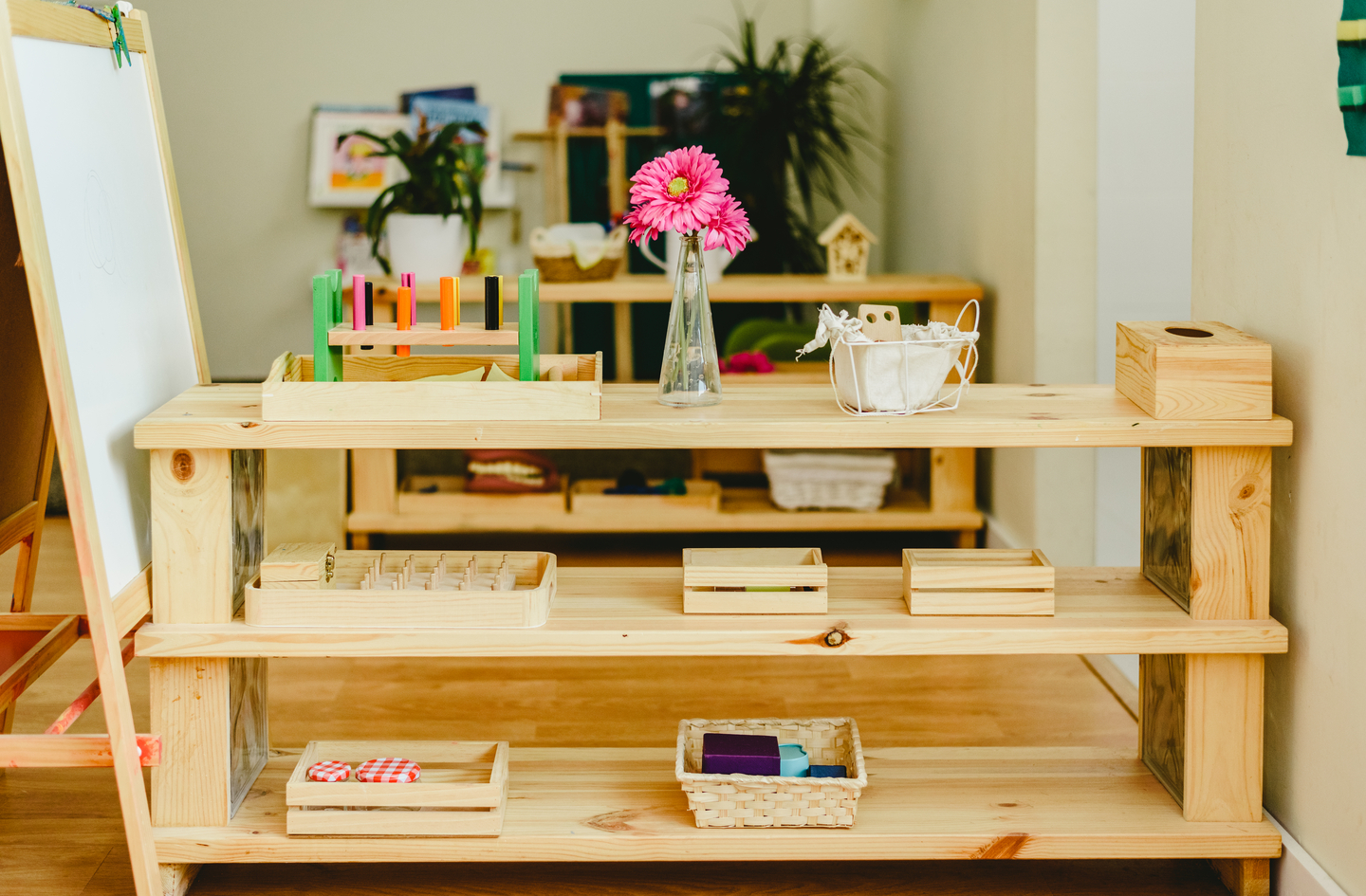
Fast reset depends on a rule that never varies: every item lives in the same place, every day. Draw silhouettes on the shelf, label baskets with a photograph, or tape a single word to the front of a bin. The label is for the child, not the adult, so it should read at eye level and use images or single words rather than sentences.
This one detail turns cleanup from a nightly negotiation into a game a two-year-old can play. It also turns “put it back” into an achievable instruction, because the “back” is legible. Design for the reset, not just the reveal.
10. Real materials, in child-scaled sizes
Real materials belong on the shelf: a small ceramic pitcher, a metal-tined fork, wooden pegs, a glass jar with a lid a child can turn. Real weight and real texture give a child feedback that plastic cannot, and breakage is part of the lesson. The scale is what matters: an adult pitcher is a hazard, a child-sized pitcher is a work.
Two safety rules override this idea. First, glass at the shelf level is only for supervised practical-life work with children old enough to understand consequence, roughly two and a half and up. Second, any material with a swallowing hazard (small beads, magnets, batteries) stays in adult-managed storage. The American Academy of Pediatrics treats swallowed small parts as a first-tier hazard for under-threes1.
Activity Zone Ideas (11 to 15)
Zones let one room hold movement, art, reading, and rest without collision. These five ideas map each zone’s placement, materials, and boundaries so the activities coexist and reset quickly.
The reader’s decision here is which zone to protect first: in a shared or small room, movement and reading usually win, because they need floor space and quiet respectively.
11. Movement zone against an outer wall
A movement zone holds gross motor work: a balance beam, a low climber, a mirror with a horizontal bar. Place it against an outer wall where possible, so wall-mounted hardware anchors into studs rather than into a shared partition. Keep at least a 4 by 6 foot clear pad in front of the hardware, with soft flooring under the fall zone.
Wall-mounted climbing, pull bars, or Swedish ladders are structural decisions, not decor decisions. A licensed installer, and (for older stock walls or non-standard framing) a structural engineer, should evaluate the specific wall and hardware before installation. This is engineering-informed guidance, not a certified installation.
12. Art zone near the door and near a wipeable floor
An art zone belongs where spills are cheapest: near the door, on a floor you can wipe or on a rug you already accept as sacrificial. A child-sized table, a small chair, and a low shelf holding one paint activity, one drawing activity, and a stack of paper are enough to open the zone.
Two systems keep it working. First, a hanging line or clip rail above the shelf for wet paintings; drying vertically saves table space. Second, an art apron on a hook the child can reach; the hook is the invitation to put the apron back on the child’s own initiative. Watch the paper stack: if it never runs down, the zone is unused, and the count on the shelf is too high, not too low.
13. Reading nook in the quiet corner
A reading nook belongs in the quietest corner, farthest from the door and the movement zone. Two floor cushions, a low lamp for after-dark reading, and a forward-facing book display of 6 to 8 titles are the whole assembly. A soft rug marks the boundary; the child either sits inside or is not reading.
Keep the nook small on purpose. A single-child nook (about 4 by 4 feet) supports concentration; a nook large enough for three children usually becomes a wrestling ring. If two siblings need to read at once, run two small nooks on opposite walls rather than one large shared one. For the detailed nook setup, see our sibling on the Montessori reading corner.
14. Infant mirror-and-bar station at floor level
For infants aged two to twelve months, a floor-level mirror with a low horizontal wooden bar 18 to 20 inches above the mat gives a full station. That station supports visual self-recognition, pull-to-stand practice, and tummy-time interest. The mirror is safety-film shatter-resistant, or acrylic, anchored top and bottom. The bar mounts into studs, not drywall alone.
Change the station as the child changes. At about ten months, add a low pull toy tied to the bar. At twelve months, swap the mirror for a low art wall. This is the room’s clearest reminder that a Montessori playroom is time-shaped as well as space-shaped. A room that works at eight months does not work unchanged at eighteen. For the underlying design principles across ages, see our sibling on the ten design principles.
15. Small-space adaptation: one wall as the whole prepared environment
When there is no dedicated playroom, one wall can hold the entire prepared environment. The recipe has four parts. Use a single low shelf of six to eight activities and a small rug in front of it, about 3 by 5 feet. Add a low mirror at one end for infant work or dressing practice. Mount a book rail above the shelf. That is the minimum viable Montessori environment for an apartment or a shared bedroom.
Two rules keep it honest. First, the wall must earn priority: nothing else on that wall competes with the shelf (no toy chest, no television, no laundry hamper). Second, back-stock and rotation happen in a closet or a labeled bin elsewhere. A one-wall setup fails the moment adult overflow starts landing on the child’s shelf.
How We Chose These Montessori Playroom Ideas
We chose these fifteen Montessori playroom ideas by applying our three-filter test to each candidate. Every idea must pass structural safety reasoning, developmental fit, and buildability in a real home.
Scope. We started with roughly forty candidate ideas drawn from AMI prepared-environment guidance, NAEYC Developmentally Appropriate Practice, and observations of family playrooms in apartments, basements, and shared bedrooms.
Evaluation criteria.
- Structural safety reasoning. Anchor points, tip-over risk, active-play placement, and swallowing hazards were evaluated against Consumer Product Safety Commission data3 and pediatric guidance1.
- Developmental fit. Each idea was checked for a specific age band (infant, toddler, primary) using CDC developmental milestones7 and Harvard Center on the Developing Child research on executive function4.
- Buildability in real homes. Every idea had to work in a real family space (a rental apartment, a shared bedroom, or a basement corner), on a real budget, and with realistic upkeep.
Methodology. This is a research-and-observation review, not a certified design service. Every quantitative figure below traces to an independent published source and links to the page that carries it. The article’s methodology is reviewed by the author and refreshed on material change. Playroom Architect sells nothing directly, accepts no sponsored placements, and never gives visibility to a competing brand’s advice.
| Design lever | Under 2 years | 2 to 3 years | 3 to 6 years |
|---|---|---|---|
| Activities on the shelf | 4 to 6 | 6 to 8 | 8 to 12 |
| Books visible (front-facing) | 4 to 6 | 6 to 8 | 8 to 10 |
| Shelf top height | 18 to 24 inches | 24 to 30 inches | 28 to 32 inches |
| Open floor pad | 4 by 6 feet | 4 by 6 feet | 5 by 7 feet |
| Tip-over anchoring | Required for anything over 24 inches | Required for anything over 30 inches | Required for anything over 30 inches |
| Movement zone hardware | Floor mirror plus low bar | Low balance beam plus low climber | Wall bars evaluated by a licensed installer |
“Play is essential to development because it contributes to the cognitive, physical, social, and emotional well-being of children and youth.”
Kenneth R. Ginsburg, MD, MSEd, FAAP, American Academy of Pediatrics1
Frequently Asked Questions
What is a Montessori playroom?
A Montessori playroom is a room designed as a prepared environment. That means low anchored shelves, a small rotating set of activities (four to eight for a toddler)5, open floor space, and quiet zones for reading, art, and movement. Every choice supports child-led activity and a fast reset without adult help.
How many toys should be on a Montessori shelf?
Show 4 to 6 activities under age two, 6 to 8 at two to three, and 8 to 12 from three to six. Research by Dauch and colleagues found toddlers played roughly twice as long per toy with four toys accessible than with sixteen2. That finding is the empirical basis for the lower counts.
Do Montessori playroom ideas work in a small space or a shared bedroom?
Yes. A one-wall setup works in an apartment or a shared bedroom: a single low shelf, a 3 by 5 foot rug, a low mirror, and a book rail. The rules that scale down are the same three filters: safety, developmental fit, and buildability.
What is the best age to set up a Montessori playroom?
A prepared environment can start at birth with a floor mirror and a soft mat, then evolve. CDC milestones and pediatric guidance support age-adapted setups from infancy through the primary years7. Reset the room roughly every three months in the first two years, then twice a year.
Limitations and Edge Cases
- These fifteen ideas cover indoor playrooms in temperate homes; outdoor prepared environments, sensory needs specific to a child, and therapeutic environments are outside our scope. For advice tuned to a specific child’s sensory or developmental profile, consult a pediatric occupational therapist.
- Anchor, hardware, and structural questions on non-standard walls (brick, plaster, prefab, uneven framing) belong with a licensed contractor or installer. The general figures here are engineering-informed reasoning, not a certified installation plan.
- For the parts of the Montessori topic these ideas do not cover (color palette, materials, storage back-stock), see the sibling articles on Montessori decor guidance and Montessori storage plan.
References
Methodology: every figure below comes from an independent published source and links to the page that carries it; the article’s methodology is reviewed by the author and refreshed on material change.
- American Academy of Pediatrics – Kenneth R. Ginsburg, “The Importance of Play in Promoting Healthy Child Development and Maintaining Strong Parent-Child Bonds,” Pediatrics, 2007.
- Infant Behavior and Development – Dauch, C., Imwalle, M., Ocasio, B., and Metz, A. E., “The influence of the number of toys in the environment on toddlers’ play,” Volume 50, 2018, pages 78 to 87.
- U.S. Consumer Product Safety Commission – “Anchor It! campaign, tip-over prevention statistics,” accessed 2026.
- Harvard University Center on the Developing Child – “Executive Function and Self-Regulation,” accessed 2026.
- National Association for the Education of Young Children – “Developmentally Appropriate Practice: A Position Statement,” 2020 revision.
- Association Montessori Internationale – “The Prepared Environment,” AMI public guidance, accessed 2026.
- Centers for Disease Control and Prevention – “CDC’s Developmental Milestones, Learn the Signs. Act Early,” accessed 2026.
Conclusion
A Montessori playroom is a room that quietly teaches independence, and it does that by getting circulation, sightlines, shelf counts, and reset logic right before decor. Fewer activities on display, real materials, one clear “home” per item, and a movement zone that respects structural anchoring do more for calm than any color palette. The room is not background for play; it is part of the play system.
For the wider view of how these ideas fit together, read the Montessori playroom setup guide for the overview of the prepared environment as a single topic.