
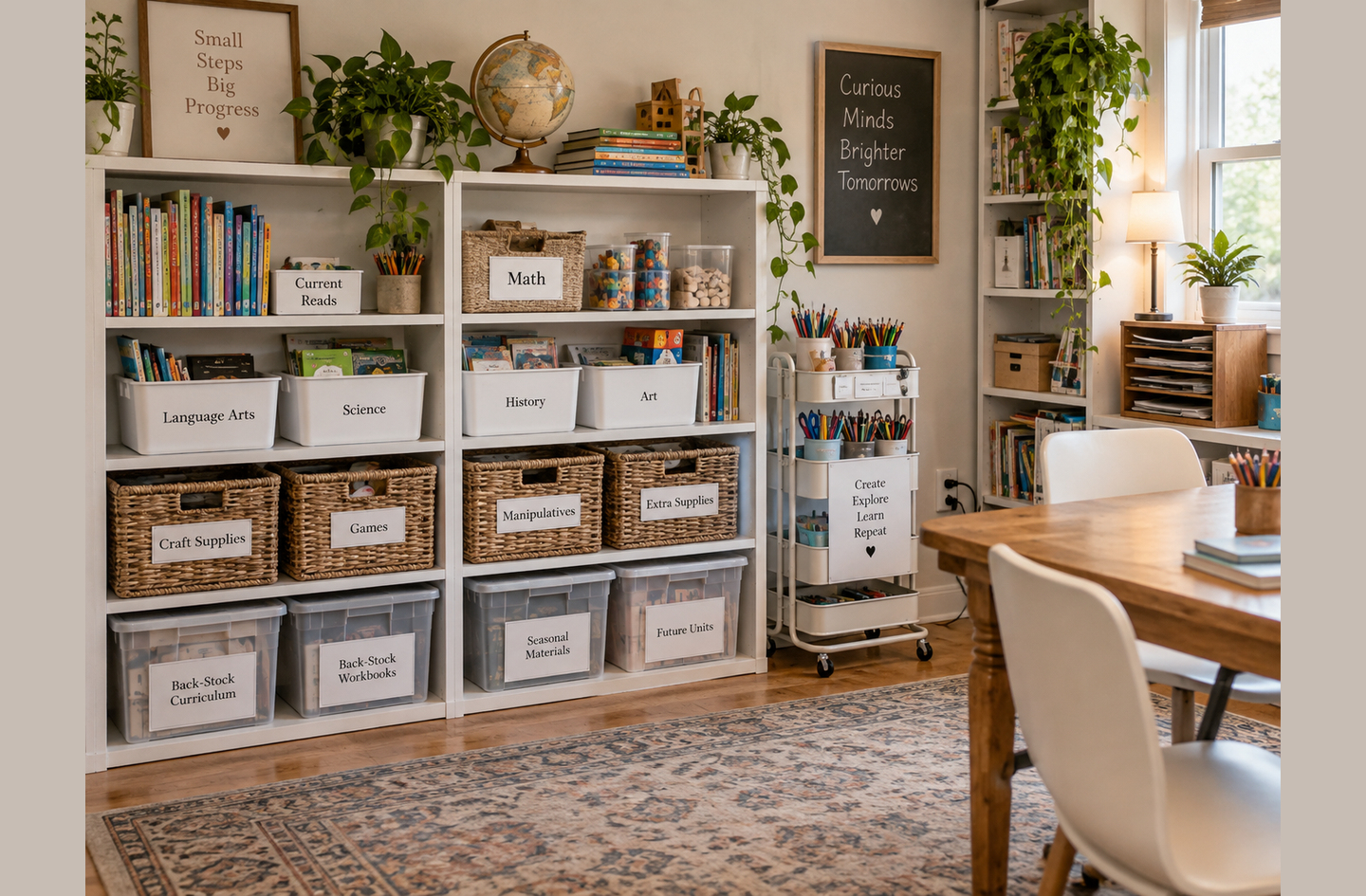
More than 3.4 million U.S. families homeschooled in 2024-20251, and most of them work at kitchen tables, on living room floors, and at shared desks, not in purpose-built school spaces. Teaching homeschool without a dedicated room is workable, but it requires a different system than having a fixed classroom. This guide builds the system from the ground up: rolling carts, portable caddies, compact back-stock storage, and a repeatable daily setup and reset. The broader overview in planning homeschool learning zones covers how this portable approach fits alongside other zone strategies.
Quick Answer
How do you homeschool without a dedicated room?
Build the system around mobility, not location. A three-tier rolling cart holds current curriculum, daily supplies, and near-term back-stock. A portable caddy carries the session essentials to any surface. A five-minute end-of-session reset returns everything to its home. With 3.4 million families homeschooling in 2024-20251, most working in ordinary home spaces, this portable model is well-tested across a range of family sizes and shared rooms.
Key Takeaways
- A rolling cart with three defined tiers (active work, supplies, back-stock) is the structural core of a portable homeschool setup in a shared space.
- The kitchen table, living room floor, and a child’s bedroom desk all work as school surfaces when supplies move with the child rather than staying fixed in one room.
- Classroom research shows children spend more time off-task and learn less in visually cluttered environments3; keeping the cart stocked but the working surface clear is a functional decision, not just an organizational preference.
- A five-minute daily reset is what keeps a portable system from collapsing; without it, the cart fills with drift and the shared space breaks down within two weeks.
- Back-stock (books, supplies, future units) belongs in a separate container from the active daily cart, or the cart becomes unnavigable within two weeks of the school year starting.
Step 1: Audit Where Learning Already Happens
By the end of this step, you’ll know your primary and secondary learning surfaces and whether the space already has any anchor storage nearby.
Before buying a cart or labeling a single bin, spend one school day watching where learning naturally settles. Most families assume they need a dedicated room but already have a workable pattern: the child does written work at the kitchen table, reads on the couch, and spreads projects on the living room floor. That pattern is your system’s starting point, not something to fight against.
Observe first, then map your surfaces
Write down which surfaces your child uses during a normal school day and roughly how long they spend at each. You are not redesigning the house; you are confirming what already works. Most families find one primary surface (usually the kitchen or dining table) and one secondary surface (a couch, bedroom desk, or floor area). Note what is near each surface already: an existing shelf, a kitchen island drawer, a closet two steps away. These become potential back-stock zones later. Nothing needs to be purchased yet.
Check for traffic conflicts
Identify when the kitchen table is free versus when adults need it, when the living room gets heavy foot traffic, and when the floor is open for spread-out project work. A portable system works because it clears at the end of each session, but clearing is faster when the surface was already calm before school started. If a surface is consistently interrupted mid-session, treat it as a secondary surface rather than the primary anchor. Building the system around a surface you fight for every morning creates friction before school even starts.
| Surface | Best for | Main constraint | Cart placement |
|---|---|---|---|
| Kitchen or dining table | Writing, table work, math manipulatives | Needs full clear by mealtimes | Cart beside or behind; rolls away for meals |
| Living room floor | Reading aloud, building, project spread | Open floor space depends on furniture layout | Cart stays at perimeter; supplies travel in caddy |
| Child’s bedroom desk | Quiet independent work, reading, writing | Space for cart may be limited | Small caddy on desk; cart in hallway or closet |
| Home office desk (shared) | Computer-based work, typing, research | Adult work schedule creates session conflicts | Cart in shared space; sessions must be scheduled |
With this surface map in hand, you’re ready to choose the right mobile storage unit. The cart serves the primary surface; the caddy serves everything else.
Step 2: Choose Your Primary Mobile Storage Unit
By the end of this step, you’ll have selected a main cart or rolling unit sized to fit your primary surface, your number of children, and the space beside the table where it will rest between sessions.
The most common mistake here is buying the cart first, before knowing how much material it needs to hold. Cart size follows from child count, active subject count, and the distance from the cart’s resting position to the nearest learning surface. Oversizing means the cart blocks traffic; undersizing means supplies pile up on the table because the cart is always full.
The three-tier rolling cart (most families’ primary unit)
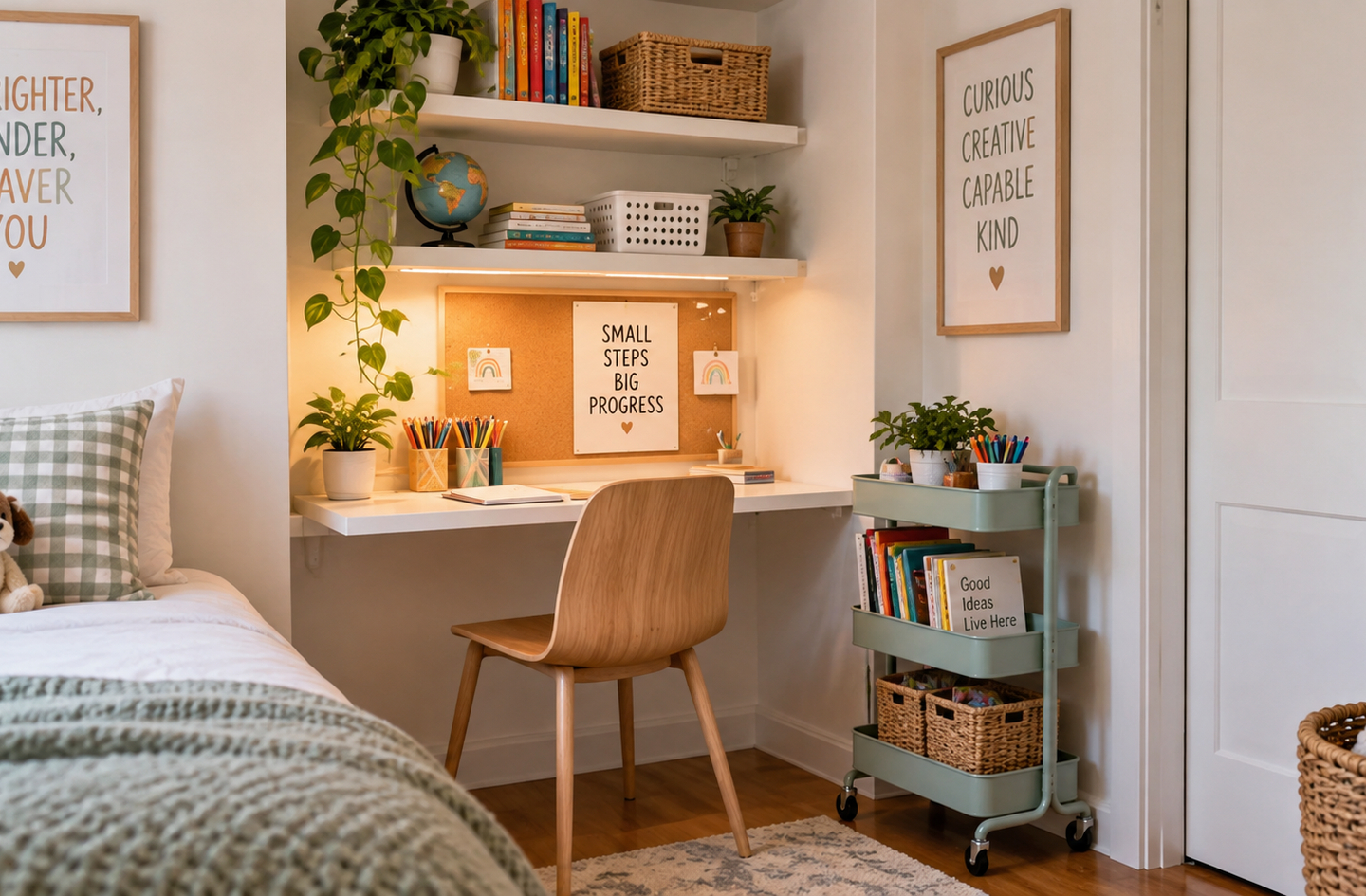
A three-tier rolling cart, roughly 13 to 16 inches wide and 22 to 28 inches tall, fits beside most standard kitchen chairs without blocking the seat. Three tiers give enough separation to divide today’s active work from daily supplies from near-term back-stock reference books, which is the organizational structure this whole system runs on.
Look for carts with locking wheels. A cart drifting mid-session creates instability and is a tip concern around young children. Locking wheels are a functional safety feature, not an optional convenience.
The utility cart or bin-on-wheels (larger families or many subjects)
Families with three or more children, or with a curriculum running more than four subjects simultaneously, often outgrow the standard three-tier cart quickly. A larger utility cart with deeper bins provides more capacity per tier. These carts are wider (18 to 24 inches) and may not fit beside a kitchen chair, so they typically park at the room perimeter while a smaller caddy carries active session supplies to the table.
The portable caddy (secondary unit, pairs with any cart)
A handled caddy (a fabric tote with interior pockets, or a mesh tool caddy with dividers) carries the current session’s consumables from the cart to wherever the child works. The caddy is what makes floor time, bedroom work, and couch reading functional without moving the whole cart. It holds pencils, crayons, scissors, glue, the active workbook, and a small ruler. The caddy returns to the cart at every reset and is never left out overnight. This single rule prevents the supply drift most families experience within the first two weeks of a portable system.
| Unit type | Width | Best for | Pairs with |
|---|---|---|---|
| Three-tier rolling cart | 13-16 in. | 1-2 children, 3-4 active subjects | Small caddy for secondary surfaces |
| Utility cart, deep bins | 18-24 in. | 3+ children or 5+ subjects | Caddy for table carry; cart parked at perimeter |
| Portable caddy only | 10-12 in. | 1 child, 2-3 consumable subjects | Back-stock in a shelf or closet bin |
Step 3: Pack the Cart by Priority Layer
By the end of this step, every item in the system has an assigned tier and a reason for being there.
An unpacked cart is not a system. The three tiers work because each tier has a specific job, and those jobs map directly to how often something is touched during a school session. Loading by frequency of use is what separates a cart staying organized from one becoming a catch-all within a week.
Top tier: today’s active work only
The top tier holds only the materials being used in today’s sessions: the open curriculum book or workbook, today’s printed pages, the active project folder. One child’s active material fits comfortably when the tier is not overloaded. For two or three children, use a color-coded folder or clipboard per child and stack them flat on the top tier. When today’s work moves to a completed folder, it leaves the top tier immediately.
Nothing lives permanently on the top tier. Anything staying there for more than three days has drifted and needs a permanent home elsewhere in the system.
Middle tier: daily-use supplies
The middle tier is the supply station: pencil cup or caddy, erasers, ruler, scissors, crayons or colored pencils in a roll or case, glue sticks, and any small manipulatives used across subjects (counting cubes, letter tiles, flash cards). These items are touched in almost every session, so they need to be reachable without rearranging the cart.
Position the middle tier at a height where the child reaches it independently. If the child needs to ask for a pencil every session, the supply is in the wrong tier or the cart is positioned too far away. Independence at the supply level keeps adult interruptions low during focused work time.
Bottom tier: current-unit reference and near-term back-stock
The bottom tier holds the current curriculum teacher’s guide or parent reference, the current unit’s supplementary books or readers, and a small amount of back-stock: the next one or two weeks of material in the sequence, not an entire term’s worth. The distinction between current back-stock (next two weeks) and deep back-stock (the rest of the year) matters here. Deep back-stock belongs on a shelf or in a closet bin, not on the rolling cart. A cart loaded with six months of curriculum is too heavy to roll easily and too visually complex to navigate quickly.
A simple loading check: if you pick up an item and cannot place it in a clear tier within five seconds, the tier is either overloaded or the item does not belong on the cart at all. Step 6 covers where to put everything overflow.
Step 4: Set Up Your Working Surface
By the end of this step, you’ll have a clear rule for which surfaces are used for school, how they’re prepared before sessions start, and what stays on them versus what stays on the cart.
A portable system still needs surface rules. Without them, school materials spread across every flat area in the house, creating both a cleanup problem and a learning one. Research on classroom environments shows children spend more time off-task and demonstrate smaller learning gains when their visual environment is cluttered3; a shared kitchen table with yesterday’s drift on it creates the same friction.
“A classroom’s visual environment can affect how much children learn.”
Anna V. Fisher, Department of Psychology, Carnegie Mellon University4
Designate school surfaces and non-school surfaces
Choose one or two surfaces where school officially happens, then hold to the rule. The kitchen table is a school surface during session hours. The coffee table is not. When school drifts to every surface, the reset at day’s end becomes a house-wide search rather than a five-minute return to the cart.
The surface designation does not restrict where children sit. If the child reads on the couch or works on a floor puzzle, the caddy travels with them. At the end of the session, the caddy returns to the cart. The couch and the floor are not supply drop zones.
Protect the table without a permanent setup
For families sharing a dining table, a silicone placemat or large cutting mat defines the school zone on the surface and protects against pencil marks, glue, and paint. When the mat goes away, school is over. Some families use a lap desk for floor or couch work; it provides a firm writing surface and acts as a natural boundary for what is “in school” at the moment. Both items pack flat against the side of the cart between sessions and add nothing to the permanent setup of the room.
Clear the surface before school starts
School starts with a cleared surface, not with supplies already out from the day before. A cleared surface takes thirty seconds when the previous session’s reset was complete. For younger children especially, the cleared-then-loaded sequence works as a visible transition cue: the cart rolls to the table, the caddy comes out, and school begins. The physical setup is the signal, which matters more for young learners than for older ones who can shift contexts with less environmental support.
Step 5: Build a Five-Minute Setup and Reset Routine
By the end of this step, you’ll have a written setup sequence and a reset checklist every family member, including the child, follows without instruction.
The reset is the load-bearing structure of a portable homeschool system. A portable setup not resetting daily is not portable; it is clutter moving around. The goal is a reset taking five minutes or fewer, returning everything to a state where the next session starts immediately without searching or sorting.
The four-step daily reset
The reset runs in this order every session:
- Finished work exits the top tier. Every completed page, workbook, or project moves from the top tier to a dedicated “completed today” folder. This folder does not live on the cart; it lives in a separate bin or shelf where finished work accumulates before filing or review. The top tier is only for active, in-progress material.
- Tomorrow’s work loads onto the top tier. If you plan loosely ahead, placing the next session’s materials on the top tier at reset time means setup tomorrow morning takes thirty seconds. No planning means the top tier stays empty until the next session begins, which is also fine.
- Supplies return to the middle tier and caddy. Every pencil, eraser, crayon, and tool returns to the caddy or its cup on the middle tier. The caddy is never left out. This single rule prevents the supply drift most families notice within the first two weeks of a portable system.
- The cart rolls back to its resting spot. The resting spot is a fixed location, against a wall, inside a closet, or beside a bookshelf, out of the primary foot-traffic path. When the cart is at rest, the table is clear and the family space is restored.
Involve the child in the reset
Children as young as five participate meaningfully in resetting their own materials. A simple rule works well: everything you used goes back before you leave the table. For younger children, give each item a visual home: a sticker on the pencil cup, a colored tab on the folder, a shelf-level label on the tier. The reset habit reduces parent labor over time, not immediately. Expect the first two weeks to require reminders.
Use a reset trigger, not a clock time
Tying the reset to a fixed clock time rarely works in a homeschool household because sessions run short or long. Tying it to a trigger works better: reset happens when the last academic subject for the day is finished, or when the kitchen timer signals the end of morning school time, or before lunch is served. The constraint of clearing the table before a meal enforces the reset more reliably than a dedicated reminder. The trigger makes the reset predictable without requiring anyone to watch the clock.
Step 6: Keep Back-Stock Contained and Separate
By the end of this step, the materials not in current use will have a specific home separate from the rolling cart, and the cart will carry only what is actively needed in the next one to two weeks.
Back-stock is the category collapsing most portable systems. It arrives as a curriculum purchase at the start of the year: twelve workbooks, a manipulative kit, a set of readers, several reference volumes. Without a dedicated home, it slowly migrates onto the cart, into stacks beside the table, and eventually into piles on every available surface. The cart becomes impossible to roll, and the table never fully clears.
Define back-stock and give it a separate container
Back-stock is everything needed in the next one to three months but not being used this week. It does not belong on the rolling cart. A dedicated bin, a shelf section, or a closet tote separate from the daily cart is its home. A banker box per child or per subject works well. A shelf section in a hallway closet or bedroom works equally well. The key rule: back-stock does not travel with the cart. When you finish one unit and begin the next, the new unit’s materials move from back-stock storage to the cart. The completed unit moves from the cart to a filing box or storage tote.
The three-zone model for a portable system
A clean portable setup runs on three distinct storage zones:
- Active zone: the rolling cart and caddy – everything needed this week and the next one to two weeks of curriculum.
- Back-stock zone: a shelf, closet bin, or tote holding the rest of this year’s curriculum plus supplementary books in the current term.
- Archive zone: completed workbooks, finished projects, and records stored flat in a box per school year, not kept in circulation.
When these three zones stay distinct, the cart never overflows and the table never accumulates drift. If the cart is heavy or hard to navigate, back-stock has migrated into the active zone. The fix is a fifteen-minute sort, not a new cart.
For additional storage strategies applying to shared-room setups, see the reset principles in planning a homework station reset, which pairs well with the portable cart approach covered here.
Common Mistakes When Homeschooling Without a Dedicated Room
The most common mistake in a portable homeschool setup is loading the cart before defining the categories. A cart with undefined tiers becomes disorganized within a week because every item goes to the nearest open space rather than its correct position.
Overloading the cart on day one
The mistake: buying all curriculum at once and loading everything onto the cart before the school year starts. Why it happens: the cart looks spacious when empty, but a full year of workbooks and reference books for two or three children fills it past usability fast. The fix: load only the current two-week unit plus daily supplies. Add materials to the cart as each unit begins.
No designated resting spot for the cart
The mistake: parking the cart wherever it ends up after each session. Why it happens: the reset feels done when materials are back on the cart, so the cart’s own position gets overlooked. The fix: mark a specific resting spot with a small piece of tape on the floor. A cart parked randomly is a tripping concern and signals to the household that school is still “on.” The cart is not reset until it is at its spot.
Skipping the caddy for floor or couch work
The mistake: letting children carry individual supplies to secondary surfaces without a caddy. Why it happens: grabbing items one by one seems simpler. The fix: supplies leaving the cart in pieces always return in pieces, or not at all. The caddy is the minimum container. Even a small handled bag works. Anything leaving the cart in a caddy returns in the same caddy.
Mixing back-stock with active materials
The mistake: keeping the entire year’s curriculum on or near the cart for easy access. Why it happens: having everything available feels like preparation. The fix: a cart too heavy to move easily or too visually complex to navigate quickly fails its primary purpose. Only active and near-active materials belong on the cart. Deep back-stock belongs in a separate, labeled container away from the daily circuit.
No exit path for completed work
The mistake: leaving finished pages, returned tests, and completed projects in the top tier because there is no designated place for them to go. Why it happens: completed-work storage is rarely planned in advance. The fix: before the school year starts, set up a single completed-work folder or accordion file per child. Finished work exits the cart at every reset. When it stays on the cart, the top tier fills within two weeks and the system breaks down.
What a Working Portable Homeschool Setup Looks Like
When the system works, school starts in under five minutes. The cart rolls to the table, the caddy lifts out, and the child begins work without searching for supplies or clearing yesterday’s drift from the surface first.
By mealtime, the table is completely clear. The cart is at its resting spot. The completed folder holds the day’s finished work. The family space is restored without a major cleanup effort, because the reset was built into the end of the school session rather than left for the evening.
The system also holds when school moves locations. If the dining room is occupied on a given morning, the caddy carries supplies to a bedroom desk without the cart moving at all. If the child wants to read aloud on the couch, the book comes from the top tier and returns there afterward. The system is location-agnostic because the supply home is the cart, not a room.
One useful check: if three school days in a row require you to search for a supply, that supply does not have a reliable home in the system. Identify it, assign it a tier or caddy pocket, and enforce the return at reset. Most systems stabilize within two to three weeks as the return habits build. After that, the reset runs automatically rather than deliberately.
Frequently Asked Questions
What is the best rolling cart for homeschooling without a dedicated room?
A three-tier rolling cart, 13 to 16 inches wide with locking wheels, works for most one- and two-child setups. Wider utility carts suit three or more children. The specific brand matters less than locking wheels, stable construction, and a width fitting beside your primary table without blocking a chair. Measure before purchasing.
How do you homeschool without a homeschool room when you live in an apartment?
The portable system here works well in small spaces. The average U.S. apartment is 1,052 square feet as of 20255, leaving little room for fixed furniture. A three-tier cart takes up roughly two square feet at rest, making it one of the most space-efficient storage options for a shared family area.
How do you keep the kitchen table clear when homeschooling in a shared space?
The table clears because the system resets at the end of every session. Completed work exits the table to a completed folder. Active materials return to the cart. The cart rolls to its resting spot. When the reset runs fully, the table is clear within five minutes of the last subject ending, and it stays clear through the evening.
Can a mobile homeschool cart organization system work for multiple children?
Yes, with some adjustments. Assign each child a color-coded folder on the top tier for active work. With three or more children, a wider utility cart paired with individual caddies per child keeps active materials separated by child, preventing the sorting problem emerging when everything shares a single pile.
How much back-stock curriculum should a homeschool cart hold?
The cart holds the current unit plus the next one to two weeks of material at most. Everything beyond that is back-stock belonging in a separate bin or shelf. A cart overloaded with six months of curriculum is too heavy to roll freely, too visually cluttered to navigate, and defeats the portability the system is built around.
Limitations and Edge Cases
- This guide addresses portable setup in shared family spaces. It does not cover fixed homeschool room design or structural changes; those decisions belong in broader zone planning rather than in a portable-system approach.
- Families with five or more children, or curricula requiring large physical materials (science lab equipment, oversized project boards, full-size maps), will find the three-tier cart insufficient as the only unit. A dedicated storage wall or closet section becomes necessary at that scale.
- Cart stability considerations change for homes with children under age three. Locking wheels address drift, but tip-resistance and storage reach heights need evaluation for a specific child’s age and physical development. A pediatric occupational therapist is the right resource when a specific child’s developmental stage raises questions about storage access and furniture safety.
References
- National Home Education Research Institute (NHERI) – “How Many Homeschool Students are there in the United States During the 2024-2025 School Year?” NHERI, 2025.
- JHU Institute for Education Policy – “Homeschool Growth: 2024-2025.” Johns Hopkins University, 2025.
- Psychological Science (SAGE Journals) – Fisher, A.V., Godwin, K.E., and Seltman, H., “Visual Environment, Attention Allocation, and Learning in Young Children: When Too Much of a Good Thing May Be Bad,” Psychological Science, vol. 25, no. 7, 2014.
- Association for Psychological Science – “Heavily Decorated Classrooms Disrupt Attention and Learning in Young Children.” Press release quoting Anna V. Fisher, Carnegie Mellon University, 2014.
- HireAHelper – “Average Apartment Size by Type and City (2026).” HireAHelper, 2026.
Conclusion
Homeschooling without a dedicated room works when the system is built around mobility: a rolling cart with three defined tiers, a portable caddy for secondary surfaces, back-stock storage kept separate from daily use, and a five-minute reset running at the end of every session. The room does not need to be school-ready. The cart does.
For a broader look at how a portable setup fits with other homeschool zone strategies, see the overview in planning homeschool learning zones.